Tyre (1000–100 BCE) — Phoenician Island-Port of Purple, Ships & Melqart
Tyre
Historical reconstruction
At a glance
Tyre turned a narrow strip of island and shore into a machine for making and moving value: ships, purple cloth, and religious authority traveled from its quays into every corner of the Mediterranean. That concentrated expertise made Tyre powerful — and, when a land power learned to close the gap to the sea, suddenly vulnerable.
From the water Tyre read like a purpose-built signal: an island crowned by a palace and a temple, ringed by quays and shipyards, and bracketed by vats and shell-middens where purple dye was extracted. That combination — a compact island heart, specialized coastal industries, and an outward-facing harbor system — created a civic logic in which seafaring, manufacture, and ritual authority reinforced one another. The same features that made Tyre difficult to take by land made it dependent on the sea; the story of the city is the story of that tension.
The island acropolis organized experience. A visitor landing at the main quay would find a narrow urban spine rising to the palace and the temple of Melqart, with warehouses and emporia strung along the harbor. Shipwrights worked on slipways tucked into sheltered basins; timber yards and ropewalks clustered near the anchorage. Close by, dye-workers emptied crushed murex into long vats and scraped shells into growing middens whose whitened hills were visible from the water. In this layout the temple and crown were not distant spectacles: they overlooked the harbors where merchants loaded and where crews took oaths before departure.
Tyre’s economy hinged on a small number of high-value crafts. The purple produced from murex was labor-intensive: tens of thousands of shellfish were boiled and processed to dye a single cloak, making the color a marker of rank across cultures. Glassmaking and textile finishing similarly concentrated skill in compact workshops whose products carried Tyre’s reach farther than its walls ever could. Shipbuilding supplied the physical means to carry that reach; a fleet of merchant and transport vessels linked Tyre to timber sources, markets, and to a web of colonial foundations whose western terminus included Carthage. In function, Tyre resembled maritime centers such as Corinth or Rhodes; in organization it differed because its commercial activity was tightly integrated with royal and temple authority.
Religion and rulership gave that commercial engine a civic grammar. The temple of Melqart regulated departures, sanctified commercial agreements, and anchored public memory; kings and priests negotiated tribute, protected convoys, and issued privileges that shaped who could profit from export monopolies. The city’s diplomatic life looked outward as much as it looked inland: Tyre shipped materials for Solomon’s temple, negotiated with Assyrian and Babylonian powers during protracted pressure that lasted over a decade, and later operated under Persian oversight while still running its harbors. Each episode tested the same capacities — provision by sea, control of specialized labor, and the ritual claims that authorized long-distance risk.
When a land power finally closed the sea lane, the result was not only military defeat but a physical transformation. Alexander’s engineers built a causeway roughly a kilometre long to reach the island; the new spit altered currents and sediments and turned the island into a peninsula. That single intervention changed Tyre’s defensive logic, its access patterns, and the balance between island core and mainland quarter. Yet Tyre’s wider impact outlasted these shifts: its crafts, its alphabetic script, and its colonies continued to shape Mediterranean commerce and culture. To walk the city between 1000 and 100 BCE was to move through an economy organized around the sea, a sacred-commercial regime that licensed risk, and a fragile geometry whose strengths and limits the great empires of the period repeatedly probed.
Key moments
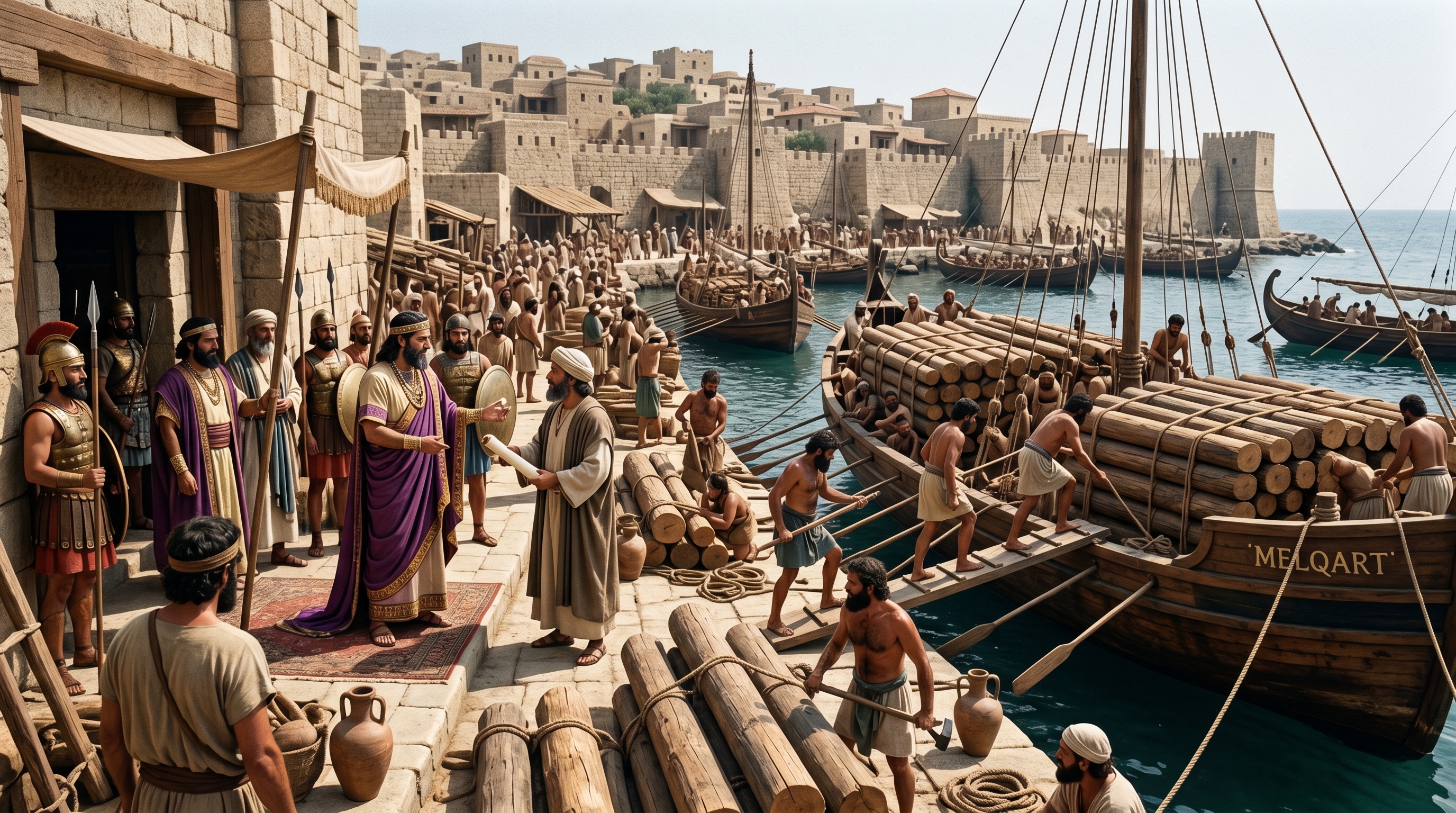
Hiram’s material aid to Solomon for the Jerusalem Temple
When Hiram sent cedar, shipwrights and crews to Jerusalem, Tyre converted its shipyards and royal stores into a tool of diplomacy—sending the island’s craftsmen and timber on a state-organized voyage that braided commerce with political influence.
The episode revealed how Tyre's economic specializations could be mobilized as foreign policy. Rather than a loose trade deal, this was an arranged shipment: large beams cut from Lebanon’s cedars, Phoenician carpenters and metalworkers, and a fleet of transport ships all moved under the king’s authority. The palace did not merely auction goods; it organized manpower, assigned vessels, and issued the seals that let cargo pass beyond the island’s harbors.
The scene at the royal quay mixed the practical and the ceremonial. Crews hauled oiled cedar timbers down a ramp while ropewalks nearby hummed with men braiding hemp. Scribes recorded beam lengths and counts on wooden tablets; a palace official handed sealed lists to an Israelite foreman who leaned over the ship’s gunwale and checked knots. Workers carried bundles of bronze fittings and chisels—tools that would stay on site for months—while a small escort of palace servants ensured the loads cleared harbour dues and left with official protection. From the temple of Melqart there would have been a short ritual: an oath taken by captains and carpenters before a voyage that exposed both goods and people to long sea-routes.
This was not just logistics. It illustrated how the crown turned craft and seafaring into leverage: access to cedar and skilled hands could be granted, withheld, or exchanged for political favors. The same harbor infrastructure that launched merchant voyages could also launch state projects inland. That dual use of ships, workshops and palace authority was a recurring theme in Tyre’s history—an island economy that reached outward through materials, specialists and negotiated privileges.
- Setting: Main island quay beside the royal palace; shipyards and ropewalks visible; vats and shell-middens a short walk away.
- Participants: King Hiram’s envoys and palace scribes; Phoenician shipwrights, carpenters and metalworkers; Israelite foremen receiving cargo; merchant crews and harbor overseers.
- Time of day: Morning into noon, when low tide left slipways exposed for loading heavy cedar beams and the light made it easier to measure lengths.
- Movement: Cedar timbers hauled on rollers and ramps, tools and fittings lashed into place, sealed lists exchanged at the gangplank, captains swearing an oath before departure.
- Objects in view: Long squared cedar beams, coils of hemp rope, bronze clamps and chisels, wooden tally-tablets with seals, and stacked amphorae of provisions for the voyage.
- What made the scene distinctive: A palace-directed logistical operation where artisanal labor, maritime capacity and diplomatic protocol were combined into a single state-managed export.
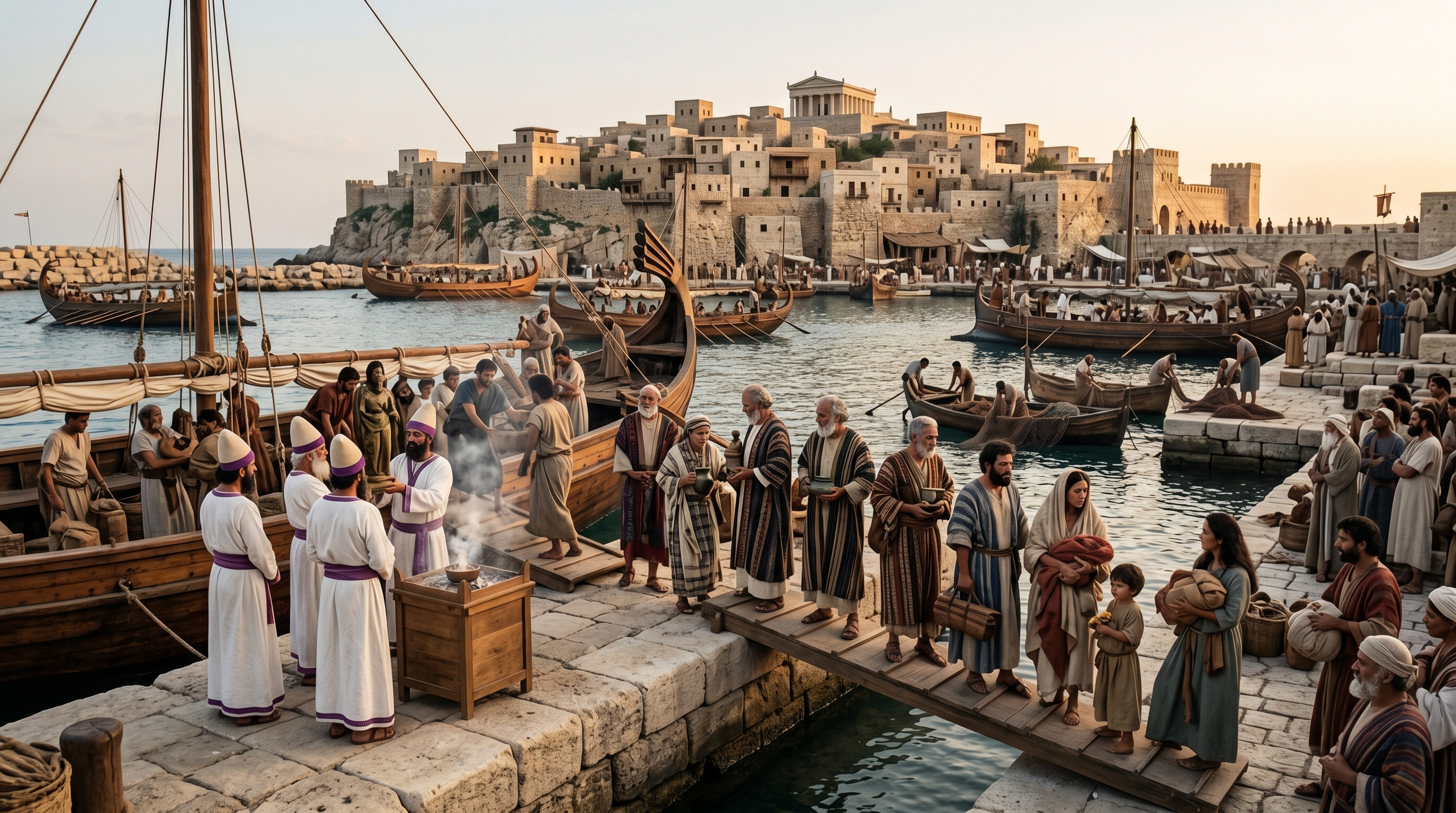
Departure and foundation of Carthage (traditional dates c. 825/814 BCE)
A small, formal convoy of Tyrian colonists left under the protection of priests and officials, carrying Melqart’s cult, specialist craftsmen, and trade stock — an act that exported Tyre’s civic order as much as people. The departure showed how ritual authorization, specialized production, and ship technology worked together to plant a new Tyre on another shore.
The scene revealed that emigration from Tyre was not a ragged flight but a planned transfer of authority and capacity. Priests and a king’s envoy presided; names and obligations were fixed in ritual before ships moved. What left the quay was meant to reproduce Tyrian ways of doing business — temple-sanctioned contracts, workshops for purple and glass, and the skills of shipwrights — rather than simply a scattering of desperate families.
The quay itself sat where island met sea: a narrow strip of stone where slipways angled into the harbor and warehouses opened toward the water. A small cohort boarded: carpenters with wrapped tools, a dyer packing the last of the murex-dyed cloth into sealed crates, a handful of women carrying household jars, and a dozen armed men for protection. Priests in plain linen invoked Melqart, the temple bell sounded, and an animal was offered; people stepped from the quay’s paving onto the long, oared hulls while handlers lashed amphorae and cedar planks into place. The smell of brine mixed with burning pitch and an acrid tang from dye vats stacked near the quay.
This departure belonged to Tyre’s broader logic: colonies were nodes in a managed network, not merely outposts. The new settlement would carry Tyre’s writing, commercial rules, and craft techniques into North Africa; in return it fed raw materials and markets back into Tyre’s harbors. That the quay later functioned as a commemorative locus made the act part memory and part municipal policy — a ritualized export of institutions that kept the island city’s reach alive across the Mediterranean.
- Setting: Stone quay at the island’s edge beside slipways and warehouses; dye vats and middens visible a short walk inland.
- Participants: Priests of Melqart, a royal or civic envoy, a small group of colonists including craftsmen (shipwrights, dyers, potters), a handful of armed escorts, and merchants who sold provisions.
- Time of day: Early morning, when tides and winds favored departure and the light picked out the white shell-middens and wet timber on the slipways.
- Movement & ritual: Names announced and oaths sworn before Melqart; an offering made; people stepped from paved quay onto long-hulled ships while crews tightened lashings and pushed vessels off.
- Objects in view: Packed crates of purple-dyed cloth, sealed amphorae, bundled cedar planks, priests’ staves, carved votive plaque or dedicatory stone fixed near the quay’s edge.
- What made it distinctive: This was an organized export of civic practice: religious authorization, specialist labor, and maritime technology combined so a transplanted community could reproduce Tyrian institutions abroad.
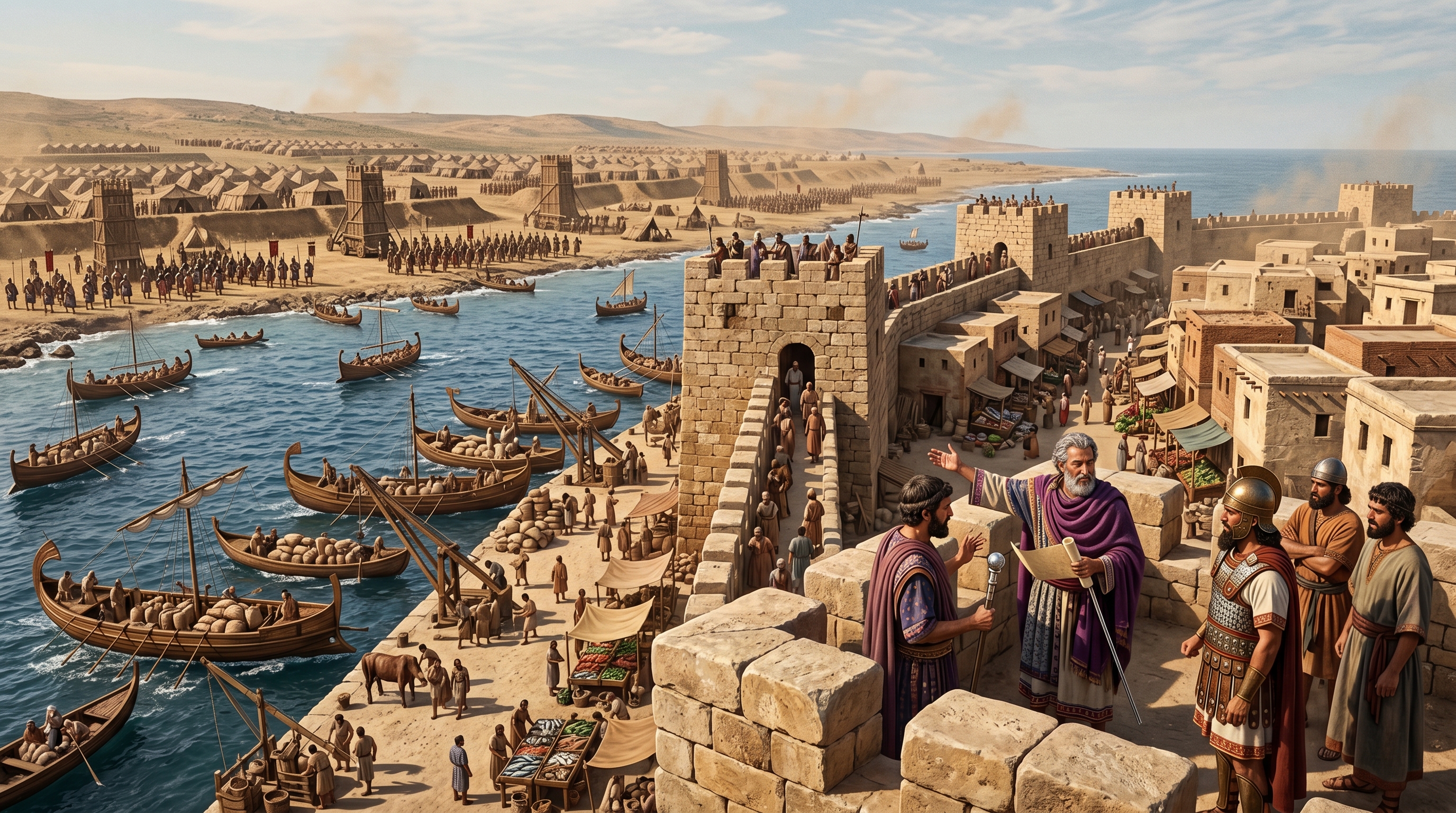
Babylonian pressure and the long contest with Nebuchadrezzar (13-year episode)
Over roughly thirteen years Tyre weathered Babylonian pressure by turning its economy and diplomacy into weapons of survival: supply boats sustained the island while envoys and priests negotiated terms from the walls.
This scene revealed how a seafaring city fought with logistics and talk as much as with walls. Nebuchadnezzar’s forces could sit on the mainland and build siegeworks, but they could not easily close the water. Tyre’s leaders treated the harbor like a lifeline: timing covoys, rationing stores, and using temple ritual to bind crews and merchants to the city’s resolve.
At dawn small boats slipped from the outer anchorage, their prows low with grain and salt fish, while larger transports rode in the deeper channels to unload at the island quays. Dockworkers balanced amphorae and casks on gangplanks; ropewalks hummed as sails were repaired; vats of crushed murex steamed in the sun and kept dye-workers busy — production never wholly stopped because exports and payments mattered as much as food. Signal fires and flag codes along the parapet orchestrated arrivals, so supply runs hugged the shadow of the walls and avoided the Babylonian emplacements across the lagoon.
Negotiation happened on the same stone. Heralds and royal emissaries met on the western scarp, where a small gate allowed controlled exchange with mainland envoys. Priests of Melqart oversaw oaths and sealings that legalized tribute or truce; written messages in different scripts moved between camps. The long contest left Tyre adjusting its defenses and provisioning routines more than it altered the island’s skyline, and it showed how a maritime polity could convert craft, ritual, and a harbor’s geometry into the means to withstand a powerful land army.
- Setting: Island acropolis with narrow quays, inner harbor basins, and vats for murex dye along the shoreline; Babylonian camps on the nearby mainland.
- Participants: Ship captains and crews, dockworkers and dye-workers, palace officials and priests of Melqart, Tyrian emissaries, and Babylonian officers and heralds.
- Time of day: Most supply runs favored low light — dawn or dusk — when boats could slip past lookouts and make for the sheltered slips.
- Movement: Small, fast boats carrying grain and correspondence threaded close to the island; larger transports berthed at guarded quays; messengers negotiated at a guarded gate.
- Objects in view: Stacks of amphorae and woven cargo nets, repaired sails and coils of rope, steaming vats of purple dye, sealed documents used in tribute agreements.
- What made the scene distinctive: A prolonged, incomplete siege in which naval provisioning and ritualized diplomacy kept the city functional despite sustained mainland pressure.
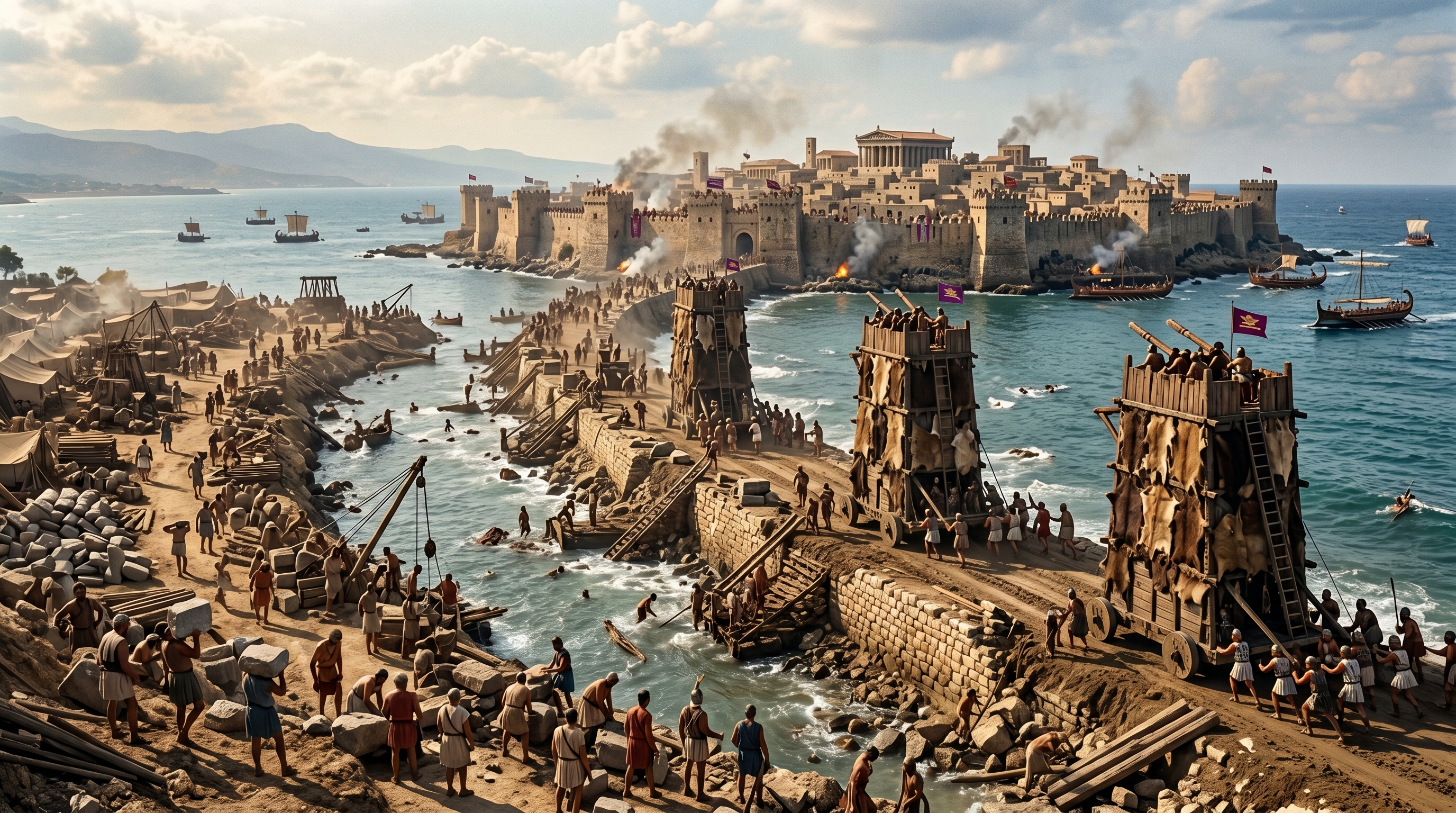
Alexander’s siege and the construction of the causeway (332 BCE)
Alexander’s seven-month siege mattered because his engineers removed Tyre’s last protection—the sea—by building a kilometre-long causeway that let siege towers reach the island and permanently altered the city’s access and harbors.
The siege revealed how thoroughly Tyre’s power depended on being an island. Cut off from direct land assault, the city had turned the narrow sea into a shield: quays, shipyards, and the temple’s quay threaded together worship, trade, and naval strength. Alexander solved the problem not by outlasting the defenders but by changing the ground beneath their feet.
Teams hauled quarried stone and rubble from the mainland, loaded it onto barges and sledges, and dumped it into the shallows until a raised spit reached the island. As the causeway grew, Macedonian engineers pushed siege towers forward on its surface; carpenters, ropeworkers, and artillery crews worked beside engineers who measured tides and currents. From the island the Tyrians replied with boats that darted out to harass the builders, with archers firing from the temple terraces, and with oil and stones dropped on approaching platforms. The noise was practical and specific: the creak of capstan ropes, the thud of blocks sliding into water, the rasp of saws, and the metallic clank of tower fittings.
When the final breach came after seven months, the physical outcome matched the military one. Stones and sediment left behind by the mole altered currents enough that the open water between island and mainland began to fill. Over years the island became a peninsula; quays and slipways adjusted, some shipyards lost depth, and the city’s defensive logic shifted from sea-first to land-aware. The episode therefore belonged to Tyre’s longer story not only because an army won a city, but because an engineered act rewired how the city met the sea — and changed who could control its commerce and ceremonies.
- Setting: Island acropolis ringed by quays, shipyards, and murex vats; a kilometre-long causeway under construction across shallow water.
- Participants: Alexander’s engineers and infantry, naval crews and allied fleets, Tyrian defenders on the walls and in ships, civilian laborers moving stone and timber.
- Time of day: Work was concentrated in daylight for hauling and dumping; night brought watches, repairs, and small sorties from Tyrian boats.
- Movement: Barges and sledges carried quarried blocks; ropes and capstans winched materials; siege towers advanced along the growing mole while Tyrian galleys hurled projectiles.
- Objects in view: Quarried stone, rubble beaches, ships drawn up near slipways, timber frames of siege towers, ropes, and the bright rows of murex vats on the island’s quay.
- What made the scene distinctive: An army reshaped coastal geomorphology as a weapon: a tactical construction that immediately changed currents and, over time, remade Tyre’s urban geography and its control of maritime trade.
Maritime networks and ship infrastructure
Tyre’s lifeblood ran through its harbors: quays, slipways, timber yards, and dye-vats organized how goods moved, how craftsmen made value, and how the city balanced autonomy with dependence on sea lanes. Control of ships and port space shaped daily work, ritual practice, and the city’s geopolitical strengths and weaknesses.
From the island quay to the sheltered basins, the city unfolded as an engineered interface between sea and polity. Wharflines, narrow slipways, ropewalks, timber stores, and long rows of dye-vats turned the coastline into a sequence of specialized workplaces where hulls were built, cargoes were measured and stored, and raw coastal products were transformed into high-value exports.
Those facilities did more than enable commerce. They choreographed the rhythms of departure and return: priests oversaw departures at Melqart, shipwrights timed launches with tides, merchants negotiated cargo parcels in adjacent emporia, and crews ate, drank, and quarrelled on the same quays where raw cedar and piles of murex shells arrived. Maritime infrastructure ordered both everyday routines and large-scale choices about alliances, convoys, and imperial submission.
Approaching Tyre, a visitor first read a practical map of labor. The main quay fronted a narrow spine of urban functions: warehouses opened onto gang-planks; ropewalks stretched along the shore in long, straight lines where teams dragged fibers into cordage; timber yards stacked massive beams and masts brought from Lebanon. Ships lay in sheltered basins where slipways descended into water shallow enough for workers to haul hulls by capstan and rollers. The visual cue—piled timber, lines of vats, and the low profile of hulls on wooden skids—signalled what the city did best: turn difficult, bulky materials into seaborne value.
Those places had distinct physical rhythms. Building a merchant hull meant cutting cedar, fashioning a keel and ribs with adzes, joining planks with trunnels, then caulking seams with pitch and hair before the first launch; that process occupied teams for weeks to months depending on size. Dye production ran its own cadence: murex shells were crushed, boiled in long vats, and repeatedly washed—a noisy, malodorous chain of pounding and stirring that left shell-middens like white hills along the shore. Loading a ship required measured choreography: amphorae stowed in orderly stacks, weights and tally marks recorded by scribes, and small crews shifting cargo by pulley and block until the vessel rode at the correct trim.
Authority and law were woven into these routines. The temple and crown set who could use certain quays, which shipments gained privileged protection, and when convoys sailed under official escort. Departure rites at Melqart fused risk-taking with sanction: captains swore oaths, merchants petitioned for divine favor, and priests recorded offerings tied to successful voyages. At the same time, commercial practice relied on mundane institutions—storage leases, stamped amphorae, partnered ownership of hulls—that distributed risk across households and across colonies whose outports depended on Tyre for timber and finished goods.
All of this made the city powerful and precarious. Sea lines enabled supply, expansion, and influence as far west as Carthage, but they also created a single point of failure: a closed sea lane or a cut-off fleet could choke the island. When a land army finally bridged sea and shore with a causeway, currents and sediment began to reshape harbors and access. The built seafaring infrastructure continued to define work and identity even as physical access changed; workshops still turned raw materials into exported goods, and the legal-commercial practices anchored in those quayward spaces kept Tyre integrated into wider Mediterranean networks.
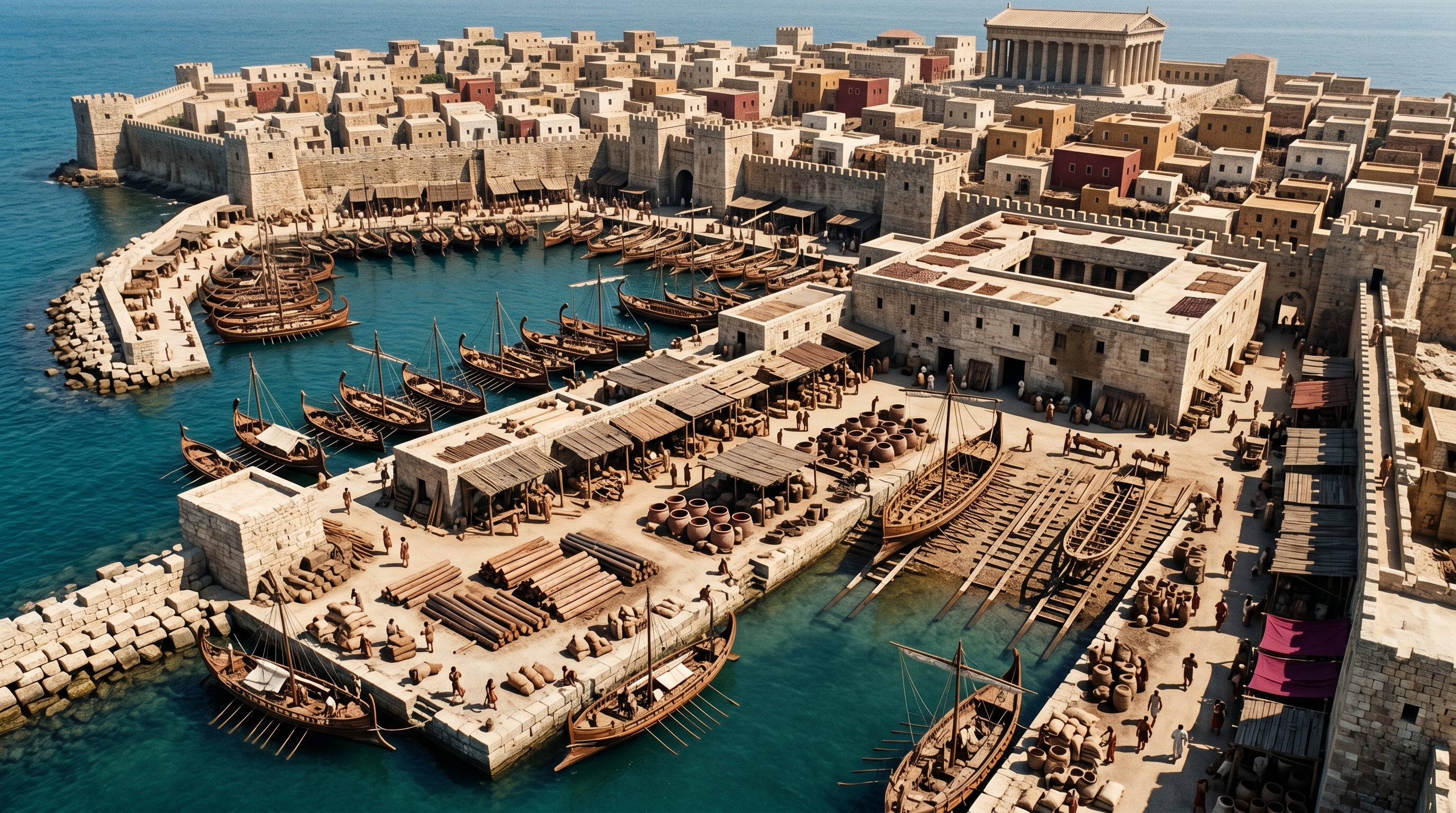
Harbor basins, quays, and shipyards
On Tyre’s quays and slipways kings, priests, and craftsmen turned timber and shell into ships, dye, and the city’s commercial reach.
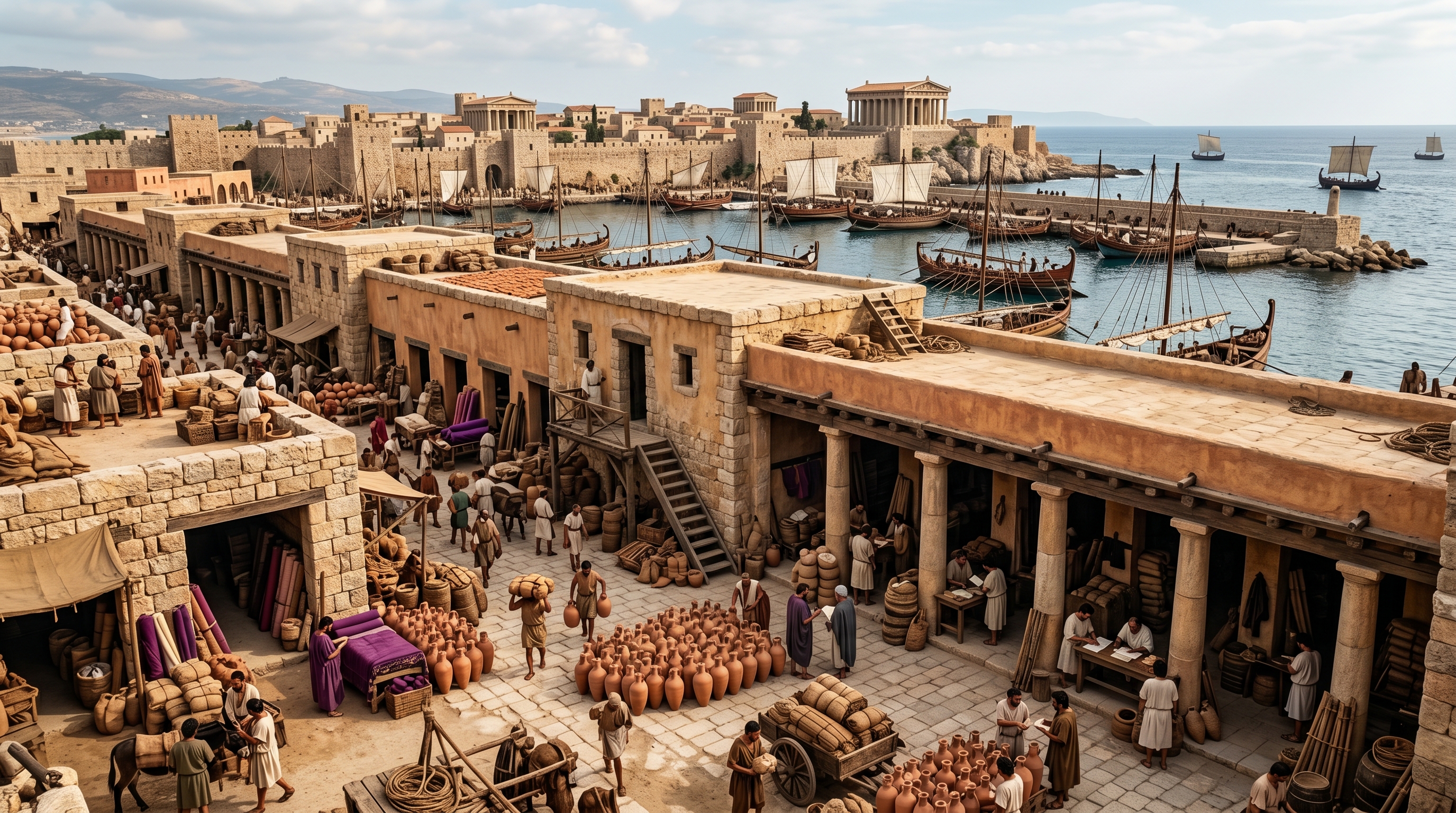
Trade warehouses and emporia district
On the quay, amphorae, sealed tags, and ledger-scribes turned Tyrian cargo into counted claims and naval leverage.
Luxury industry and craft production
Tyre’s luxury crafts—above all purple dye, glass, and finished textiles—were not incidental industries but the engine that shaped where people lived, how the harbor worked, and what the city’s rulers regulated.
In Tyre those crafts clustered at the edge of the island and on the nearest shore: long vats for dyeing, rows of furnaces for glass, ropewalks and timber yards for ships, and warehouses that opened directly onto quays. Production left a visible trace—piles of crushed murex shells, heat-blackened floors, stacks of seasoned cedar planks—and it gave the city a practical grammar of specialized places and seasonal rhythms.
Authority threaded through this economy. The temple and palace controlled departures, privileges, and dispute settlement; craftsmen and sailors answered to commercial norms enforced as often by ritual obligations as by written contracts. Because the highest-value goods required both intense hands-on work and uninterrupted maritime links, luxury production concentrated skill and economic power in a narrow strip where sea, temple, and workshop met.
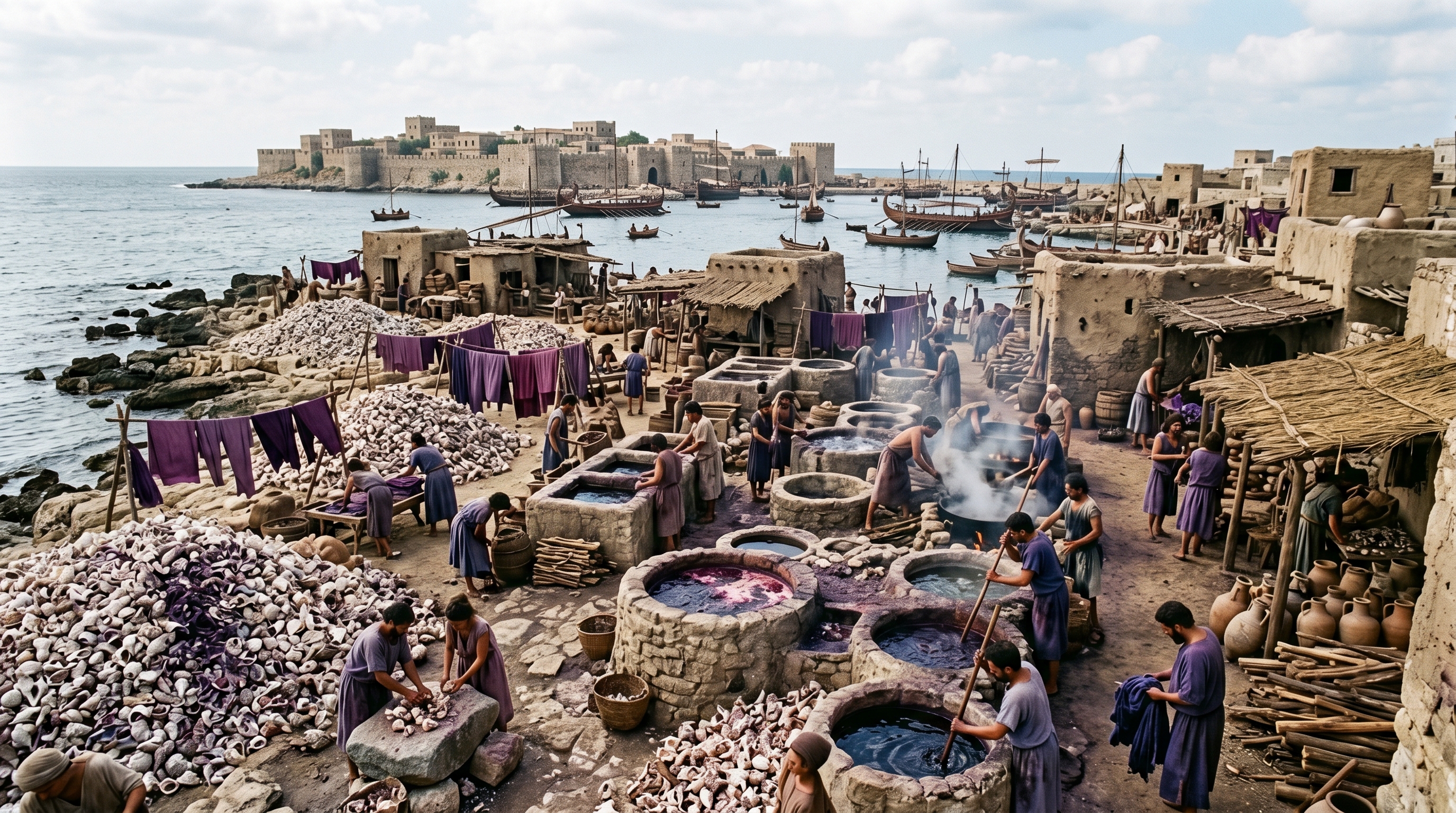
The most immediate thing a visitor would have seen was the scale and layout of manufacture. Dyeing took place in banks of shallow vats set at the water’s edge so brine and seawater were at hand; beside them lay heaps of broken shells—white middens that rose metre by metre as processing continued. Glassmakers worked from compact buildings with small, fiercely hot furnaces; they kept crucibles and rods at hand, and produced beads, core-formed vessels, and glass ingots that left little room for casual laborers but demanded skilled attendants. Shipwrights and rope-makers occupied long, linear spaces: slipways angled into the harbor, timber stacked in open yards, and ropewalks stretching as long as a street so workers could lay out fibers by the dozen metres required for good cordage.
Work itself followed tight, repeated patterns. Dyeing began before dawn with crews hauling and breaking shells, then boiling and skimming for hours while the air smelled sharply of brine and fishy rot; a single cloak could consume the yield of ten thousand or more shells, so the action was both repetitive and exacting. Glassmaking revolved around the furnace cycle: stoking through the night, forming a batch at peak heat, and then a slow cooling regime that required guard shifts. Textile finishing involved repeated rinses, stretching, and weighting to set the purple so that color and cloth length met the assessments made by merchants and priests. At midday sailors brought news from other ports; at dusk temple officials sometimes checked manifests or took oaths from captains before a voyage.
People moved through these places in overlapping social roles. Veteran artisans handled fragile steps—mixing mordants, shaping glass, seasoning planks—while seasonal labourers performed the most exhausting tasks of shell-crushing or hauling timber. Priests and palace agents regulated who could operate vats, who could export dyed cloth, and who could claim sanctuary in the temple’s records when disputes arose. That arrangement produced a constant tension: the city’s wealth depended on uninterrupted maritime access and skilled, closely held knowledge; at the same time those same features made Tyre vulnerable if sea lanes closed or if political privileges shifted. Luxury production amplified prosperity, and with it a fragile dependence on sea-borne supply and the city’s own institutions for controlling rare, labor-intensive expertise.
Sacral kingship, temple cults, and civic religion
In Tyre, sacred authority and commercial power were inseparable: the island temple and palace turned oaths, offerings, and ritual calendars into the legal and moral machinery that made long-distance trade and colonial ventures possible.
On the island the palace and the temple shaped more than belief; they structured transactions. Merchants, shipmasters, and kings all moved through the same narrow spine of quays, warehouses, and sanctuaries, where the cult of Melqart and the royal court ratified departures, privileges, and the flow of wealth.
Rituals happened where the work happened. Crews performed libations and swore oaths before loading; priests and scribes kept seal impressions and tallies in storerooms; festivals and seasonal sailing windows set the calendar for expeditions and for the dispatch of colonial parties. Religion was a practical technology for authorizing risk at sea.
Approaching Tyre meant coming up against a compact civic choreography. A ship tied to the main quay below the island would see warehouses and ropewalks beneath the palace terrace and the temple platform. The temple’s open courts, altars, and inner rooms occupied visible high ground; from there a priest could watch cargoes moved between ships and storerooms. Before a long voyage a captain could not treat the voyage as a mere business deal. He moved from his cargo’s tally to the temple precinct, offered a libation or sacrifice, and swore an oath invoking the city’s god. That sequence—count, oath, offering—bound private contracts to public, sacred authority.
Palace and temple also overlapped in administration. Royal officials issued privileges and exemptions that changed who paid what on a given cargo; priests kept or supervised storerooms where dedications, consecrated goods, or temple-owned vessels were kept. Accounts were not just private ledgers but objects that acquired weight because they were deposited, sealed, or sworn under religious auspices. When Tyre supplied cedar and shipwrights for projects abroad, the material transfer passed through the court’s logistics and the cult’s sanction simultaneously.
The human rhythm that this produced was concrete and repetitive. Dye-workers emptied murex into long vats at dawn; shipwrights laid cedar timbers on slipways while priests made quick offerings to ensure good winds; colonists gathered cult tokens or images for founding voyages and walked through the temple threshold one last time. Annual and seasonal moments mattered: ritual calendars set when it was proper to sail, when tax levies were collected, when tribute delegations presented goods. Those recurring acts made the city legible—so that a single person could read a merchant’s contract, a priest’s certificate, and a royal permit as pieces of the same civic order.
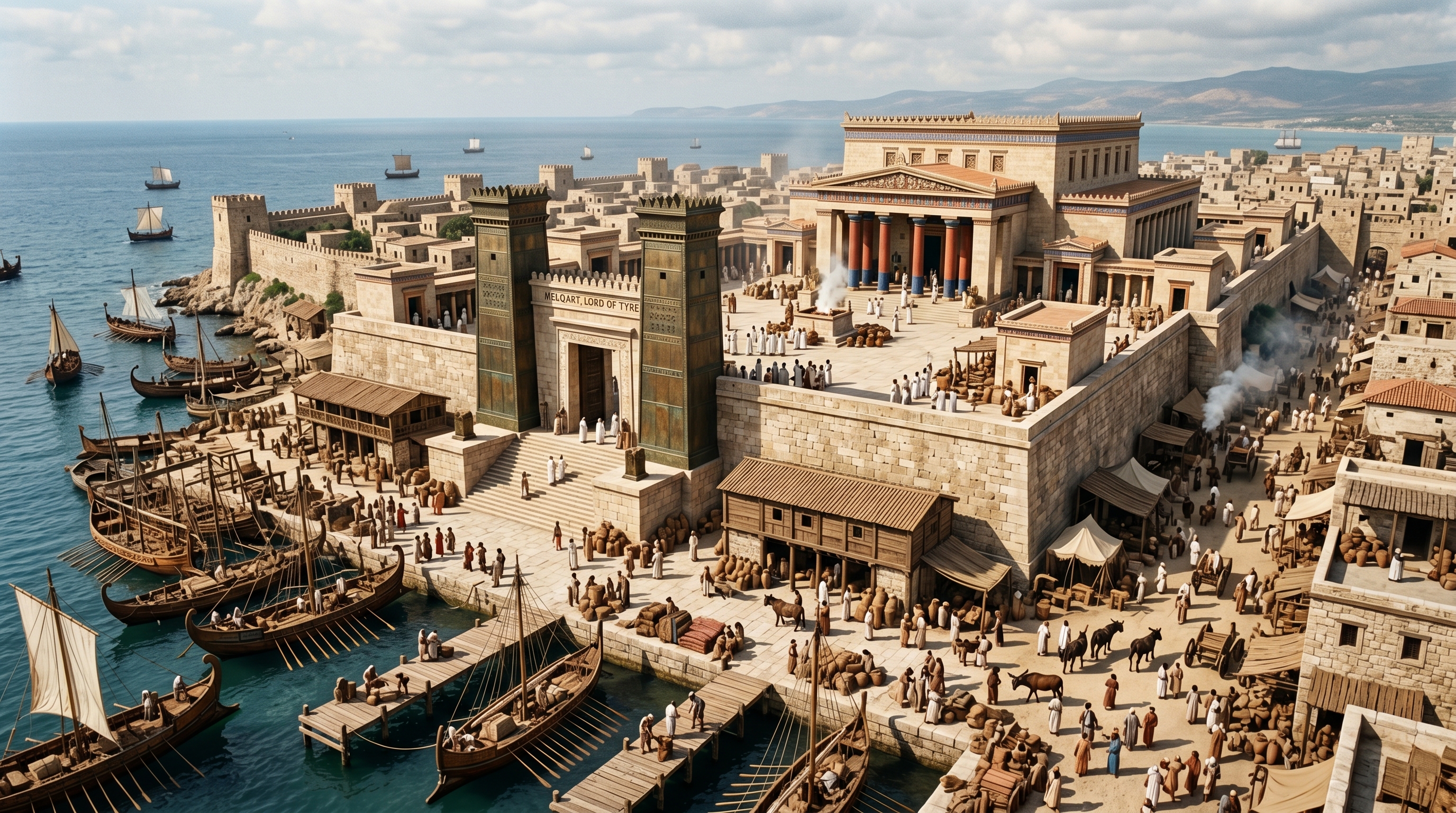
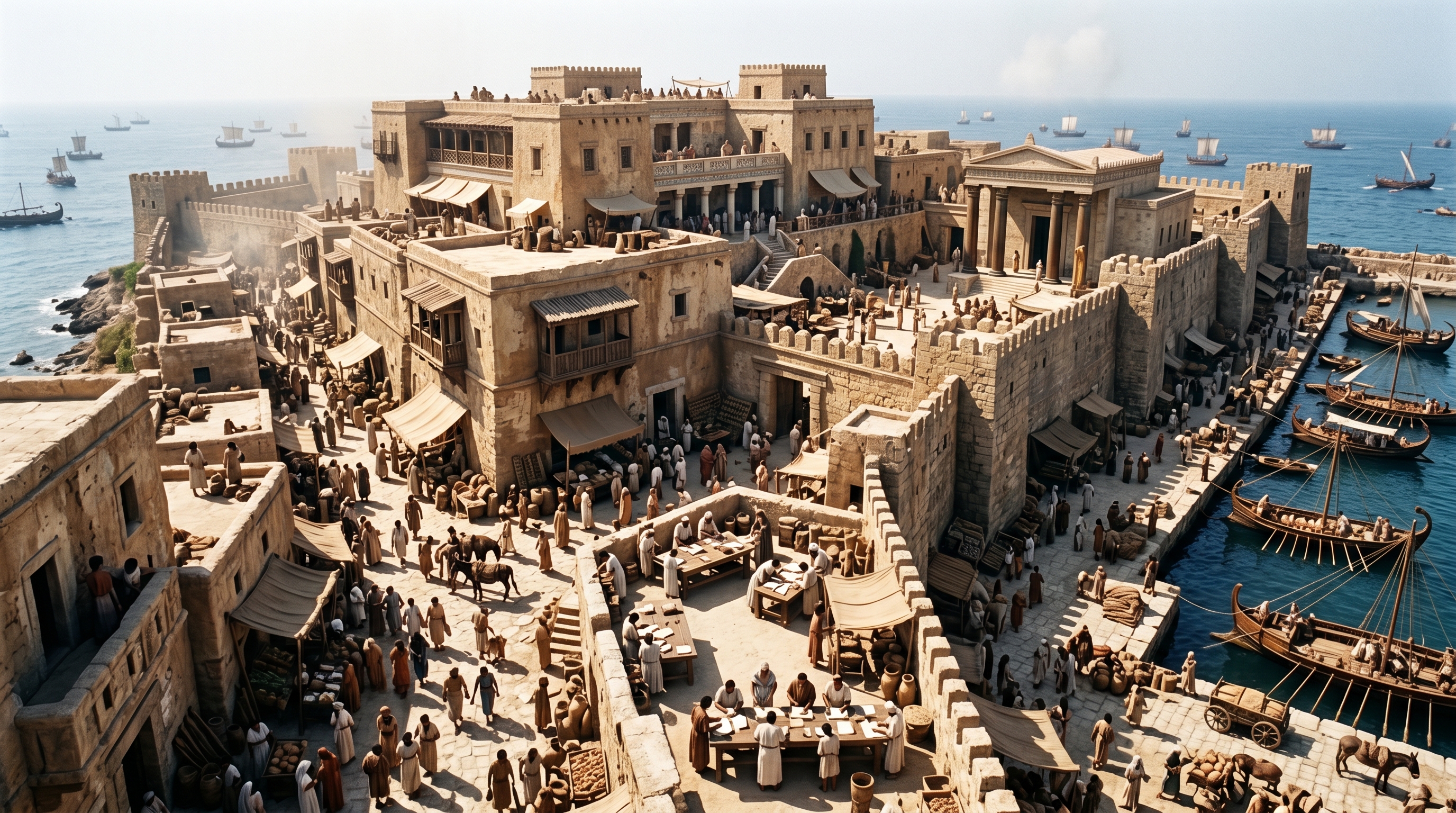
Temple of Melqart (temple complex)
Perched above the quays, Melqart’s temple converted oaths into guarantees and made seafaring a civic, sacred act.
Royal palace and administrative quarter
Where kings turned sealed privileges and harbor manifests into the rules that ran Tyre’s sea-based economy.
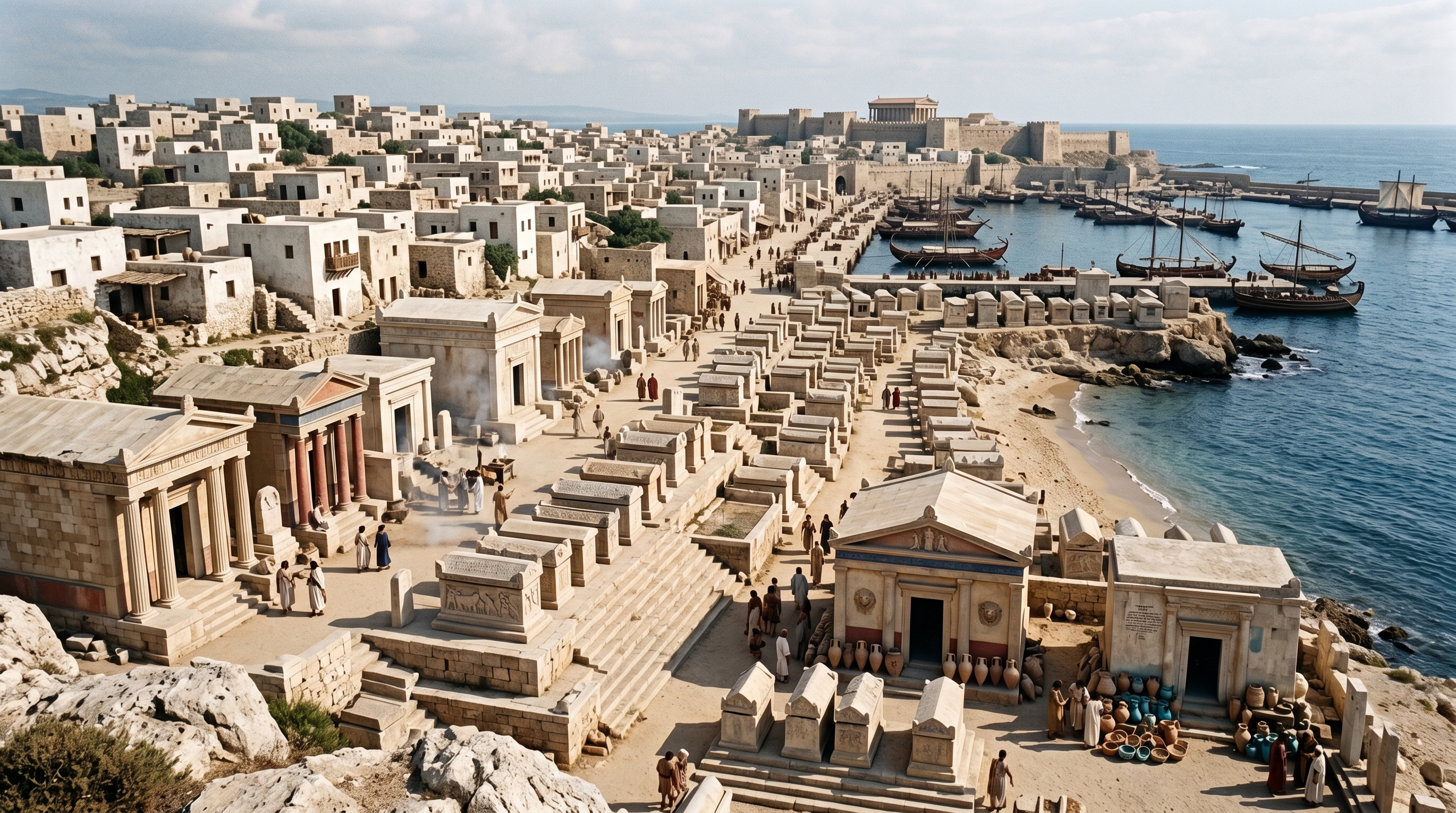
Necropoleis and monumental tombs
Stone tombs along Tyre’s shores turned family wealth and sea-borne connections into public claims across generations.
Urban form, island-mainland relations, and coastal engineering
Tyre’s physical form was a built argument: an island city whose small, vertically organized core put seafaring, specialized manufacture, and sacred authority into immediate contact — and whose survival depended on a sea that could be opened or closed by engineering feats from beyond its walls.
From the island acropolis down to the quays, Tyre’s urban geometry shaped what people did and how they judged risk. The compact island concentrated palace, temple, warehouses, shipyards, dye-vats, and middens so that work, worship, and administration happened within sight of the harbors that supplied and threatened the city.
That closeness produced predictable rhythms — launches at first light, priests blessing voyages at the temple’s steps, dye-workers hauling steaming vats at noon — and a hard vulnerability: an opponent who could change the sea’s currents or lay a causeway could change the city’s fate. The mole built in 332 BCE did exactly that, turning a maritime defense into a new coastline and a different urban logic.
Walking onto Tyre from the water meant moving through a sequence of calibrated spaces. A boat tied to a low quay slid up against warehouses whose doors opened directly onto the harbour; carts backed up to receive amphorae and bales. Narrow streets rose quickly from the shore toward the palace and the temple of Melqart, so the view from a quay put rulers and priests literally above commerce. Shipwrights worked in shaded basins cut into the rock; their slipways were sloped timbers and packed sand where hulls were assembled, caulked with pitch, and launched into calm water. Nearby ropewalks stretched out long, linear yards where crews and apprentices spun and stretched hemp into lines. Those were the spaces that decided whether a voyage would leave, and on what terms.
The coastal industries had their own timetables and senses. Dye-workers moved in cycles of heat and decay: boats brought sacks of murex, shells were crushed and boiled in shallow stone vats until a faint sulphurous tang rose above the salt air, and hands scraped resin into cloth. The process demanded time, space, and secrecy; vats sat at the water’s edge to rinse goods, while middens of broken shells grew into low white hills visible from a mile out. Shipbuilders measured timber by the fathom and watched seasonal winds; merchants timed departures to markets and to the temple calendar, because religious sanction often preceded contracts and fits of protection were negotiated there.
All of this produced a civic choreography — morning launches and evening arrivals, priestly rites for voyages, slate-voiced overseers checking cargo lists, teams hauling murex across the quay, and soldiers pacing the walls. The island’s compactness made such choreography tight: mistakes on a slipway interrupted a chain of work across the harbor; a bad season for timber echoed through warehouses down to the dye-works. That tightness also explained why changing the coastline changed the city. When Alexander’s engineers hauled rubble into the sea to form a roughly kilometre-long causeway, they did more than breach defenses. They altered currents, let sediment accumulate in formerly sheltered basins, and created new ground for the mainland quarter. The result was a shift in where people worked, where ships berthed, and which rituals mattered most.
Read this dimension as the physics and politics of proximity. The island’s small scale forced commercial practices and religious authority into immediate contact; everyday life pivoted on the choices made at quays, vats, and slipways. The landmark entries beneath will let you step into those places — the island core where palace, temple, and harbors met, the mainland spaces that grew where sediment and settlement met, and the mole that rewrote the city’s relationship to the sea.

Island acropolis (the island core of Tyre)
A fortified island ridge where palace, temple, quays and murex vats compressed authority, ritual, and maritime industry into one visible signal.
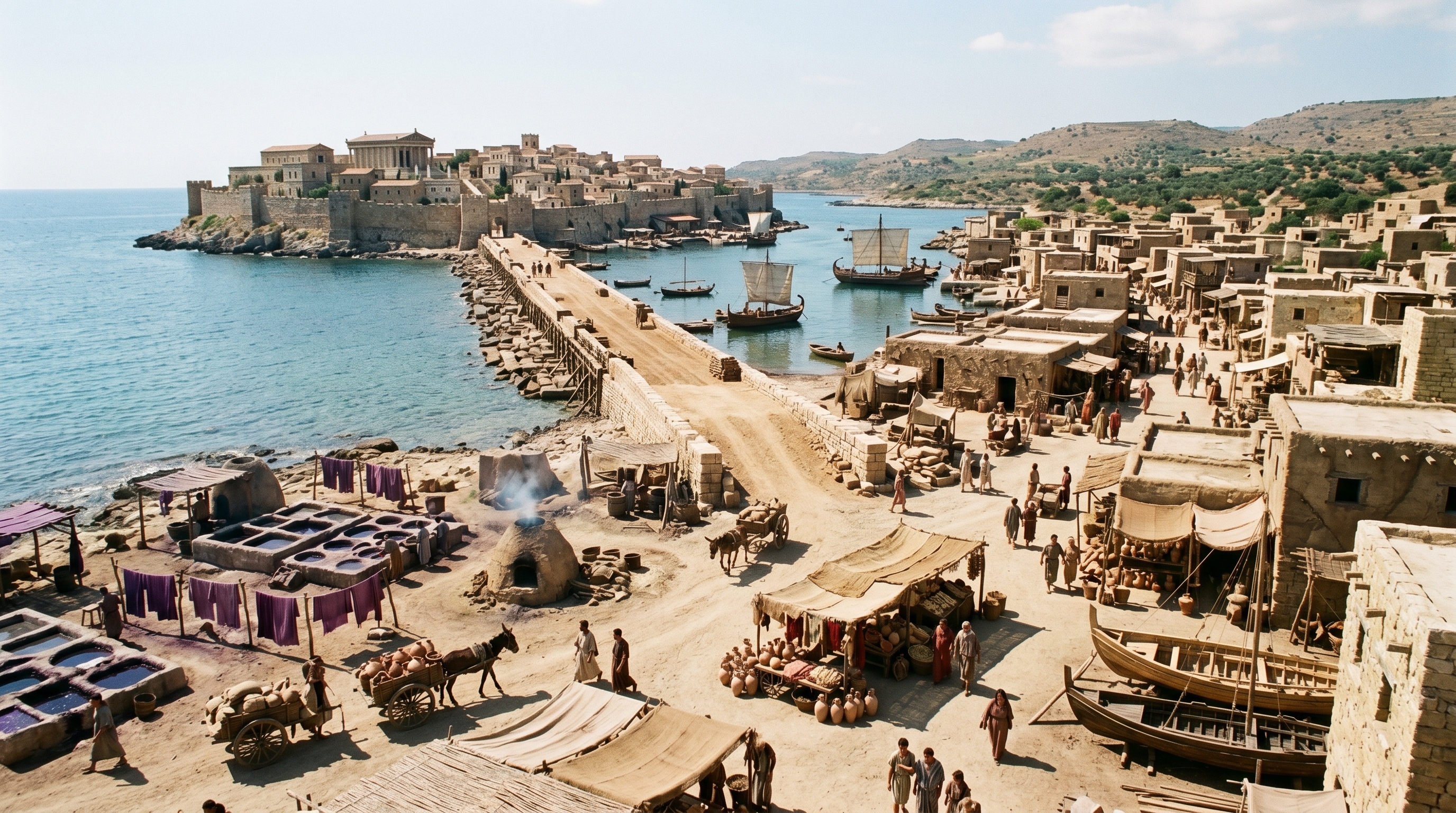
Mainland settlement / Tyre’s eventual mainland quarter
Where island authority met bulk labor: shingle quays, vats, middens, and the long yard-work that kept Tyre’s ships afloat.
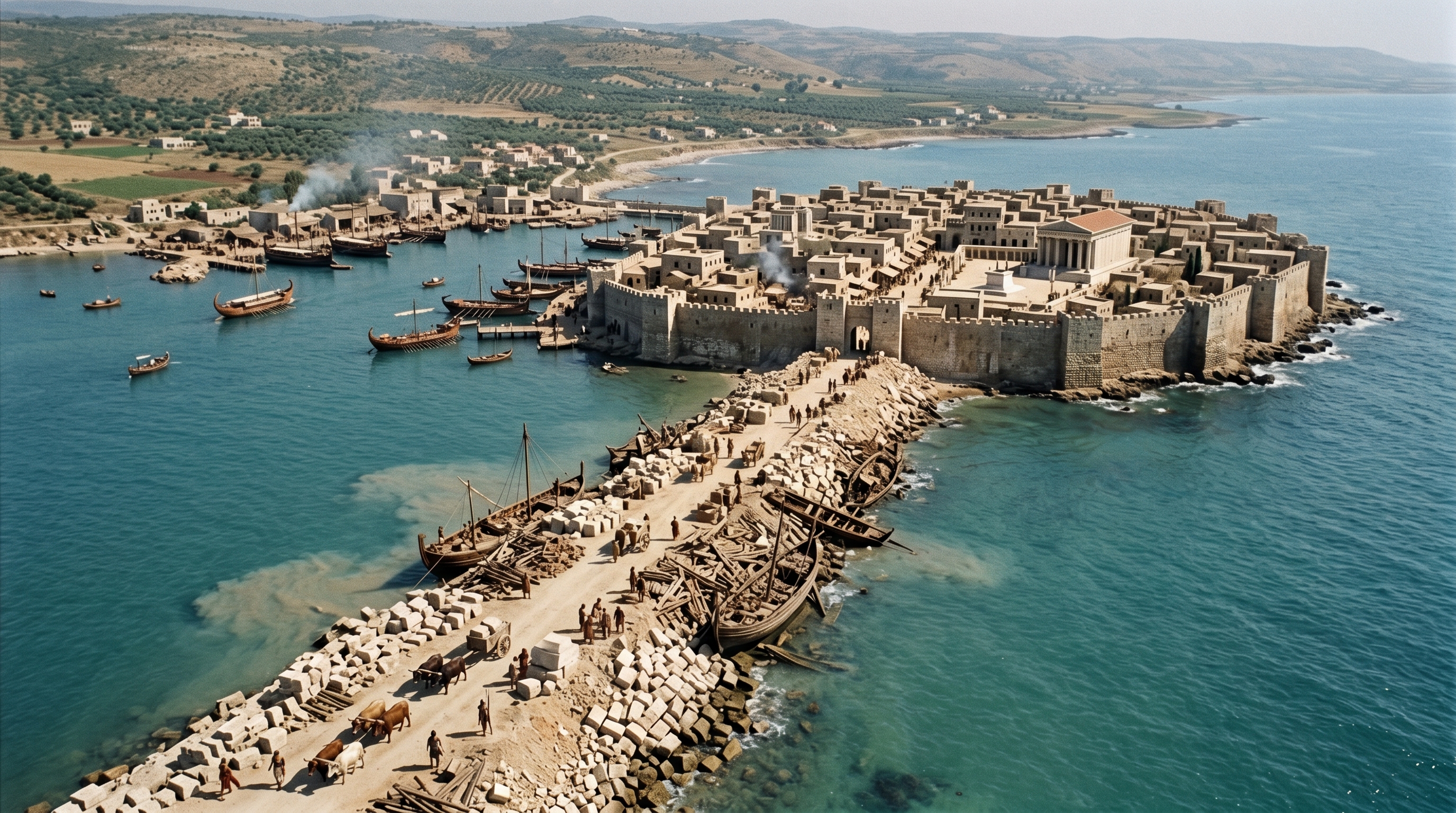
Alexander’s causeway (the mole) and its geomorphological legacy
A siege ramp that became a peninsula: Alexander’s mole remade Tyre’s harbor, its defenses, and the way the city met the sea.
Diplomacy, colonial projection, and imperial entanglement
Tyre conducted diplomacy and colonial expansion as everyday statecraft: kings, priests, and shipmasters negotiated access to timber, markets, and imperial protection while sending out colonies that exported Tyrian law, craft, and ritual. These activities framed the city’s economy and its vulnerability — its security depended on sea lanes that it both controlled and had to placate larger empires to keep open.
Diplomacy in Tyre was not an abstract policy arena but a sequence of bodily practices staged on the water: oaths at the temple, loading of cedar and murex-dyed textiles on the quay, and the departure of settlers whose voyages were licensed by palace decrees. The city’s colonial projects, most famously the founding of Carthage, extended Tyre’s economic reach while creating new political ties and obligations across the Mediterranean.
At the same time Tyre negotiated — and sometimes resisted — great powers. Assyrian and Babylonian pressures, Persian oversight, and finally Alexander’s attack each forced the city to convert commercial privileges into diplomatic payments, military improvisations, or ritual capitulations. Reading diplomacy here meant following how space, craft, and ceremony translated local advantage into long-distance influence or, under strain, into submission.
To understand Tyrian diplomacy one had to watch where people chose to meet. Envoys from inland kingdoms came to the island quay or to the palace hall that looked over the harbor. Temple officials met captains on the shore so that agreements could be sealed with an oath before Melqart and then recorded by sealing a wooden chest or placing a dedicatory offering in the temple precinct. These were not mere performances. The temple’s sanction converted commercial contracts into social commitments. A merchant’s right to load a chest of purple cloth, or a captain’s license to carry cedar to a foreign king, depended on those rituals.
The material choreography that made diplomacy possible sat along a narrow waterfront. Long vats held simmering purples whose labor made Tyrian dye a diplomatic currency; slipways and ropewalks produced the hulls and rigging that carried envoys and settlers alike; warehouses measured out tribute and cargo in amphorae and bales. Shipwrights and dye-workers moved in and out of those spaces with different temporalities — a cloak took weeks and tens of thousands of shells to dye, a ship took months of collective labor to finish, and an envoy’s mission could settle a bargain in a day or take years to ratify.
Colonial departure was a ritualized export of institutions as much as people. The act of dispatching a group to found a new emporium followed a script: proclamation from the palace, sacrificial libation at the quay, oath in the temple, and a manifest of goods and personnel loaded onto the vessel. Those departures turned Tyre’s diplomacy into a spatial project; each new settlement created an outpost for trade, a relay for timber and textiles, and a network node that required periodic negotiation with local powers and with Tyre itself.
When empires pressed their advantage, the same set of places and practices reappeared under strain. A diplomatic mission might turn into a tribute negotiation. The harbor that usually supplied colonies became the artery through which grain and timber entered during a long siege. The causeway Alexander built changed currents and access patterns, but what the city exported — its craftsmen, its alphabetic scripts, and its commercial habits — continued to travel beyond the water’s new edge. Visiting the colonial quay or the siege-era defenses meant encountering where those decisions had been made and seeing how ritual, craft, and sea traffic were inseparable from diplomacy in Tyre’s political life.
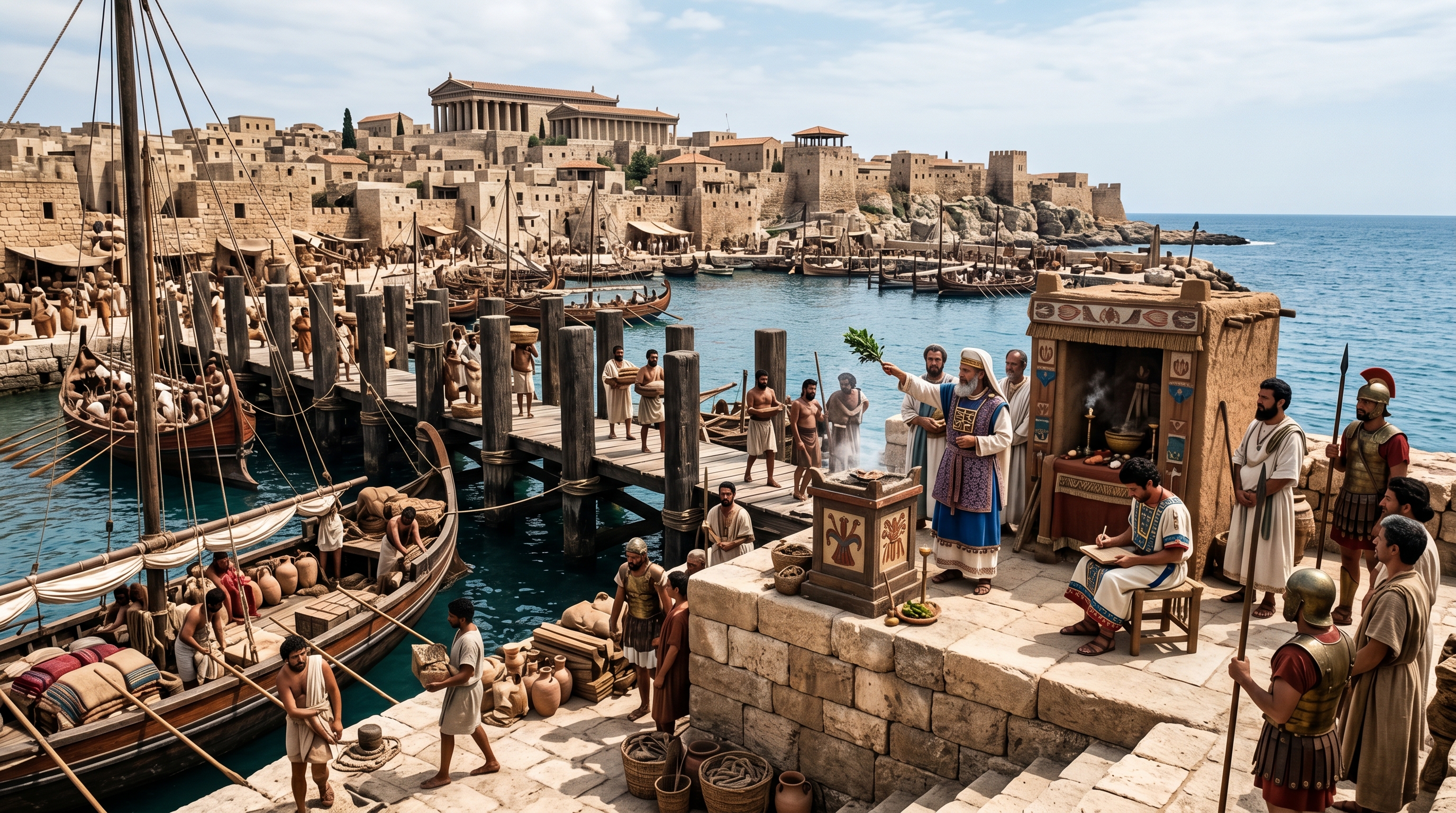
Colonial departure quay / commemorative foundation locus
A narrow quay where Tyre consecrated departures and launched colonies under the eyes of the temple and the crown.
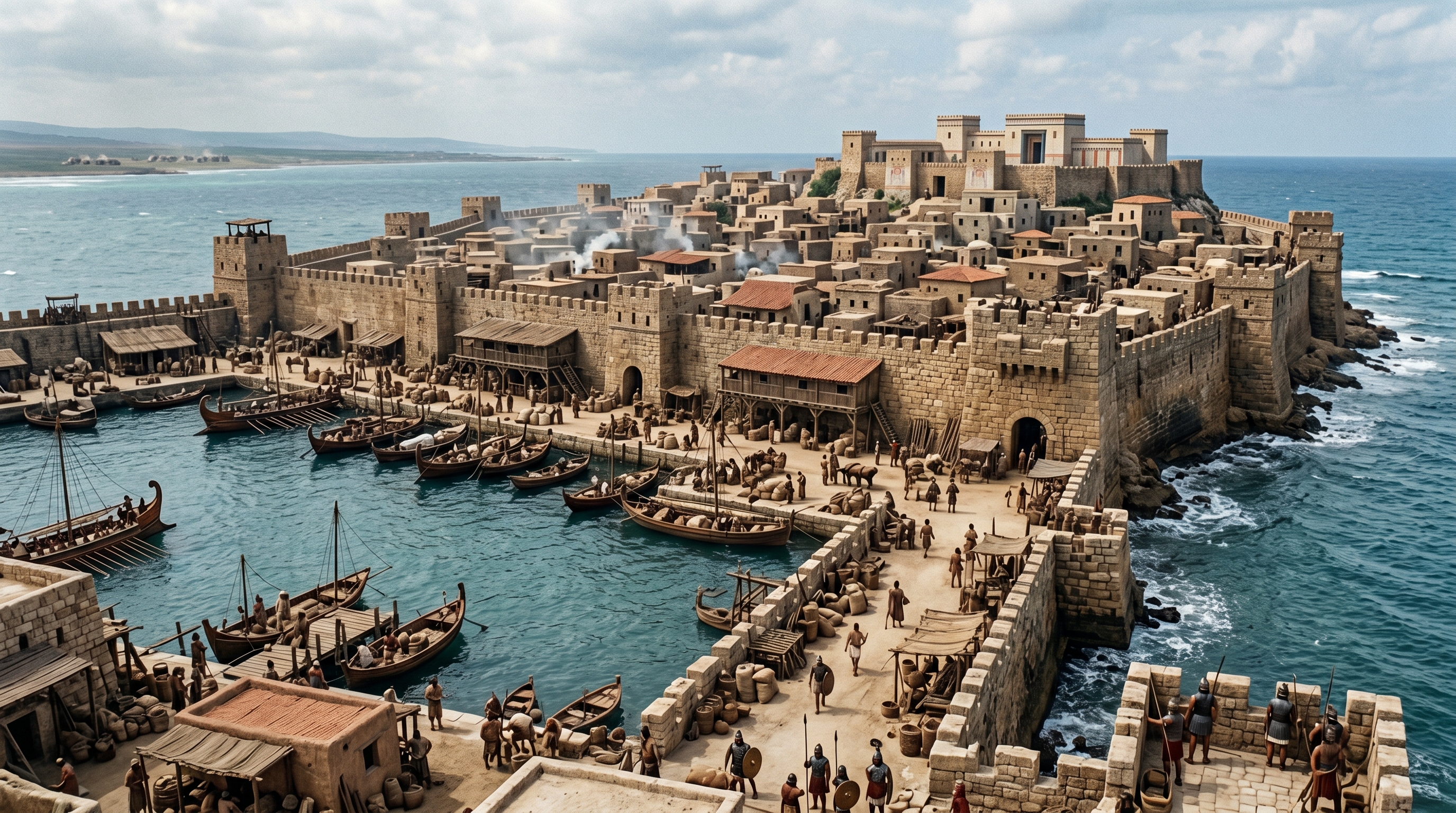
Nebuchadnezzar-era siege defenses and related works
A dispersed seaworn defense: quays, warehouses, and fleets that let Tyre hold out and negotiate for thirteen years.
sound
Oars and sails creaking at dawn, hammers and adzes at the shipyards, shouted ledger prices at the emporia, and the low, repetitive chant of priests before a departure ritual.
smell
A mix of brine and fish, the sharp ammonia of crushed murex vats, drying hemp and tar, and incense burning in the temple courts.
light
A relentless Mediterranean glare off the sea; purple stains caught the sun on drying cloth, and bronze fittings flashed from ships moored along the quays.
touch
Coarse ropes and weathered timber underhand, gritty shell fragments beneath boots near the vats, and sun-smoothed limestone on palace and temple steps.
Sources
Interpretive synthesis
- City essay: interpretive synthesis on Tyre’s urban form and maritime economy (provided corpus).
secondary
- City essay on Tyre (interpretive frame provided with this project)
- Aubet, Maria Eugenia. The Phoenicians and the West: Politics, Colonies and Trade. (1993)
- Markoe, Glenn. Phoenicians. (2000)
- Glenn E. Markoe, Phoenicians (modern synthesis of Phoenician economy and urbanism)
essay
- City essay: Tyre (1000 BCE – 100 BCE) — island acropolis, harbours, specialized crafts, and the relationship of temple and crown
- City essay: Tyre (1000–100 BCE) — Island heart, harbors, and the sacred-commercial regime
interpretive essay
- City essay: Tyre (1000 BCE–100 BCE)
ancient text
- Pliny the Elder, Natural History (sections on Tyrian purple and dyeing)
- Accounts of Alexander’s siege in classical histories (for the later change in coastal geometry that affected shoreline industries)
interpretive
- City essay on Tyre (interpretive summary of urban form, economy, and ritual authority)
project
- City essay: Tyre (1000–100 BCE) — project synthesis on Tyre’s urban form, harbors, and the role of Melqart and the crown in departure rites.
primary-interpretive
- City essay: 'Tyre (1000–100 BCE)' — description of urban layout, purple-dye economy, and the relationship between temple, palace, and harbor.
city essay
- City essay: Tyre — compact island heart, specialized coastal industries, and an outward-facing harbor system (provided corpus).
classical text
- Diodorus Siculus, Bibliotheca historica, Book 17 (account of Alexander’s siege of Tyre)
- Arrian, Anabasis Alexandri (narrative of Alexander’s campaigns)
- Quintus Curtius Rufus, Historiae Alexandri Magni (descriptions of the mole and siege works)
site file
- Landmark research file: Nebuchadnezzar-era siege defenses and related works (site summary).
book
- Glenn Markoe, The Phoenicians (a concise survey of Phoenician economy and craft specializations)
- Maria Eugenia Aubet, The Phoenicians and the West: Politics, Colonies and Trade (2001)
- Glenn Markoe, Phoenicians (2000)
- Sabatino Moscati, The Phoenicians (discussion of Tyre’s commerce and purple production)
archival
- Landmark record: Harbor basins, quays, and shipyards (planning notes and significance)
primary
- Ezekiel 26–27 — poetic and civic descriptions of Tyre that note its maritime orientation and distant contacts.
- Arrian, Anabasis Alexandri (accounts of the siege of Tyre and construction of the causeway)
- Diodorus Siculus, Bibliotheca historica (narrative of Alexander’s campaign at Tyre)
- Classical tradition on Phoenician colonization, including accounts of Carthage’s founding (e.g., Justin’s epitome of Pompeius Trogus).
- Pliny the Elder, Natural History (notes on Tyrian purple and murex dye production)
- Herodotus, Histories (for accounts of Tyrian maritime activity and Persian-period relations)
Primary historical accounts
- Arrian, Anabasis Alexandri and Diodorus Siculus, Bibliotheca historica — classical accounts of Alexander’s siege and the construction of the causeway
catalogue
- Landmark brief: 'Necropoleis and monumental tombs' — notes on burial practices, grave goods, and planning priorities.
metadata
- Landmark metadata: Temple of Melqart — role in oaths, departure rituals, and civic sanctuary
primary text
- Ezekiel, chapters 26–29 (ancient account of Tyre and imperial pressure).
- Flavius Josephus, Antiquities (summary accounts of Near Eastern events including Tyre’s relations with empires).
Secondary scholarship summary
- Studies on Phoenician production and maritime commerce: descriptions of murex-based purple dye and its labor intensity (background scholarship summarized in city essay).
modern synthesis
- Glenn Markoe, Phoenicians (comprehensive modern synthesis on Tyre and Phoenician maritime economy)
secondary literature
- Studies in coastal geomorphology and historical harbours (scholarly articles on sedimentation and harbour infill relevant to Tyre’s causeway)