At a glance
This cluster of walls, quays, and stockworks showed how Tyre turned its maritime economy into a strategy of endurance: rather than surrendering, the city tightened control over its harbors, stores, and ships and used diplomacy to buy time. Read as a lived place, the defenses were less about a single fortress than about a distributed system that kept food, crews, and ritual authority flowing across the water for thirteen years.
What made it possible for an island city to resist a major land power for thirteen years? The clearest answer lay along the shore: not only high masonry but a network of practical defenses—reinforced quays, packed warehouses turned into granaries, cisterns cut into rock, and fleets clustered in protected basins—that converted Tyre’s maritime infrastructure into a defensive web. Those works did not read like a single ring of fortification. They read like the city’s economy stretched into militarized service.
Imagine landing at the main quay during the pressure years. The same narrow spine that led up to the palace and Melqart’s temple also funneled goods to guarded storehouses. Timber piles and ropewalks sat beside slipways where shipwrights hurriedly refitted merchant hulls with extra benches for oars or platforms for archers. Vats used for purple dye, long and shallow and smelling of brine and ferric smoke, became staging points for supplies; shell middens, pale as chalk, marked where stores and people clustered when space on the island tightened. Signal fires burned on small towers by night; by day, the creak of capstans and the slap of oars dominated the harbor soundscape.
Compared with other maritime centers — Corinth or Rhodes, for example — Tyre’s defenses leaned on its economic specializations. Where Corinth might throw up a single heavy wall, Tyre dispersed its resistance into fleets, warehouses, and temple-controlled privileges that regulated who could sail and when. That distribution mattered because a direct battering on the landward side could not by itself force the island to capitulate if ships still crossed the channel. The physical traces of packed stores and reinforced quays therefore read as evidence of a deliberate policy: hold by sea; negotiate by politics.
Nothing about these works erased the reality of coercion. For over a decade kings and priests negotiated with Babylonian agents even as galleys landed food and timber under escort. The defenses reveal a city practicing two tactics at once—endurance through material preparation and continued diplomatic engagement. Seeing them this way changes Tyre from a single fortified island into a city-state that weaponized its commercial architecture and its ritual authority to survive prolonged imperial pressure.
Closer looks
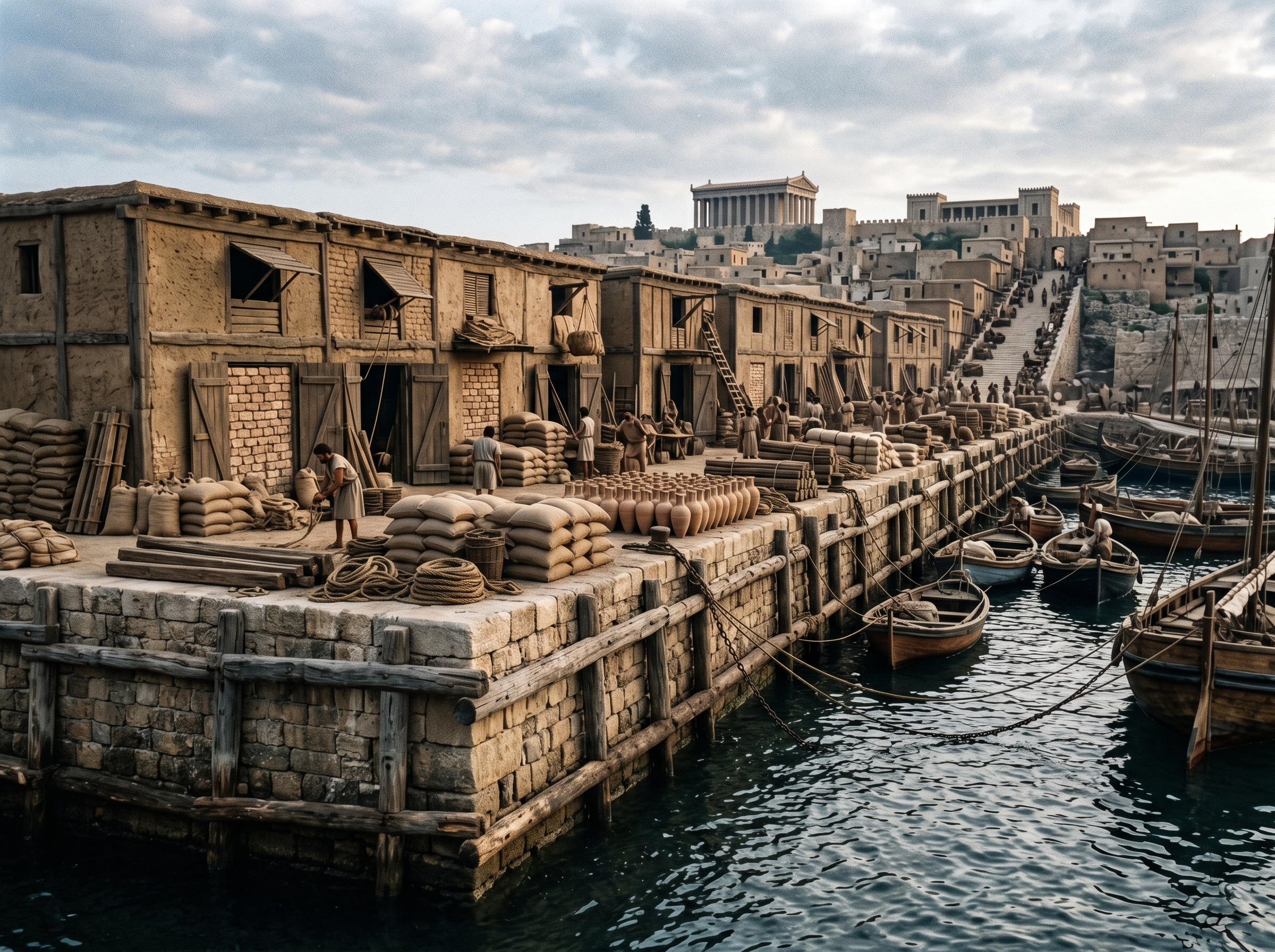
Reinforced quay and packed warehouses
Quays and waterfront storehouses had been repurposed into a city-sized pantry that kept Tyre alive while the mainland pressed in. Thickened quay faces, reinforced with timber bands and chained moorings, sheltered rows of shuttered emporia whose hoists now lowered sacks of grain instead of foreign cargo.
Some warehouse doors were bricked up and plastered floors sealed to keep spoilage down; amphorae sat cheek-by-jowl with timber piles and lashings being made for departing boats. Small escorted launches threaded the berths under the supervision of temple clerks who checked manifests and granted permissions to sail. During the thirteen years of pressure, those quays did more than hold goods: they organized who moved food, who boarded, and who could claim a ration when land access failed.
Warehouse architecture—hoists, shuttered openings, plastered floors—was adapted to store grain as securely as it once stored traded luxuries.
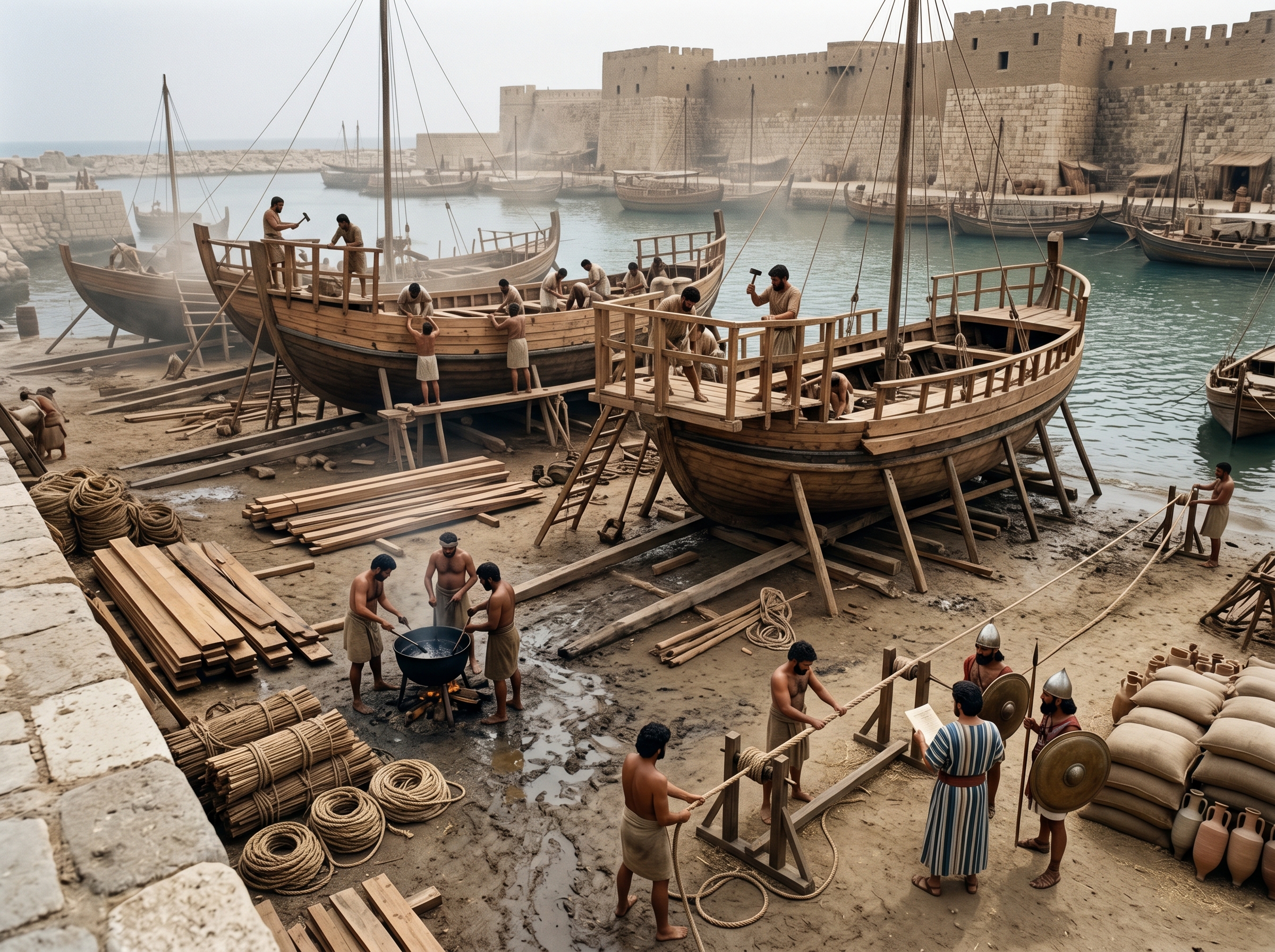
Slipways and shipyards refitting merchant hulls
Shipwrights converted ordinary merchant hulls into fast, escorted transports that could run the channel under threat. Slipways crowded with beached hulls became workshops where carpenters fitted extra rowing benches, bolted on temporary fighting platforms, and smothered seams with pitch from boiling cauldrons.
Ropewalks and timber piles fed a steady supply of oars and planks; teams replaced light cargo holds with stanchions and lashings so a merchant crew could carry armed men. Temple officials sometimes stood beside captains, checking lists and allocating priests’ blessings before a refitted boat left. The point was practical: Tyre did not launch purpose-built warships at scale; it turned what it had into craft that could protect convoys and ferry staples under escort within days of a sortie order.
Rather than building a naval fleet from scratch, Tyre prioritized rapid conversion of merchant hulls into hybrid transport-galleys that balanced cargo and combat capacity.
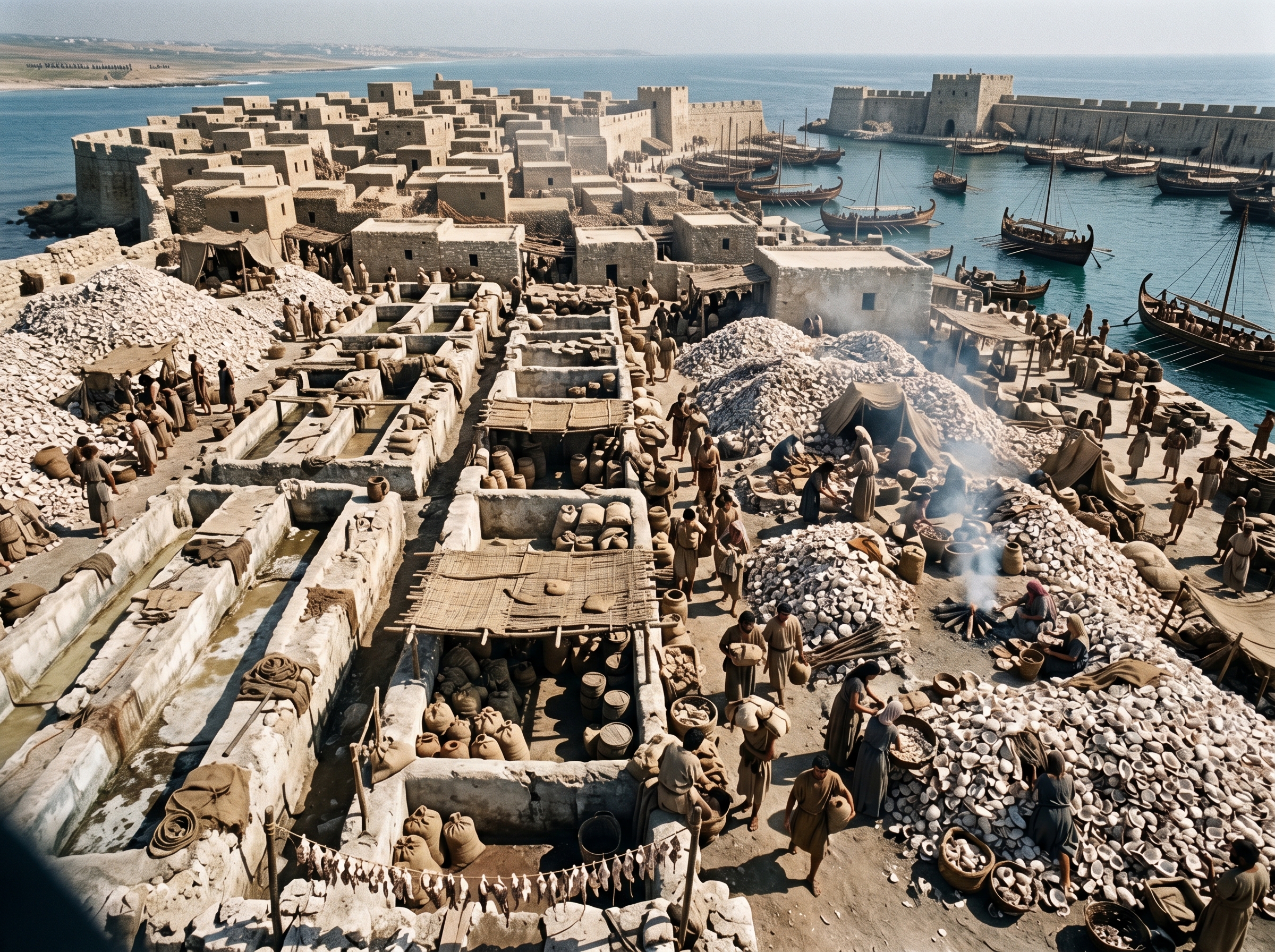
Dye vats, shell middens, and temporary supply staging
The long, shallow dye vats and their blinding-white shell middens stopped being just workshops; they became staging yards and improvised terraces for people and supplies. Vats stained purple-black were heaped with sacks and amphorae, used as low platforms to stack provisions where quays were full.
Workers moved among the middens—shells scraped, lines of murex drying, pots simmering—turning an industry into logistics. The dye trade demanded vast numbers of shellfish (tens of thousands for a single cloak), so these vats were already wired to the harbor; repurposing them kept supply flows tight because the storage lay just a few steps from boats. From the water the pale middens read like waypoints that directed where to land when space on the quay grew scarce.
Because murex processing was both bulky and coastal, dye vats could be shifted into storage without severing the city’s export lines.
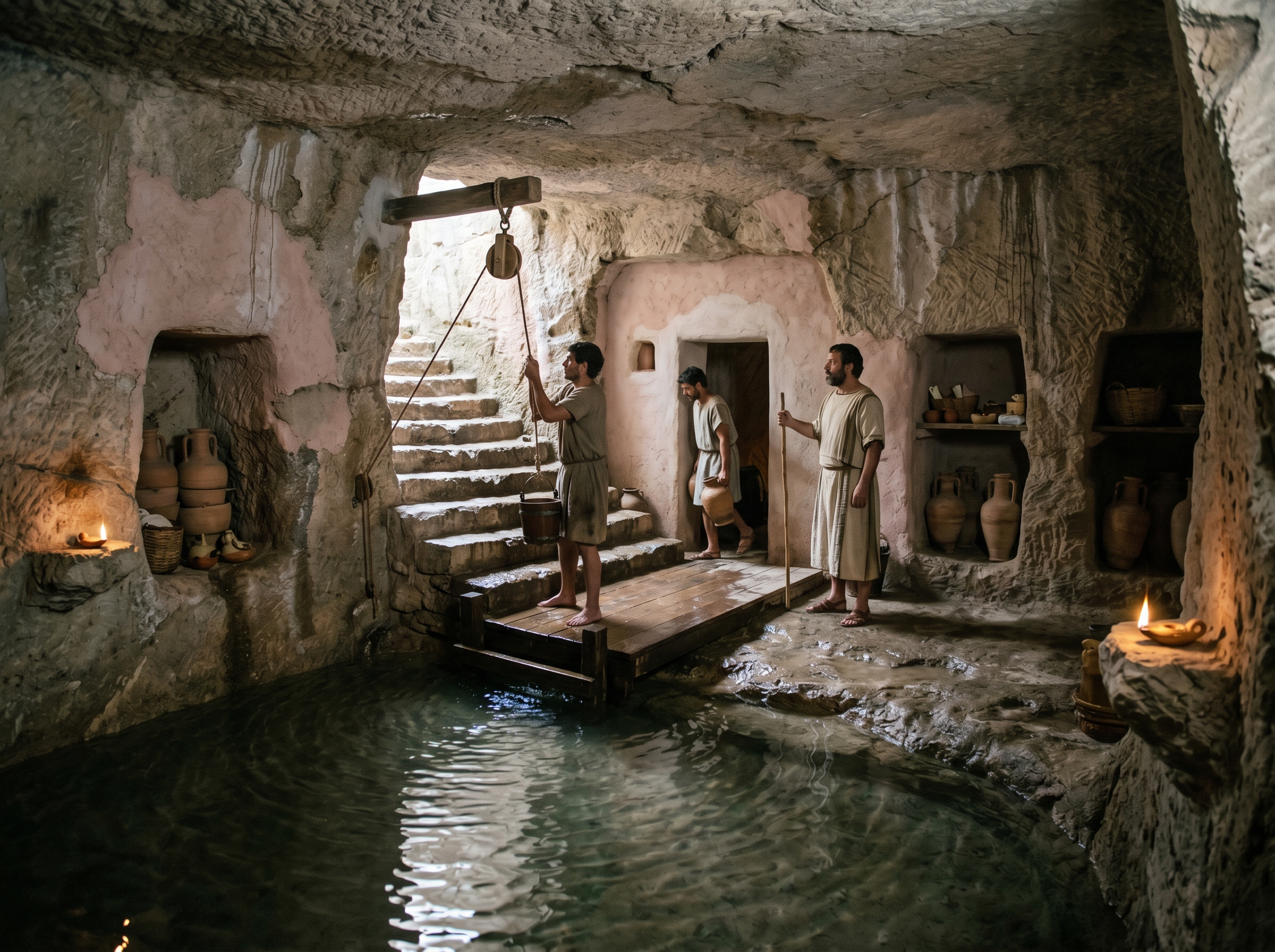
Cistern cut into living rock beneath a warehouse
Water was a strategic resource and many of Tyre’s lifelines ran underground. Rock-cut cisterns beneath warehouses held shallow pools whose plastered walls kept rainwater drinkable through repeated use and occasional contamination.
Stone steps led down to bailing platforms where workers hauled up water in amphorae; ropes and simple pulleys eased the labor and left drip marks and patched plaster where repairs had been frequent. Cisterns were often sited under storage buildings to keep them shaded and to protect access from enemy observation. When the channel remained open but the land approaches were sealed, those sealed reservoirs decided how long a district could hold out.
Plaster repairs and tool marks in cisterns recorded an economy of maintenance: water stores were constantly tended, rationed, and prioritized during long periods of isolation.
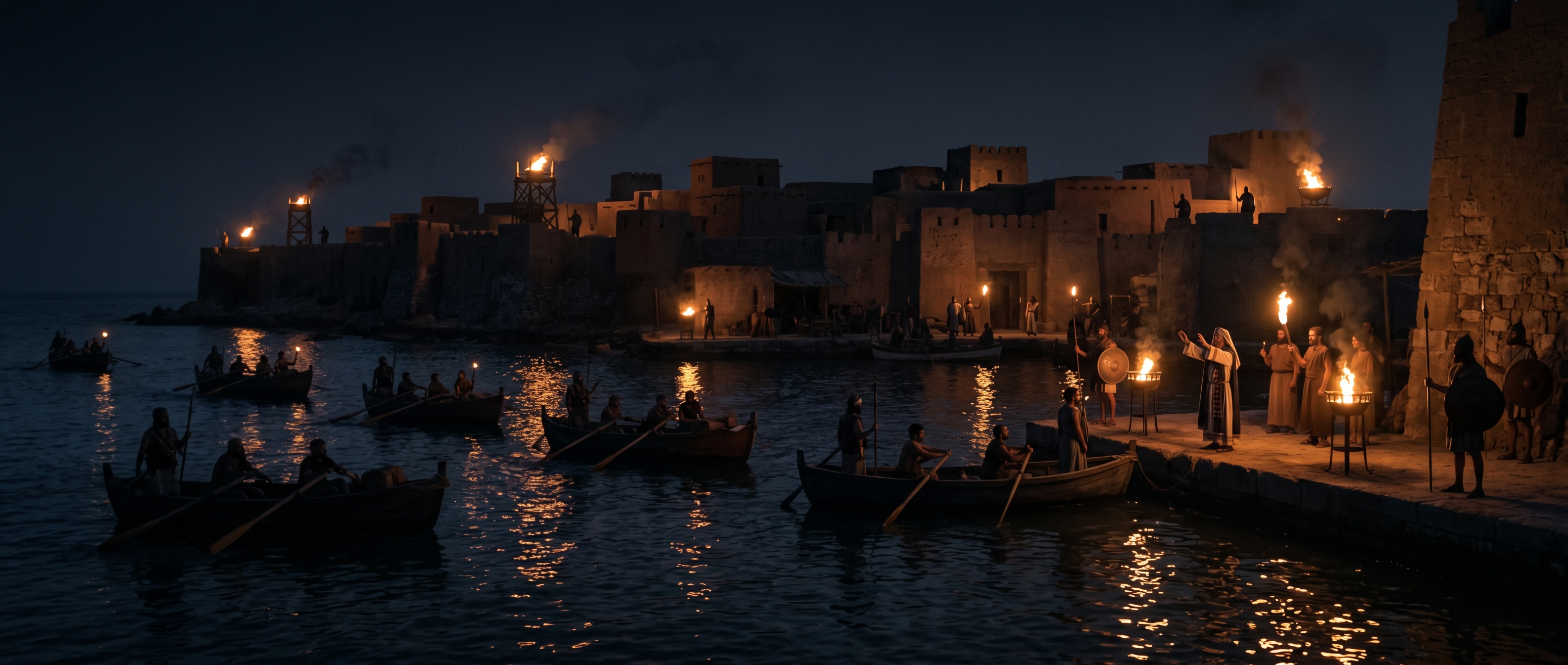
Signal towers, sentries, and escorted night landings
At night Tyre ran a choreography of signal fires, guarded launches, and priests' rites that kept supply runs discreet and coordinated. Controlled flames and smoke on small towers relayed prearranged codes across the channel so convoys could leave in tight formation and arrive without mistakes.
Boats moved in measured gaps—oars quieted, crews briefed—while torchlight glanced on the water and the island’s spine stayed mostly dark. Priests performed quick blessings at the quay edge before a launch slipped away; sentries rotated on fixed schedules and listened for the creak of oars. That ritualized coordination reduced the risk of interception far more than ad hoc night runs would have, and it made each crossing a civic act as well as a logistical one.
City context
The defenses sat at the seam where Tyre’s economic life met imperial coercion. Ordinary people encountered them every day: shipwrights and rope-makers working to keep convoys running; warehouse foremen tallying incoming grain; temple officials issuing departure rites for armed merchantmen. For a worker on the quay, a fortified storehouse and a plastered cistern were not abstractions but the difference between food arriving and famine. The shore was where the city’s survival was negotiated in timber, salt, and manpower.
In rhythm and ritual the works rewrote familiar patterns. Trading voyages were reordered as escorted supply runs. The temple and palace presided over permissions to sail; priests blessed convoys and recorded pledges that carried political weight. At night sentries watched both the channel and the approaches from the mainland, and the soundscape tightened: fewer public festivals, more shouted orders and the steady thud of oars. Understanding the defenses makes clear that Tyre’s life under pressure remained maritime at its core, but maritime reorganized around endurance and negotiation rather than open commerce.
Sources
city essay
- City essay: Tyre — compact island heart, specialized coastal industries, and an outward-facing harbor system (provided corpus).
site file
- Landmark research file: Nebuchadnezzar-era siege defenses and related works (site summary).
primary text
- Ezekiel, chapters 26–29 (ancient account of Tyre and imperial pressure).
- Flavius Josephus, Antiquities (summary accounts of Near Eastern events including Tyre’s relations with empires).