At a glance
The mainland quarter forced a rethink of Tyre: it was where the island’s compact, ritual-commercial heart met the practical demands of bulk industry, burials, and overland access. Once Alexander’s engineers linked island and shore with a roughly one-kilometre causeway, that meeting became a permanent fusion that changed defense, labor, and how the city fitted the sea into everyday life.
What happened when a city defined by its island core began to occupy a broad coastal plain? The mainland quarter answered that question in concrete terms: long low warehouses and yards for timber and shipbuilding, terraces of processing vats and white shell-middens, and rows of simple houses and funerary enclosures stretched along shallow shorelines. Those features read differently from the island’s vertical spine of palace and temple — they were horizontal workspaces built for movement, storage, and repetitive labor.
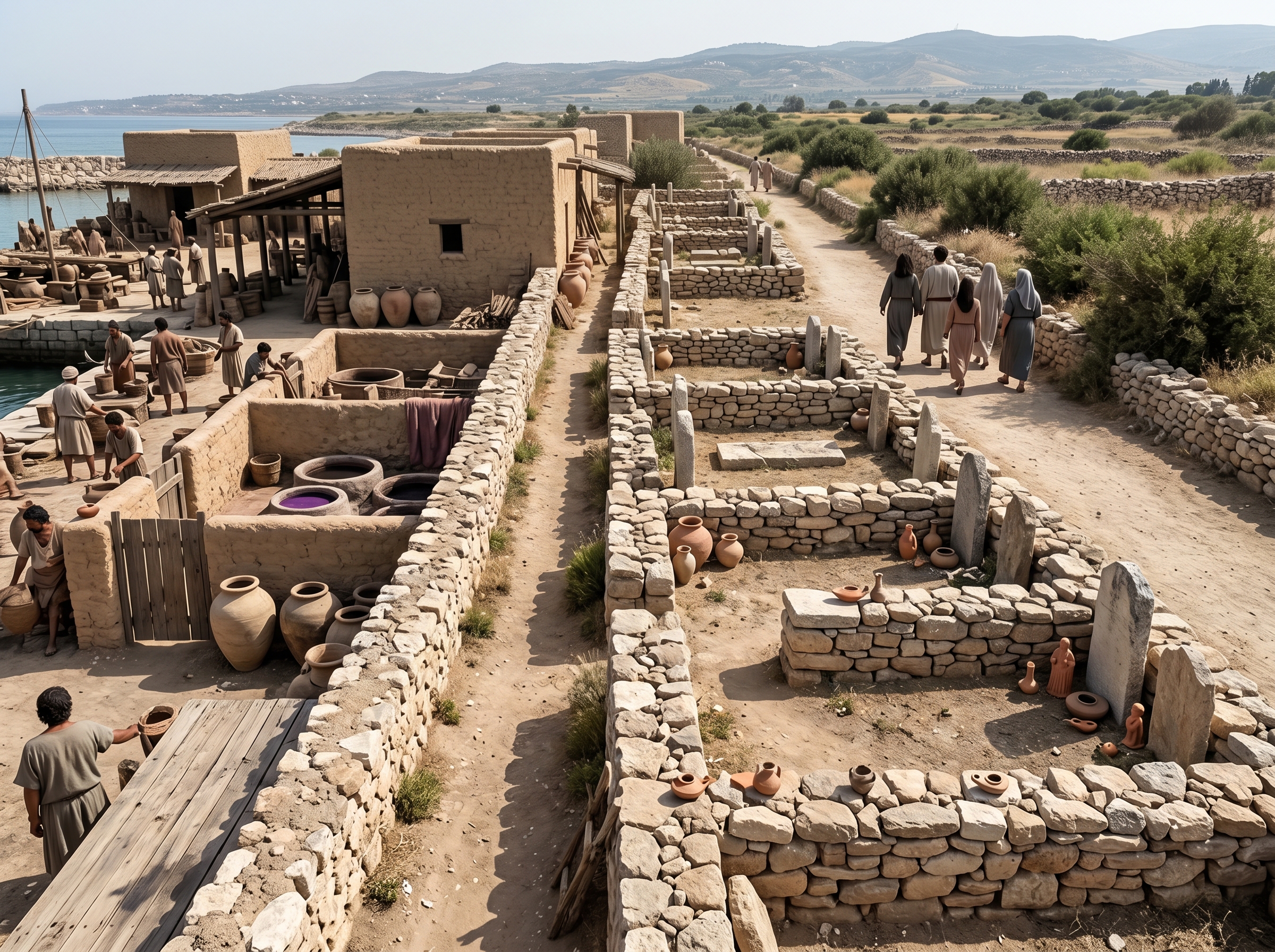
Approaching from the sea, a visitor saw quays that could not be mistaken for elite display. They were broad, flat aprons of packed sand and stone where oxen strained hauling timber and amphorae, where ropes coiled in sun-bleached loops, and where shipwrights eased planked hulls on greased skids. Nearby, dye-works arrayed long rectangular vats stained faintly purple; the air carried a sour, fishy tang mixed with smoke from continuous fires. Behind those yards, middens of crushed shells rose in pale hummocks — the exhausted byproduct of producing a color that, for all its prestige, required relentless, low-margin labor.
In function the mainland resembled the industrial outskirts of other Mediterranean ports — think the open shipyards outside Corinth — but its existence changed Tyre’s civic grammar because the island core retained ritual and royal authority. The mainland held the heavy lifting: timber storage for fleets, fuel and workshops for glass and textiles, cemeteries set apart from dense island housing. The result was a two-part city in which the island decided voyages and oaths, while the shore supplied the ships, rope, dye, and men who made those voyages possible.
Alexander’s mole converted a precarious seasonal adjacency into permanent contiguity. The roughly one-kilometre causeway trapped sediment and widened the shore; what had been transient mudbanks and narrow landing spots became streets and permanent yards. That single physical change shifted risk and control: land armies now had a direct approach, but Tyre gained more room for bulk activities that the island had never comfortably held. Seen this way, the mainland quarter was not just an appendage — it was the mechanism by which Tyre scaled its maritime economy beyond what its island could contain.
Closer looks
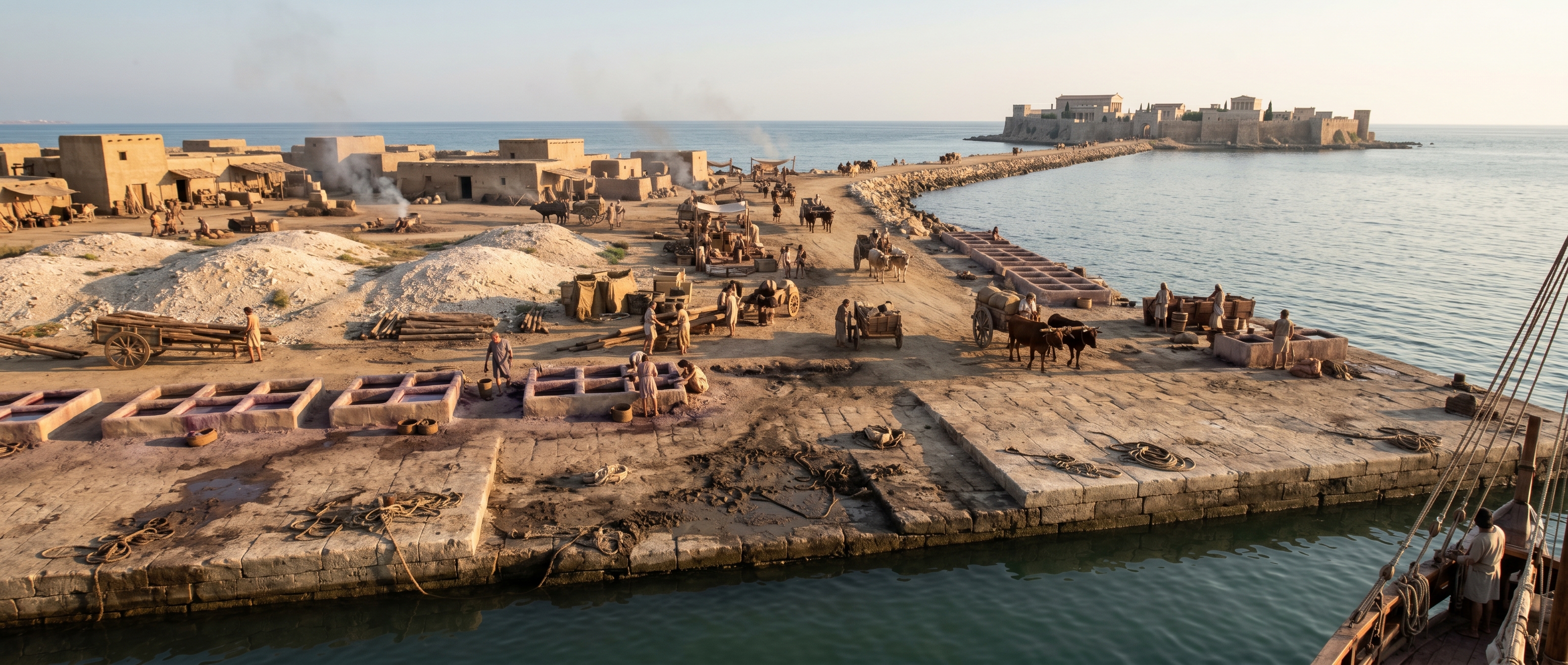
Panorama of the mainland shore and Alexander’s causeway
The causeway rewrote Tyre’s relationship to the sea by turning a seasonal landing strip into a permanent working spine. What had been a narrow channel of tidal flats and moorings became a rough, metre-deep tongue of stone and earth nearly a kilometre long that trapped sand and built a new shore.
Carts creaked across the mole, oxen dropped their heads as drivers hauled cedar timbers inland, and men stacked planks along the newly widened apron. The long, flat quays that ran beside the causeway read horizontally: wagonable stone surfaces, ropes coiled in sun-bleached loops, and broad clearings where ships could be loaded without the island’s tight vertical crowding. Hydraulically the mole mattered as much as militarily — currents slowed, mudbanks grew, and small tidal pools turned into streets and yards that could hold bulk stores that the island never could.
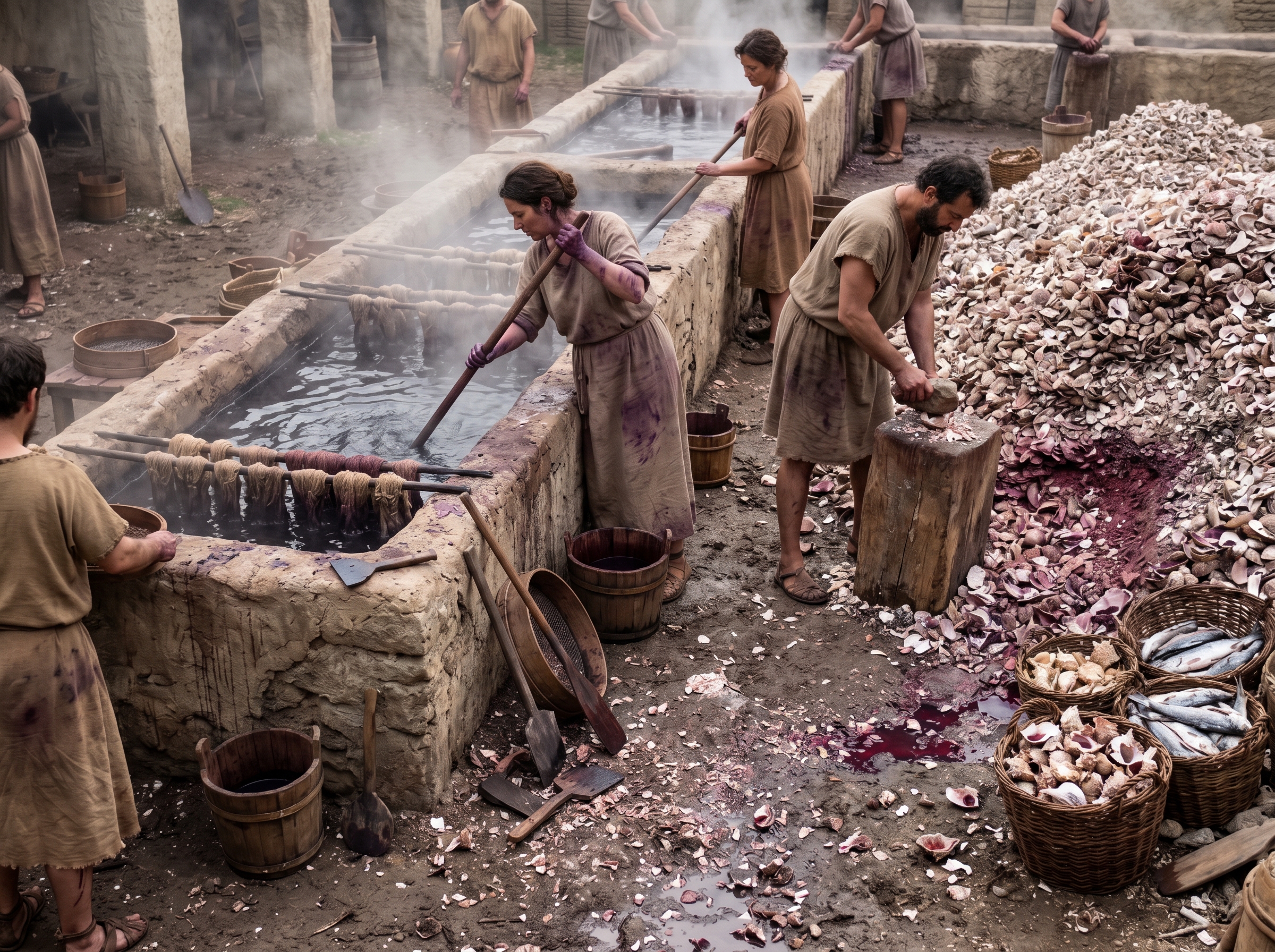
Dye vats and midden — the chemistry of Tyrian purple
The purple vats turned prestige into waste. Producing a single cloaked dye required tens of thousands of murex shells, and the shore showed that arithmetic: white hummocks of crushed shell dotted the hinterland while low rectangular vats steamed along the waterline.
Workers of both sexes stood ankle-deep in salt-splashed mud, prised glands from cracked shells, and boiled them for hours over constant fires. The smell was sharp and fishy; nearby stones and cloth took on a faint, stubborn purple. Archaeologists now find chemical traces in soils from ancient dye workshops, which explains why these operations clustered beside seawater for ready access to salt and to rinse cloth quickly. The glamour of Tyrian purple depended on repetitive, low-margin labor and a surprising hunger for fuel and space.
Soil chemistry from dye-works survives: archaeologists detect molecular residues that confirm intense, localized murex processing along ancient shores.
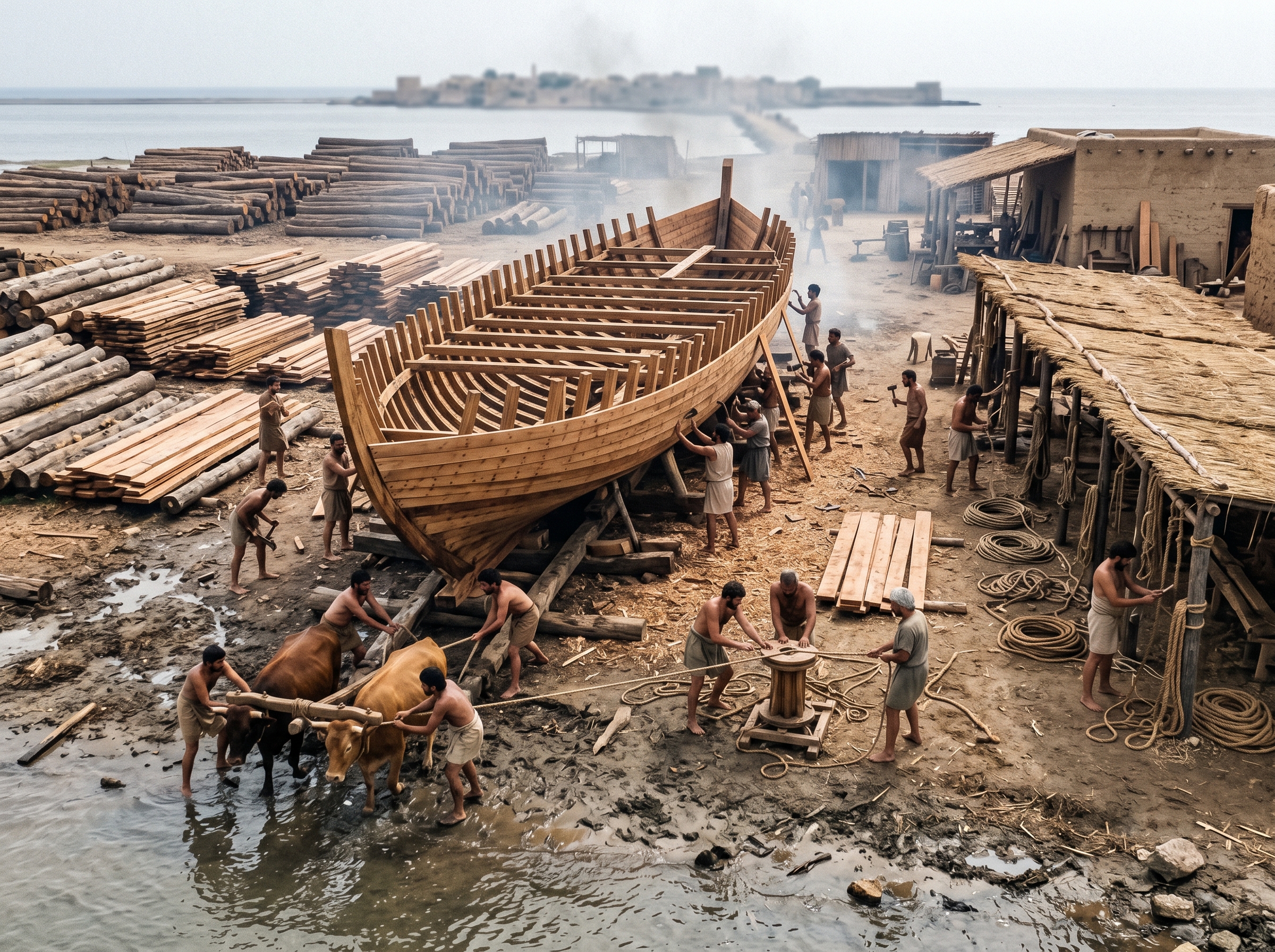
Shipwrights on the slipway: building and launching merchant hulls
Shipbuilding was organized like an assembly line stretched along the shore. A hull sat on greased skids sloping into the sea while teams timed a launch to tide and manpower rather than any mechanical device.
Adzes rang as carpenters shaped planks of Lebanese cedar and pine. Rollers, capstans, and oxen provided the brute force; men hauled on ropes and packed the keel with pitch and oakum for caulking. Launches depended on the tide and choreography: a single misstep could pin a hull in mud for days. The mainland had the flat space and timber yards the island lacked, which is why large merchant hulls were usually started here and finished quickly to meet the seasonal trade cycle.
Launches were scheduled to tidal windows and required coordinated teams using rollers, capstans, and animal power rather than mechanical winches.
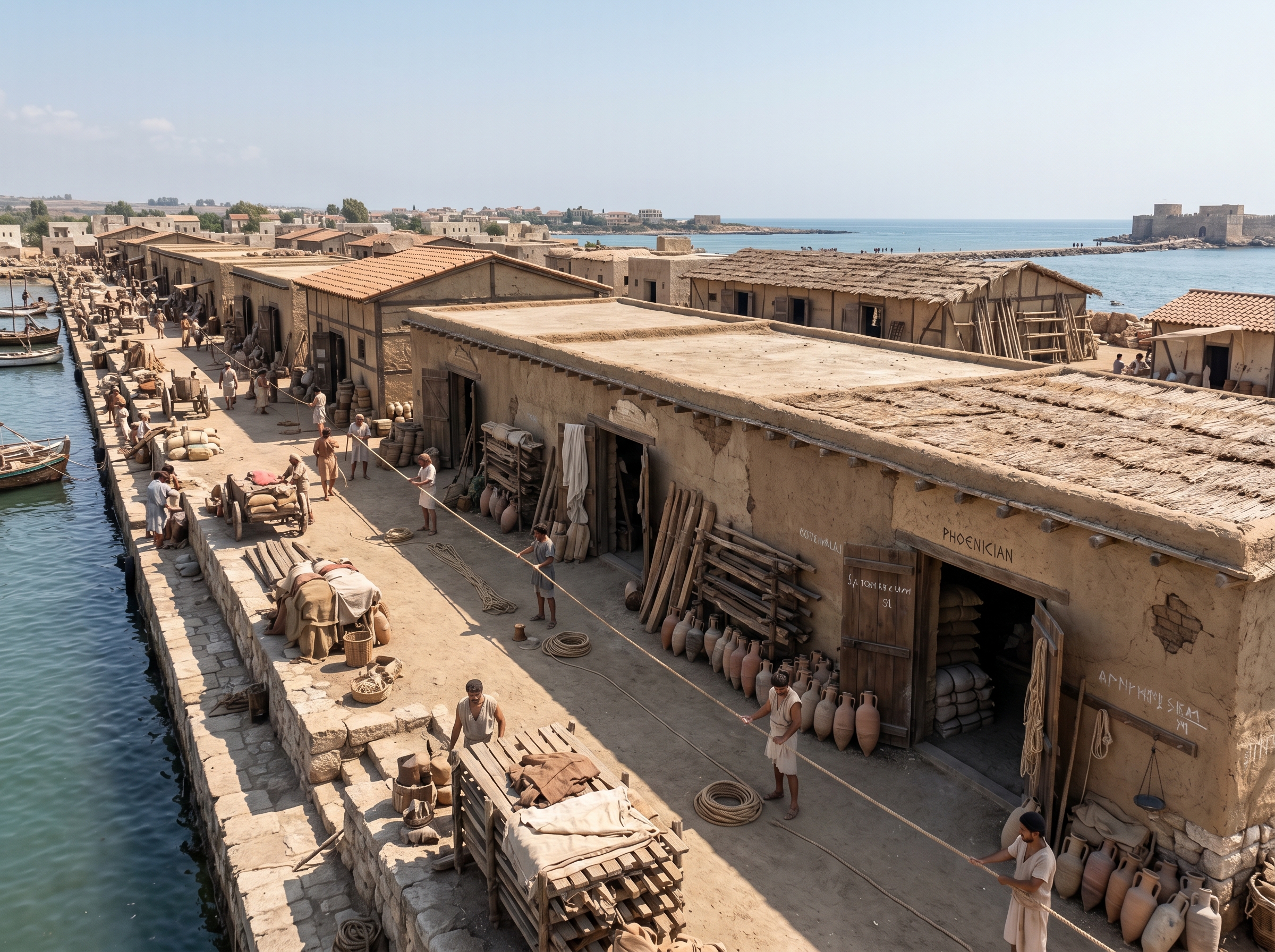
Long warehouses and ropewalks along the quays
The shore read horizontally: long low warehouses and ropewalks stretched like stripes along the quay. These were not decorative aisles but pragmatic strips of storage and uninterrupted working ground where bulky materials were handled and readied for shipment.
Ropewalks ran straight for dozens of metres so spinners and pullers could stretch long lines of hemp or flax into ropes for rigging and hauling. Wide doors on shallow-roofed warehouses allowed oxen and wagons to back in, and chalk markings or stamped amphora handles recorded ownership and cargo weights. The repetition of bays and awnings made the shore efficient — predictable spaces where a single worker could find the right length of rope, the right timber bundle, or the properly stamped amphora without chasing through a maze.
Ropewalks required long, flat stretches; their linear form dictated both production speed and the visual rhythm of the quayside.
Funerary enclosures at the landward edge
Death sat deliberately a few hundred metres inland, where low funerary enclosures buffered the smell and noise of production. The landward edge offered a narrow zone of quiet: small tombs, modest stone markers, and processional ways that moved people away from the quays and vats.
Processions walked along raised paths or past low walls, leaving the shell-middens and boatyards behind before rites began. Offerings were modest pottery and small personal items placed by graves; the interments read like neighborhood memory rather than elite display. That separation changed the city’s choreography: families who worked on the shore could bury their dead near home, but the route to commemoration required a step away from the everyday industry that sustained them.
Tombs were modest and set back deliberately; the raised processional ways helped keep funerary spaces apart from runoff and odors coming off the vats.
City context
The mainland quarter functioned as Tyre’s working flank. Ordinary people crossed between island and shore daily: rope-makers and shipwrights carried long coils and planks toward the quays; women and hired laborers tended vats and hauled sacks of salted fish for dye vats; wagon trains brought cedar and pine from inland forests and stacked them in long rows awaiting shipment. The island’s temple and palace still framed major rituals and diplomatic exchanges, but the everyday business of provisioning fleets and producing export goods happened on the shore.
Cemeteries and funerary enclosures typically sat at the landward edge, where processions moved away from the port and the smell of workshops. That spatial separation shaped social experience: death and ancestral memory were kept apart from the commercial bustle, while households that relied on heavy industry lived and worked within earshot of the quays. After the causeway, soldiers and officials could march directly across formerly exposed water, and military presence increased on the new peninsula — changing how residents thought about vulnerability and protection.
Sources
secondary
- City essay on Tyre (interpretive frame provided with this project)
- Glenn E. Markoe, Phoenicians (modern synthesis of Phoenician economy and urbanism)
primary
- Arrian, Anabasis Alexandri (accounts of the siege of Tyre and construction of the causeway)
- Diodorus Siculus, Bibliotheca historica (narrative of Alexander’s campaign at Tyre)
- Pliny the Elder, Natural History (notes on Tyrian purple and murex dye production)