At a glance
The palace was where Tyre’s political power turned ships and precious manufactures into enforceable rights: a working court that issued privileges, marshalled tribute, and scheduled convoys. Perched on the island’s narrow spine, its reception halls, archive rooms, and storage courts looked out over the quays and the temple of Melqart, collapsing ritual authority and commercial control into a single working complex.
What did it mean for a king to rule a maritime city whose wealth rode on ships and sealed contracts? The palace answered that question through rooms and routines. Rather than a distant ceremonial mound, it sat on the island crest where visitors first saw it from the quay: ashlar walls rising three or four metres above terrace courts, flat roofs reached by broad steps, and a sequence of inward-facing chambers that moved from public reception to private council and then to stacked storage courts. The building’s main approach aligned with the urban spine so delegations could arrive directly from the harbor without cutting through crowded workshops.
Inside the reception hall, benches faced a raised platform where the king or his deputy heard envoys and merchants. Floors were flagged with local limestone; walls held painted plaster and stone niches for offerings and seals. Adjacent rooms stored sealed bundles, bronze tally-tags, and inscribed stelae that recorded concessions, safe-conducts, and tax assignments. A narrow room with clay and leather tags functioned like an archive: clerks wrote on perishable media and on durable stone or lead when files needed legal force. Courtyards opened toward the harbor, allowing guarded transfer of tribute—amphorae, timber manifests, and crates of dyed cloth—directly into royal custody.
Compare this with other maritime cities where mercantile councils sat apart from civic palaces. In Tyre the palace, the temple of Melqart, and the quay formed a tight triangle of action. Sailors took oaths and merchants swore contracts in the sanctuary; they then passed through the palace gates to register privileges or to accept royal escort. That closeness made the king less an absentee adjudicator and more an active manager of trade: controlling who received export monopolies, which convoys got protection, and which foreign envoys received harbor access.
Because the palace combined reception, administration, and storage, it shaped everyday economic choices. Granting a single privilege could redirect dozens of ships and hundreds of workers; denying a permit could strand cargo at the quay. Understanding the palace therefore changes what the city looked like in motion: not a free-market strip of docks but a regulated economy whose engine sat at the island’s highest point and whose decrees left visible traces in who fished, who built ships, and who dyed purple on the shore.
Closer looks
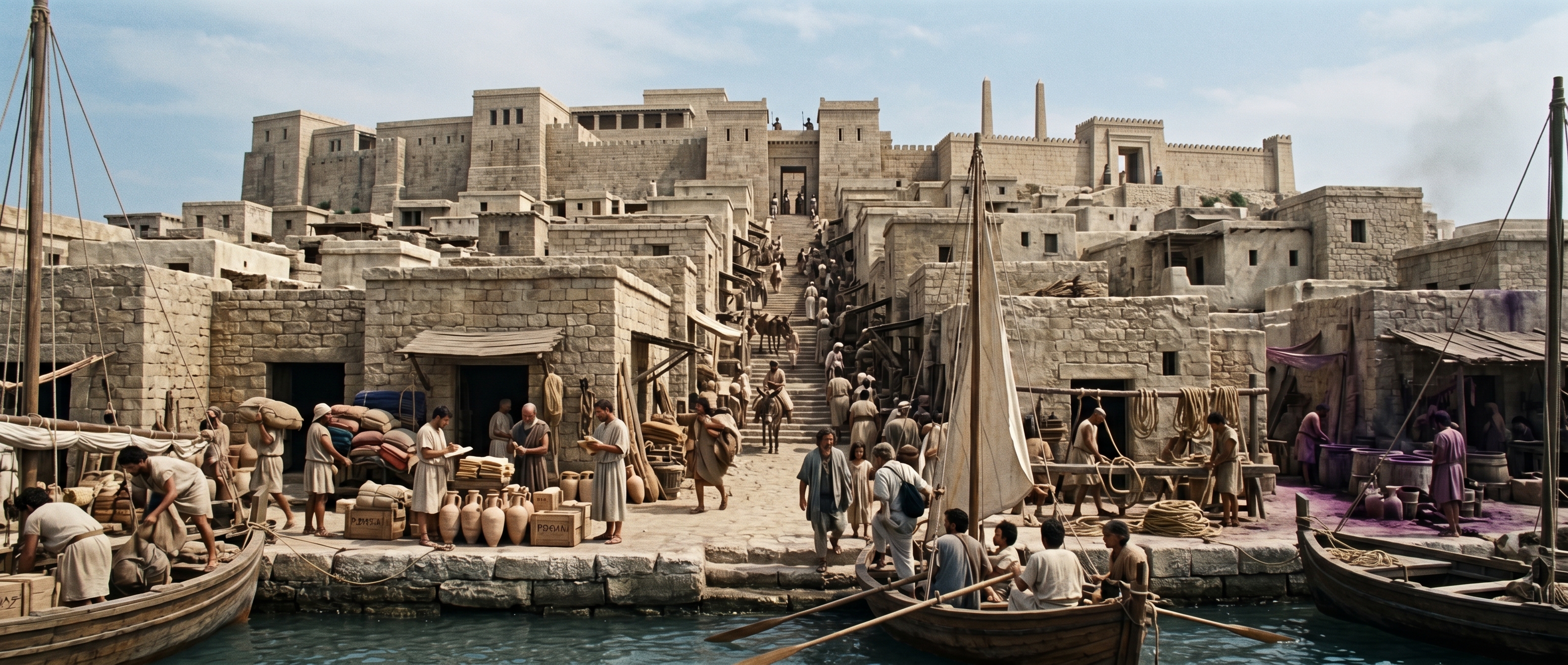
Landing at the main quay: the island spine rising to the palace
Arrival at the main quay revealed how Tyre turned access into authority: the island’s narrow spine funneled people, goods, and information straight to the palace, so the first step ashore already negotiated privilege. Landing boats bumped against timbered quays while crews hauled crates; to the sides ropewalks stretched like long belts and vats for murex boiled and hissed, sending a briny, fishy smoke that mixed with the tang of pitch. Clerks with tally-tags moved along the spine, porters balanced sealed bundles, and the palace’s ashlar walls rose above flat roofs so that the king’s agents could watch who approached before anyone crossed the threshold.
That tight geography altered choices. A delayed manifest could be spotted at the quay and acted on before a ship even tied up; an envoy who arrived with a sealed privilege could be admitted quickly, while unregistered cargo waited under guard. The spine was not a mere street but a procedural funnel where arrival, inspection, and admission happened in sequence, often under the temple’s shadow.
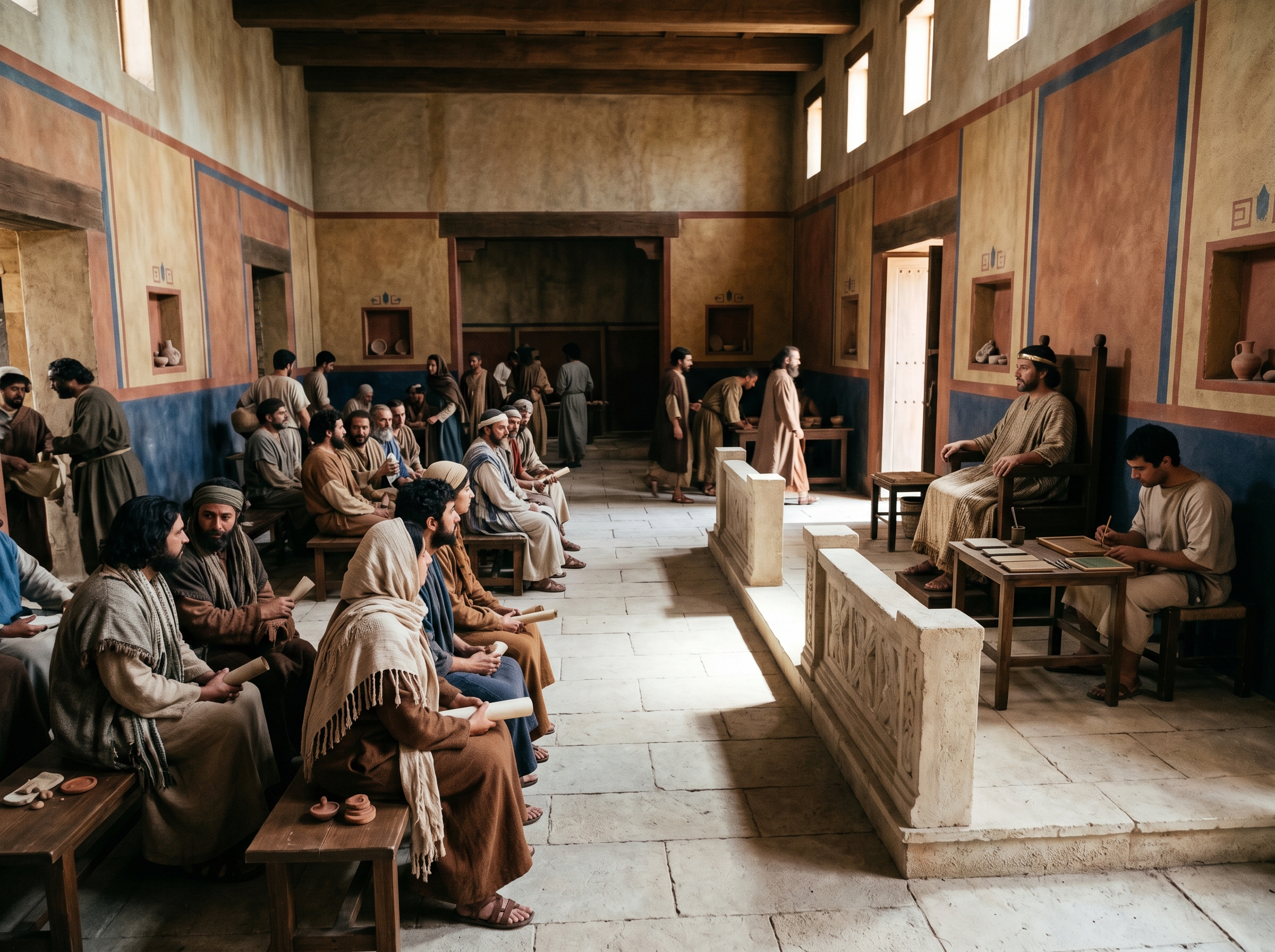
The reception hall and raised royal platform
The reception hall compressed royal decision-making into a single visible moment. Benches faced a raised platform where the king or his deputy judged disputes, issued safe-conducts, and handed down privileges; voices carried clearly from the doorway and clerestory so rulings reached the quay and the courtyard beyond. Floors were flagged with local limestone and walls held painted plaster and small niches where seals and tokens were kept within reach of attendants.
Decisions were performative and material. A merchant who produced a stamped token could go from complaint to convoy in an hour; a denied petition left goods stranded on the quay. Scribes sat close to the platform with wooden tablets and bronze tally-tags, ready to seal an order into a bundle that would travel with a ship. The hall therefore worked as courtroom, customs office, and public record all at once—an ordinary administrative drama that nonetheless determined who sailed under palace protection.
Benches faced the platform so witnesses, rivals, and clients could hear and remember rulings that affected commercial privilege.
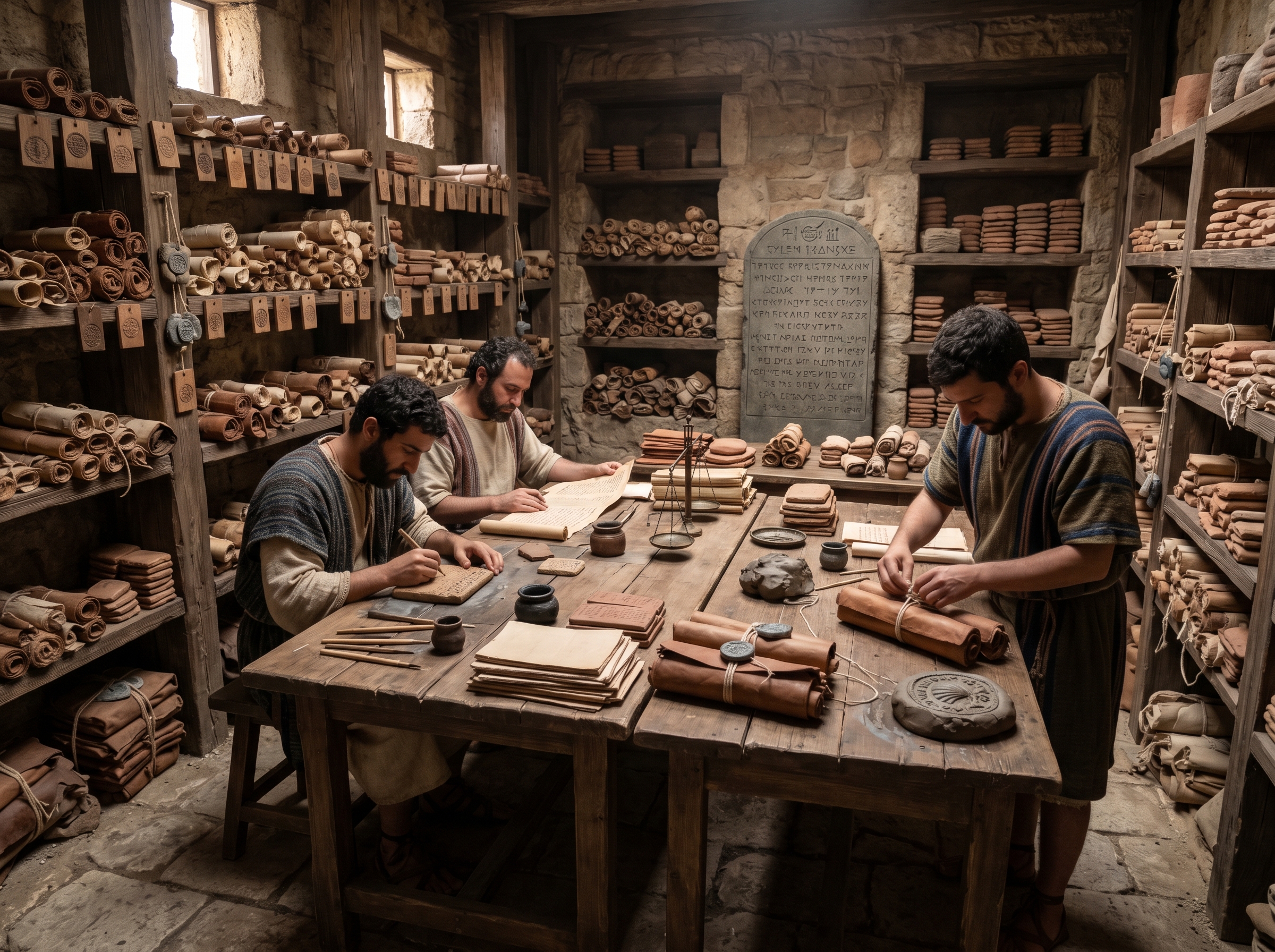
The archive room: clay tags, leather bundles, and the working clerks
The archive room made visible the small, grubby machinery that kept long-distance trade honest: clerks bent over clay tablets, leather rolls, and wooden tags stamped with seals that functioned like portable contracts. Most records were perishable—waxy tablets, tied bundles—so officials habitually duplicated critical entries onto durable stone or lead when legal force was required. Shelves held rows of bundles, each tied and impressed with a seal to show who had custody and when the packet could be opened.
Administrative power depended on material signs. A clay bulla with an impressed token could prove a payment or a privilege at sea; a sealed leather roll accompanied a convoy as its passport. Hands were stained with ink and salt, styluses showed repeated grooves from constant use, and a clerk would often cross-reference a live manifest against a stored inscribed plaque before releasing goods to a captain.
Perishable records were primary; durable inscriptions were reserved for files that needed long-term legal weight or public display.
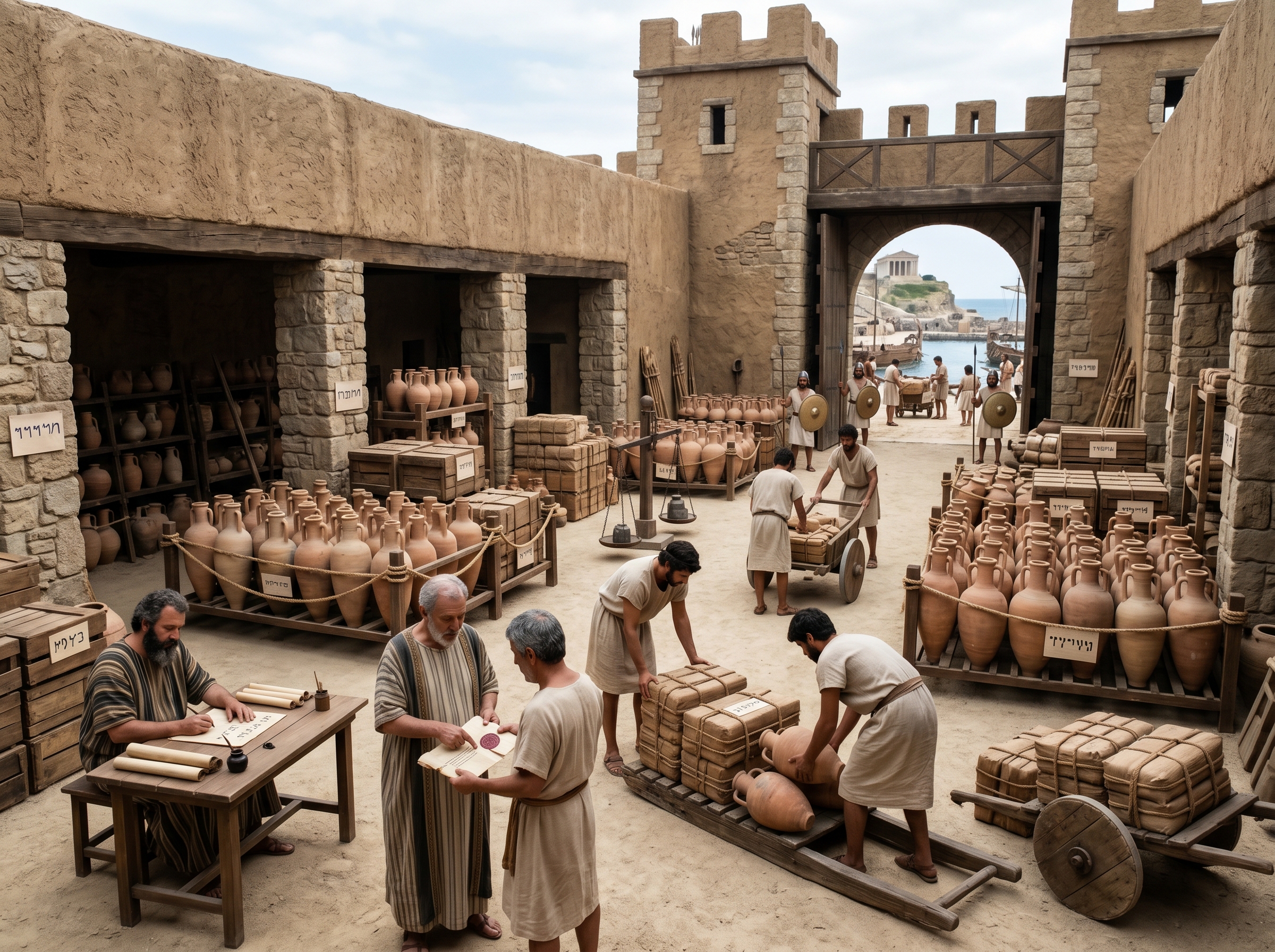
Royal storage court being loaded: amphorae, crates, and timber manifests
The storage court functioned as the palace’s staging yard: amphorae and crates were stacked in ordered runs, each marked with painted signs that indicated origin, destination, or tax status. Porters moved loads on sleds and small wheeled carts while an overseer checked painted marks against a tally; nearby a simple balance with stone weights measured consignments destined for convoy. The courtyard held capacity—scores to hundreds of amphorae—arranged so officials could inspect tribute without blocking the quay gate.
Control happened by paperwork and sight. An official could issue a sealed order that rerouted a shipment, redirecting timber manifests from shipwrights to royal stores or sending cloth into palace custody for diplomatic gifts. The smell of pitch and resin hung on wooden crates, ropes scraped when loads shifted, and every painted stamp on an amphora carried a chain of responsibility that officials could trace in minutes.
Painted marks on amphorae encoded origin and fiscal status; scribes matched those marks to tally-lists before goods left the court.
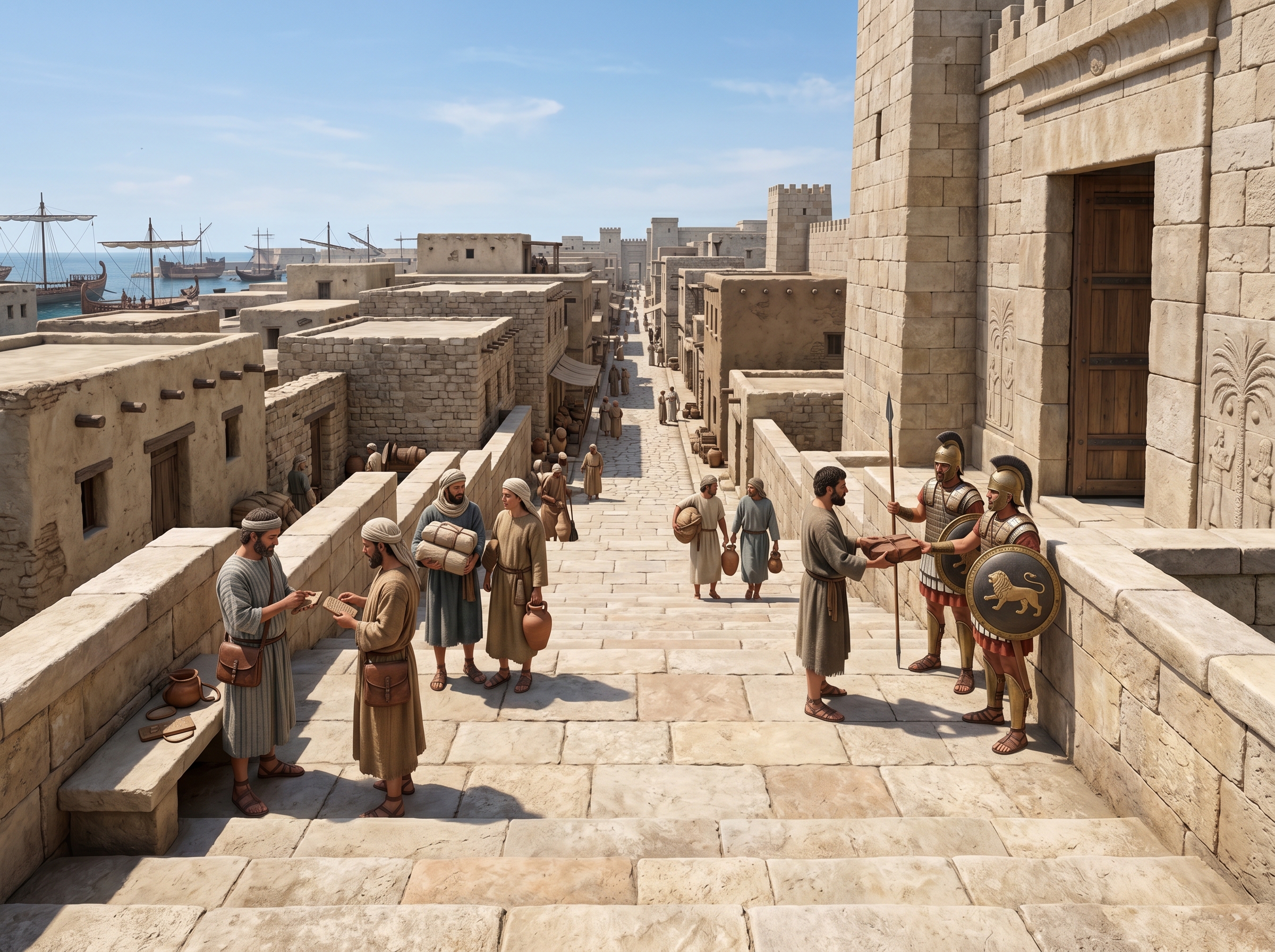
The palace approach: broad steps aligning with the urban spine
The palace approach was an engineered stage for control: broad steps aligned with the urban axis so delegations moved up in orderly procession from harbor to gate. Low side walls and stone benches created pockets where porters could rest, where quick negotiations happened, and where guards could halt suspicious bundles for inspection without clogging the spine behind them. The layout let palace officials see arrivals at a distance and marshal escorts in a few deliberate motions.
Staging mattered because reputation moved on sight. A delegation that waited on the steps with sealed privileges projected readiness; one that fumbled tokens risked delay. The approach thereby worked as a pre-screening space—visual, physical, and procedural—so that when a group reached the palace gate its status had already been partly determined.
The steps doubled as a queue and an observational platform, letting officials pre-screen arrivals before they reached the palace interior.
City context
The palace stood at the heart of daily life by design. In the morning captains presented manifests at the quay, then climbed the spine to register cargo and request safe-conduct; clerks stamped tokens and wrote entries while porters moved consignments into the palace courts. Artisans and shipwright foremen negotiated priority for timber or rope with palace agents who controlled distribution; a small bribe or a written privilege could speed a hull into the water.
Ceremony threaded the complex into civic rhythms. Before departure masters and pilots took oaths at Melqart and then crossed to the palace to collect royal escorts or written letters of credit. On feast days the palace projected power: musicians and priests paraded from the temple, the king presented honors on the reception platform, and the harbor briefly stilled as ships set out under sanctioned protection. In moments of crisis—diplomatic pressure or a naval blockade—the palace became a war room, issuing instructions that reordered labor and redirected the island’s maritime lifelines.
Sources
interpretive essay
- City essay: Tyre (1000 BCE–100 BCE)
secondary
- Aubet, Maria Eugenia. The Phoenicians and the West: Politics, Colonies and Trade. (1993)
- Markoe, Glenn. Phoenicians. (2000)
primary
- Herodotus, Histories (for accounts of Tyrian maritime activity and Persian-period relations)