At a glance
Tombs in Tyre turned family memory into a public, coastal claim: monumental graves and stone sarcophagi faced the sea and displayed imported goods that linked households to long-distance trade and temple authority. Reading those burials changes the city by showing how elite power was anchored not just in palace or temple, but in a visible archive of goods, names, and ritual continuity running from quay to necropolis.
What did it mean to die in a city whose life depended on ships and purple dye? The necropoleis answered that question in stone. Along the island’s approaches and on neighboring slopes, families set out chamber tombs, raised stone cairns, and carved sarcophagi whose faces looked toward the harbor. Those monuments were made of cut ashlar or local limestone, occasionally faced with imported marble slabs, and topped with standing stelae or carved reliefs that recorded names, lineages, and images tied to maritime success — ships, anchors, and deity symbols.
Inside the chambers, the dead lay with goods that mapped Tyre’s trade routes. Coffins could be surrounded by glass beads and amphorae from western markets, pieces of ivory and faience that had traveled from farther afield, and metalwork polished enough to catch sunlight as boats arrived. A single funerary assemblage might contain textiles dyed from tens of thousands of murex shells, small glass vessels blown in Phoenician workshops, and personal jewelry stamped with motifs that echoed the temple of Melqart. Those objects did not sit quietly in the tomb; their placement, inscriptions, and reuse in family cults turned graves into active sites of claim and remembrance.
Physically, these graves negotiated space the way the city did. Some tombs were cut into rock faces and reached by narrow processional ways; others occupied low ridges where their stelae shadowed incoming ships. Their scale varied: modest shaft graves for craftsmen, larger above-ground sarcophagi for wealthy patrons, and multi-chamber monuments for extended lineages. The largest required teams to quarry and move blocks weighing several tons; smaller cache tombs could be tended by a single household. Think of these necropoleis not as separate zones but as an extension of Tyre’s civic grammar — where commercial success, royal favor, and religious ritual were fixed into permanent, visible claims.
Compare that to the island’s temple and palace: both controlled ritual and administrative authority, but tombs distributed that authority through time. A quay lined with warehouses and vats did not only advertise wealth through goods loaded and unloaded; beyond it, stone memorials reminded sailors and rivals that particular families had long controlled access to those same resources. If the temple sanctified departures, the tombs sanctified lineage — a complementary pair that let the living justify privileges and the dead keep sending signals across the harbor.
Closer looks
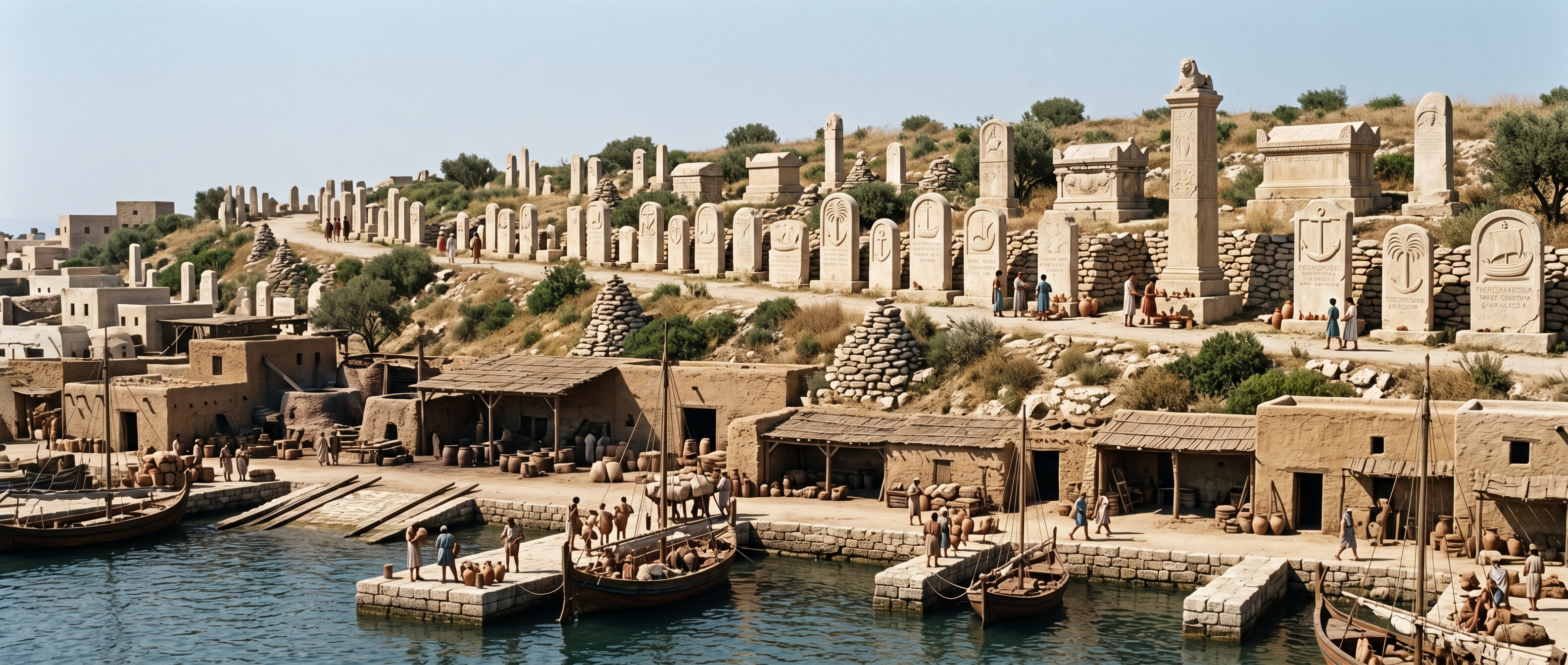
Stelae on the ridge, visible from the quay
Those rows of standing stelae read like a coastal address book: families cut their names and ship motifs into stone so arriving crews could see who claimed the quays and workshops below. The markers were close enough to be read from the water — typically within two to five hundred metres of the main quay — and their carved ship prows, anchors and votive symbols tied a household’s identity directly to navigation and commerce.
The stelae were simple blocks of local limestone, sometimes taller, sometimes set on low cairns, each incised with a name-frame or a stylized hull. Boats and slipways lay in the foreground; warehouses and the long vats for murex dye sat along the shore. Descendants left small offerings at the feet of particular stones, and captains steered past with an eye on which family’s emblem greeted them. In practice, these memorials acted like public signs: they reinforced claims over mooring places, signaled who could call in favors, and supplied a running list of the city’s commercial networks to anyone entering the harbor.
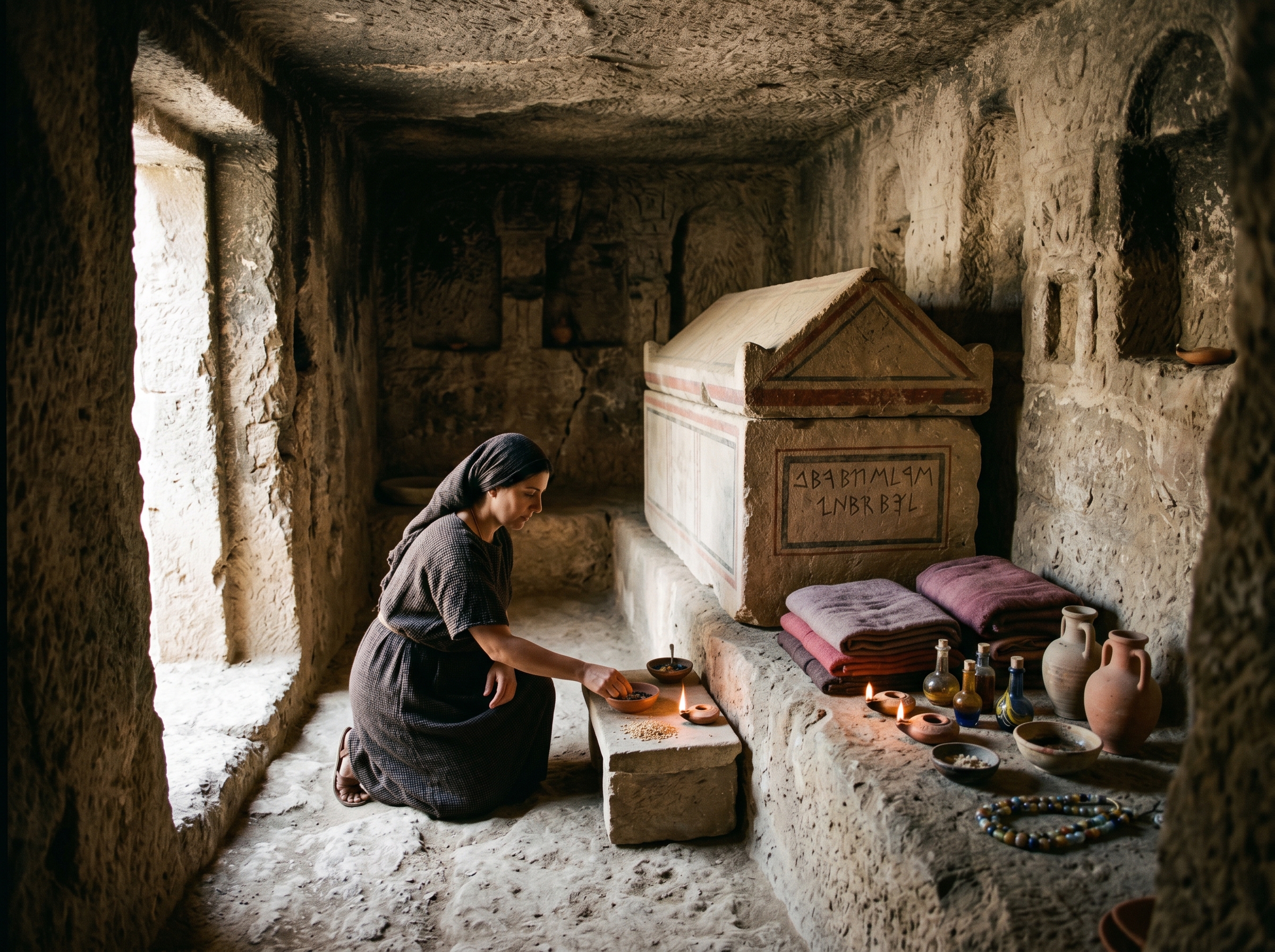
Interior chamber with funerary assemblage
A tomb chamber could feel like a household inventory locked in stone. Inside, a sarcophagus or raised bench sat with carefully arranged objects meant to remake a life in perpetuity: folded textiles whose purple required the dye of tens of thousands of murex, small blown-glass unguent bottles, amphorae sealed with resin, strings of glass beads and ivory inlays.
Inscriptions carved on the sarcophagus face or the inner wall named the deceased and sometimes recorded a lineage or a trade marker; a bead or a stamped motif tied that name back to a workshop or a ship’s route. Lamps and bowls bore oil stains and faint black soot where offerings had been relit by descendants who entered periodically to tend the cult. These visits mattered: rearranging a particular garment or pouring oil into a lamp kept economic relationships alive, because the objects in the chamber were also proof that a family had access to imported goods and to the temple’s favor.
Funerary chambers were not sealed time capsules but spaces periodically reopened by descendants to renew offerings and rearrange goods.
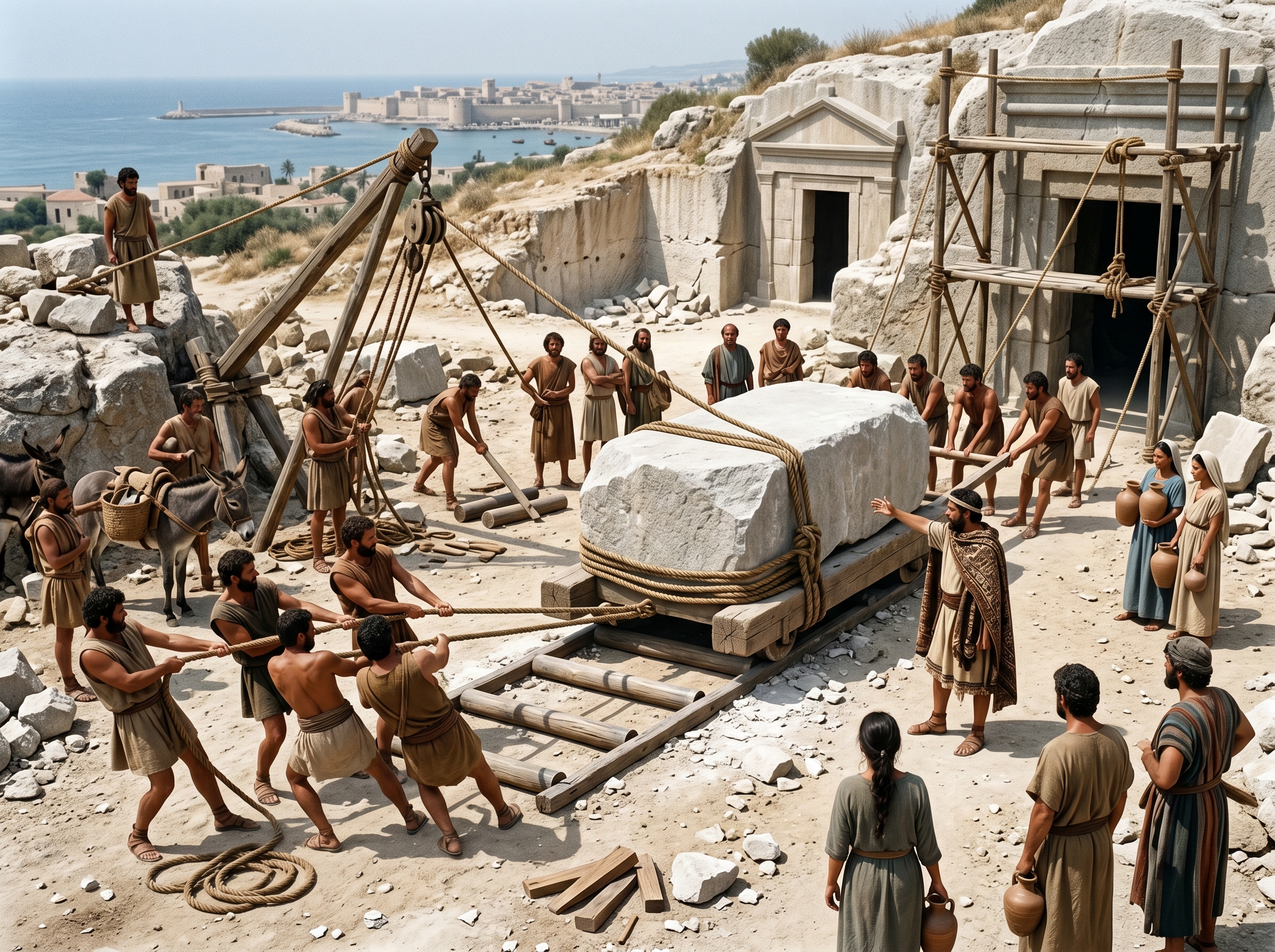
Quarrying and moving a monumental sarcophagus
Quarrying and hauling a multi-ton sarcophagus was a public demonstration of muscle, material reach and logistical know-how. Teams levered a coffin block onto rollers or sledges, lashed oil-soaked ropes, and wound wooden levers while overseers directed the work; the effort commonly took weeks and dozens of labourers to complete.
The project required more than local manpower: timber for rollers and ramps often arrived by ship from forested coasts, stoneworkers brought chisels and wooden wedges to split blocks at the quarry face, and animals or pack crews moved ancillary supplies. Neighbours and clients gathered to mark the event, because hauling a single block signalled that a household could mobilize resources that overlapped with the same networks used for long-distance trade. In short, the act of setting a sarcophagus was also a public claim about who could command labour, wood, and boats.
Large sarcophagi often weighed multiple tons and moved slowly on timber rollers and sledges, requiring weeks of coordinated effort.
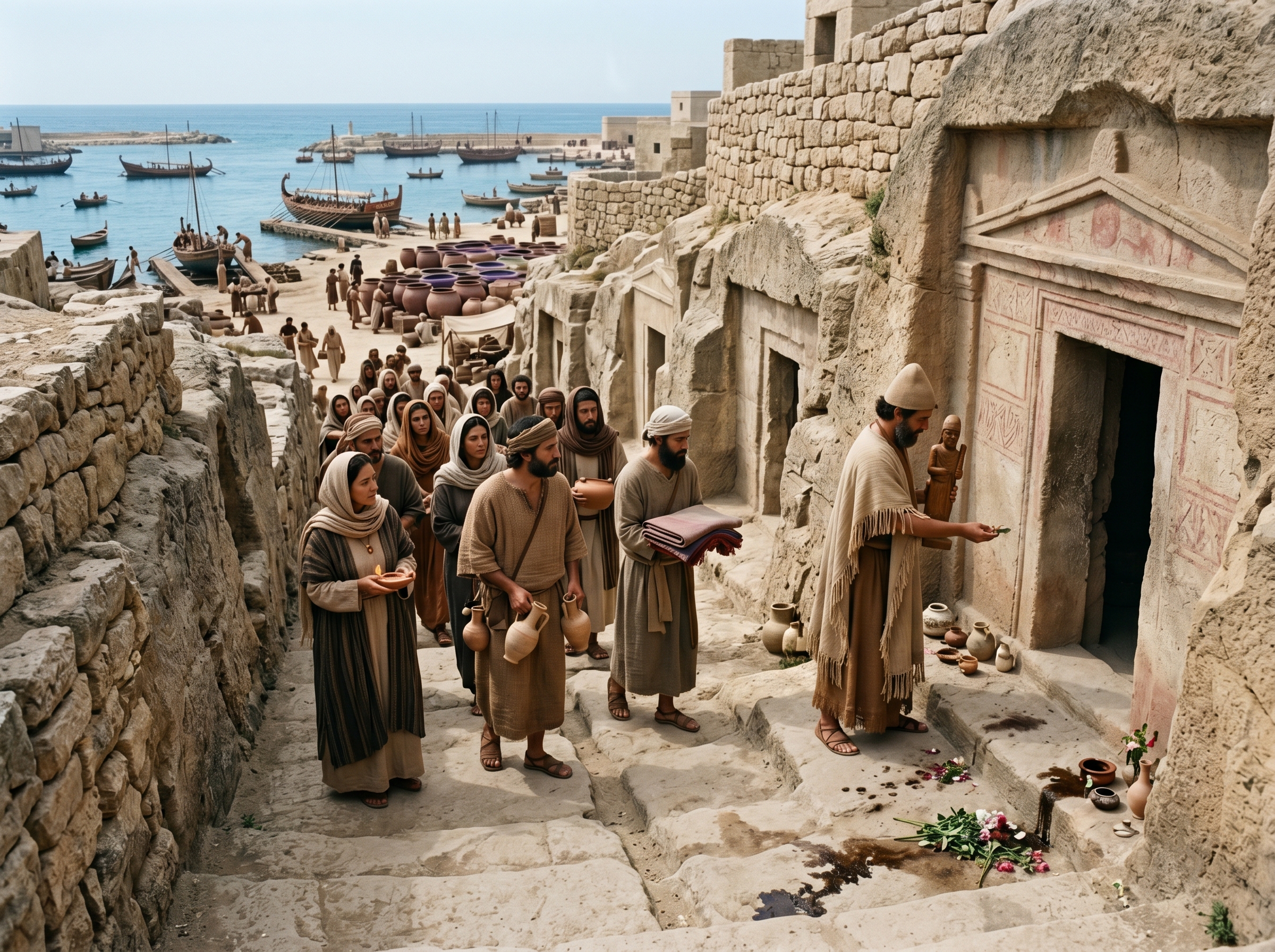
Funerary procession along the narrow approach
Funeral processions tied the temple precinct and the quay to the tomb in a single, audible route. Mourners descended a narrow, carved approach carrying lamps, folded cloth and amphorae; priests chanted names and set a portable emblem of Melqart at the mouth of the rock-cut tomb so sailors and workshop workers passing below could witness the rite.
The steps themselves were part of the message: worn grooves showed frequent foot traffic, small votive deposits and oil drops glistened at thresholds, and the scent of lamp oil mixed with the faint tang of crushed shell from nearby vats. These processions were often timed with departures or market days so that offerings and names reached the widest public, turning a private burial into an event that continuously renewed a family’s claim on moorings, workshops and the temple’s protection.
Processions commonly moved along carved steps toward visible tomb mouths so that ritual and civic audiences overlapped at moments of departure and trade.
City context
Necropoleis sat where land, sea, and memory met. Ordinary dockworkers, ship captains, and temple attendants passed those graves on the way to work; a morning walk from the main quay could bring you past family stelae and fresh offerings laid by descendants who maintained funeral cults. Funerary processions moved from the temple precincts toward these tombs, carrying offerings and announcing lineage claims aloud. The placement of tombs along approaches meant that burial was part of daily civic choreography, not a remote ritual hidden from view.
Politically, monumental tombs were a material argument. A palace issued privileges and the temple ratified oaths, but tombs kept a running record of who had profited, for how long, and under which gods. When a merchant’s amphora or a dyed garment appeared in a tomb, it converted an economic transaction into a family claim that could be invoked in disputes over access to workshops, moorings, or trade rights. For outsiders, the necropoleis read like an address book: names, goods, and images advertised the networks a household could call upon at sea and on shore.
Sources
primary-interpretive
- City essay: 'Tyre (1000–100 BCE)' — description of urban layout, purple-dye economy, and the relationship between temple, palace, and harbor.
catalogue
- Landmark brief: 'Necropoleis and monumental tombs' — notes on burial practices, grave goods, and planning priorities.