At a glance
This narrow quay was where Tyre turned departure into public ritual: ships left not only loaded with goods but consecrated by priests and recorded by the crown. Understanding this strip of stone and timber reveals how the city disciplined emigration, exported privilege, and linked commerce to temple authority.
What happened when a Tyrian ship pushed off from the island and headed west: was that a private merchant voyage or an act of civic expansion? The most interesting question about this quay was whether departures were routine commercial movements or formal, state-managed foundation events that made colonies into extensions of Tyre’s political and religious order.
Physically the place would have been compact and loud. A paved stone platform ran along a sheltered inlet, interrupted by wooden piers and low slipways where hulls were eased into the water. Short stone blocks, some roughly the height of a bench, lined the quayside; these could have been mooring points and places for depositing offerings. From the quay the line of the city rose immediately toward the palace and the temple of Melqart, so priests and kings looked down on departures the way a captain watched the helm.
A small open shrine or raised spot of dressed stone likely sat close to the edge. Here a priest or magistrate would have presided: hands sprinkled water, a few grains or wine poured into the sea, a brief list of names spoken aloud. Crew and colonists stepped forward to touch wood and make oaths; a stela or two—short inscribed slabs, perhaps set at the quay’s head—marked the group’s dedication and the donor’s name. Nearby, warehouses waited with sacks of finished goods, and ropewalks and shipwrights stood ready to repair sails and masts.
Compare that scene to a Greek emporion where trade moved in and out on a timetable. The difference here was the visible presence of temple and crown. Departure was both economic logistics and public liturgy: the same quay that loaded dye, glass, and finished textiles also organized who could leave, who received a grant, and whose voyage carried the city’s name across the sea.
Closer looks
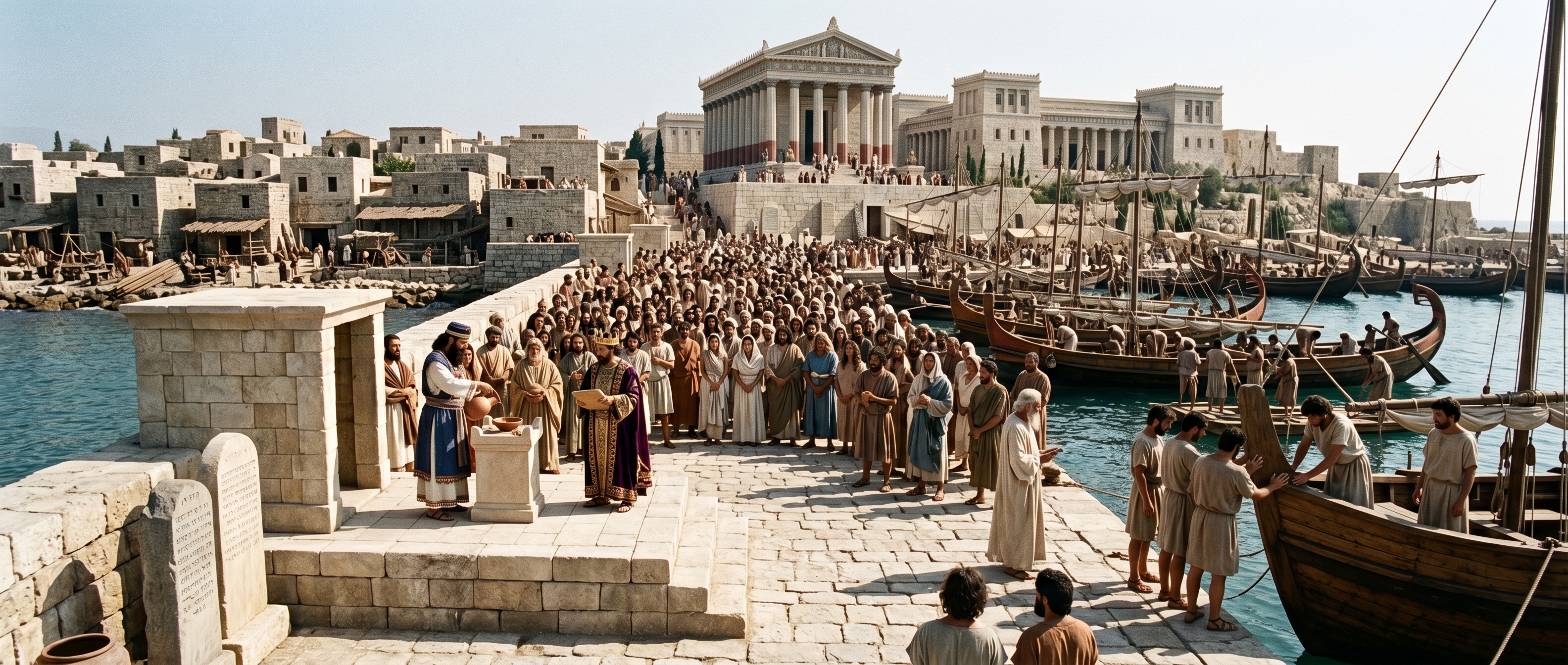
Consecration at the quay — priests, magistrates, and the crowd
Departures were civic acts as much as they were nautical ones: priests and a crowned official turned the pushing-off of a ship into a public legal moment. The quay held a compact ritual arena where oaths were spoken aloud, names were read from a tablet, and a small crowd pressed close enough to touch the timbers of the departing hull.
Stone benches and low mooring blocks doubled as places for offerings. A priest poured a libation; a magistrate ticked off a roster; colonists stepped forward to touch the prow and repeat a vow. Short inscribed stelae sat at the quay’s head—weathered, legible in parts—recording donors or the group’s dedication. Around them, warehouses crouched against the slope and shipwrights kept one eye on the ritual and the other on the ropes.
The scene was neither private nor theatrical. Between one hundred and three hundred people commonly gathered for such departures, and convoys could include five to twenty vessels. In that crowd the crown asserted who could claim Tyrian protection and whose voyage would carry the city’s name into new harbors.
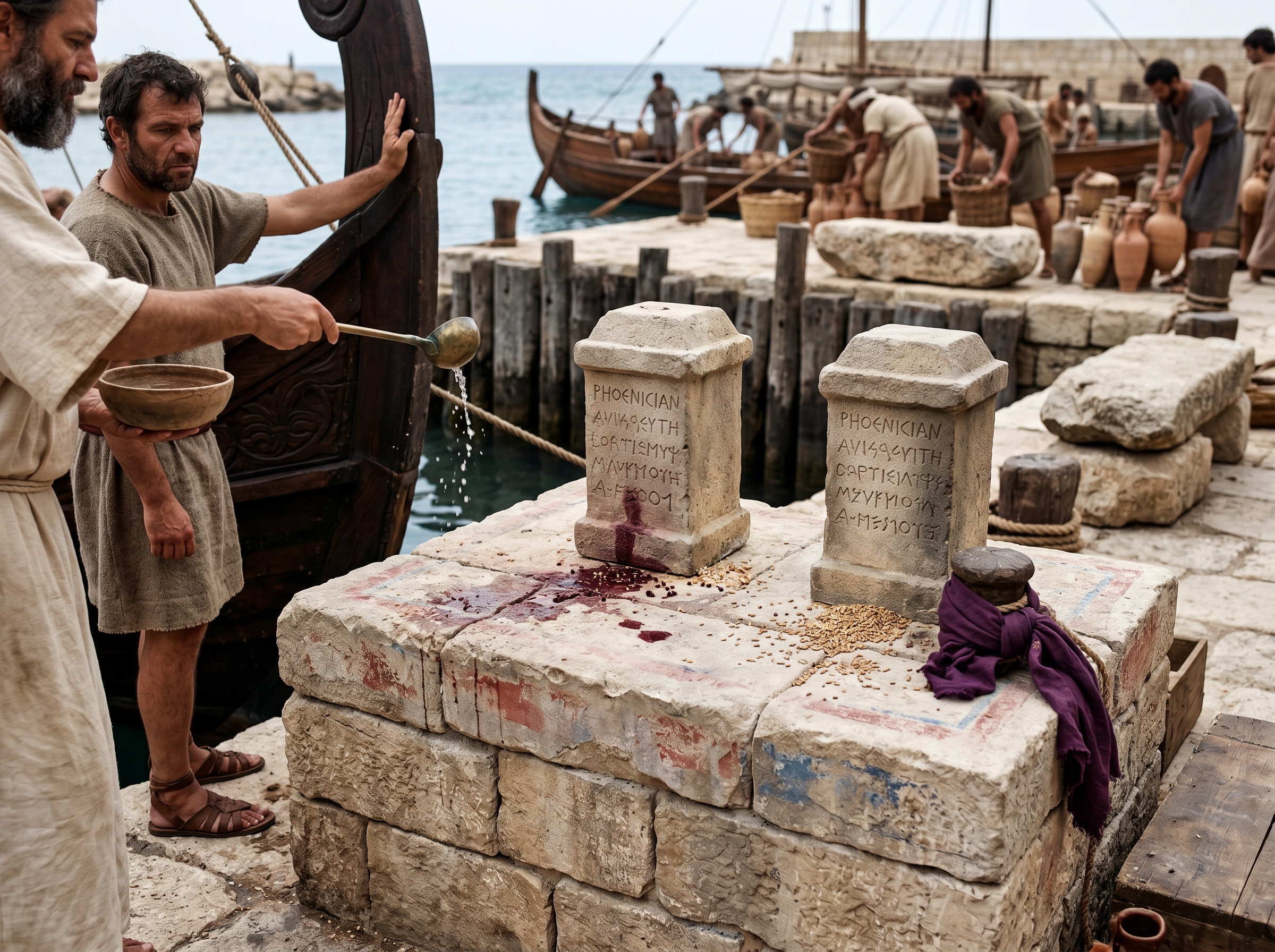
Shrine, stelae, and the votive deposits
Small stones did the heavy work of making departures binding. A raised dressed-stone slab or modest shrine acted like a courtroom bench at the water’s edge: it concentrated gestures into a sequence that made an act both sacred and legally meaningful.
The stelae nearby were short civic markers, not triumphal monuments. Chisel marks and traces of painted plaster survived on the shrine’s face. Script blocks recorded names and sometimes a brief formula of dedication; they were weathered, salt-stained, but readable where a good eye paused. People left literal tokens: a cup of wine poured into the surf, a scattering of grain, a strip of purple cloth tied to a mooring bollard. A colonist might press a hand to the prow while a priest’s fingers brushed water across the wood.
Those tactile gestures solved a practical problem. In a world without passports, a carved slab and a priest’s spoken list helped outsiders recognize who carried Tyrian privileges ashore and who did not.
Stelae were short and civic: their inscriptions typically named donors or the departing group rather than glorifying rulers.
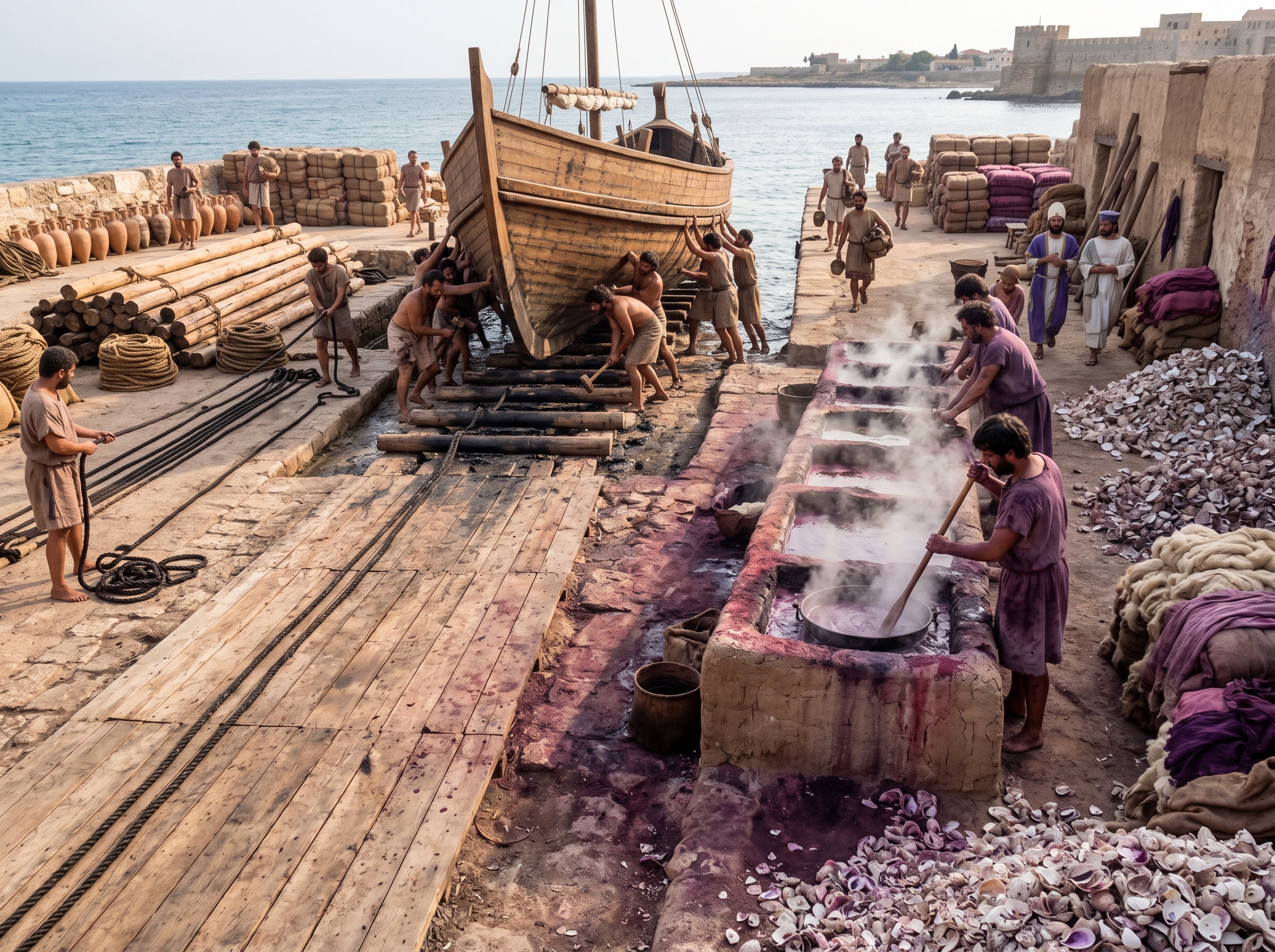
Shipwrights, slipways, and the dye-workers’ vats
The quay functioned like a workshop front window: shipbuilding, rope-making, and dyeing all unfolded within arm’s reach of the gangway. That proximity made maritime departure dependent on intense, messy crafts rather than distant coastal suppliers.
On a slipway, workers used adzes and levers to ease a transport hull into the water. Tarred ropes lay in coils from a nearby ropewalk; bundled masts waited on trestles. A few steps away long shallow vats boiled with murex and steam, staining stone and hands purple. The heaps of crushed shells formed white middens that announced the dye industry from the shore. Producing a single high-status purple cloak could consume around ten thousand shells, so the vats were not decorative— they were continuous, foul-smelling work sites that fed the cargo lists of Tyrian ships.
Sailors loaded bales of finished textiles and amphorae into the hold while craftsmen repaired caulking. The result was a narrow ribbon of labor where commercial supply and ritual departure met and sometimes collided.
Murex processing was intensive: roughly 10,000 shells were needed to dye the cloth for one high-status purple cloak.
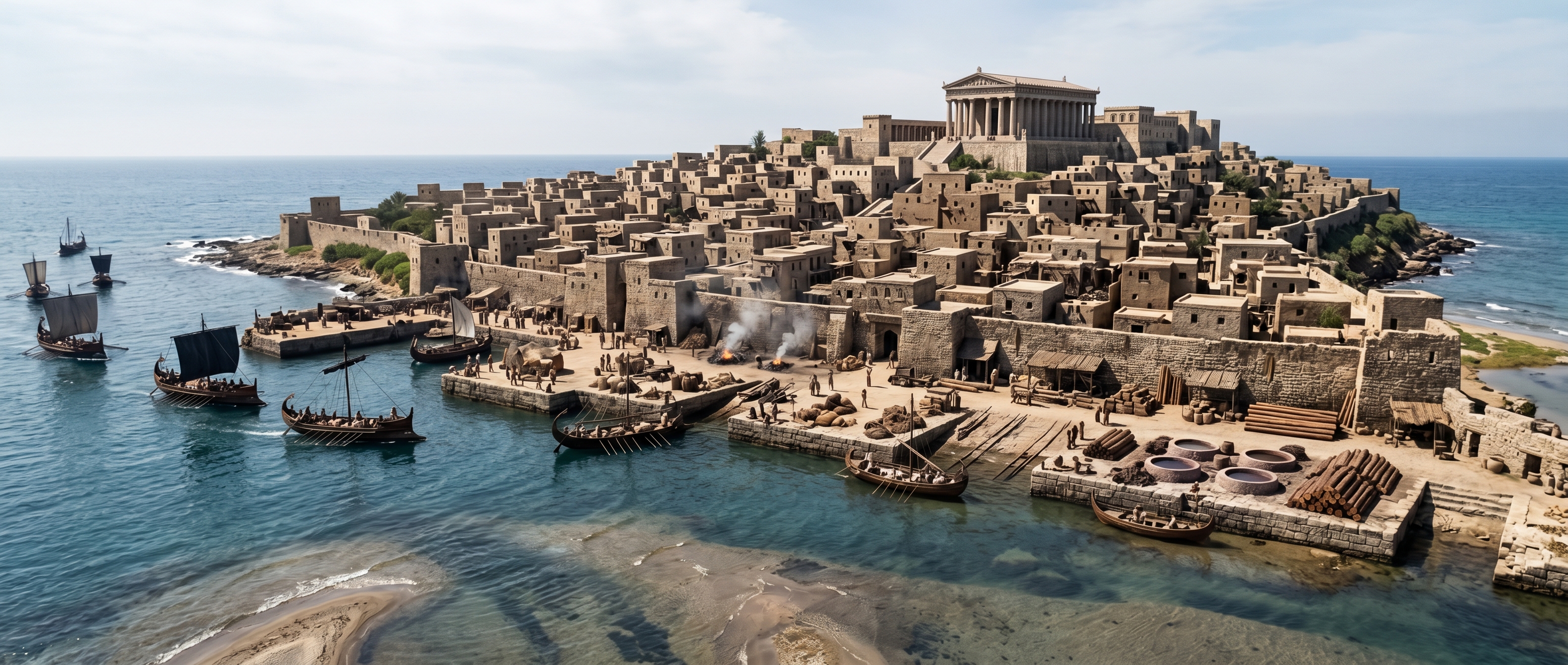
Approach from the sea — island silhouette, quays, and the temple crown
The island read quickly from the water: a continuous quay, interruptions for slipways, and a temple massing at the crest. That silhouette communicated a simple proposition—authority controlled the shore and everything that left from it.
From low sea level the palace and the temple of Melqart dominated the skyline. At the waterline ropewalks, timber yards, and rows of vats clustered close together; small convoys of merchant vessels moored in shallow basins or rode at wooden piers. Sandbars and shifting shoals fringed the approach, a reminder that the harbor relied on sheltered inlets rather than deep docks. Centuries later an engineered causeway would join island to mainland and alter those currents, but in this period the visual dominance of the temple over the quay made clear who authorized risk at sea.
Seeing Tyre arrive meant reading power: the compact layout broadcast that goods, ships, and oaths came from a place where palace, priesthood, and production met on the shoreline.
City context
The quay sat at the island’s seafront where the urban spine rose toward Melqart’s temple. Ordinary traders used the same stretch of stone for loading local exports—textiles, glass, and purple-dyed goods—so a day of routine commerce and a day of departure felt physically contiguous. Ropeworkers, shipwrights on their slipways, and warehouse hands all pressed into the same narrow margin of space between town and sea.
Ceremonial departures punctuated the city’s rhythms. Seasonal winds set timetables; when conditions aligned the quay emptied into controlled ritual. Priests read names, kings or magistrates ratified privileges, and families left gifts at markers before the gangway was pushed back. That combination of ordinary loading and extraordinary ritual meant the quay was both an engine of Tyre’s trade and the place where the city extended legal and sacred protection to people who no longer lived under its roofs.
When distant powers choked Tyre’s access to the sea, blocking this narrow strip of civic performance, the result was not only economic strain but also the collapse of a mechanism that exported Tyrian authority. Losing the quay’s functioning altered balance between island core and outward reach; the city could still make goods, but it could no longer consecrate departures that turned goods and people into an imperial network.
Sources
project
- City essay: Tyre (1000–100 BCE) — project synthesis on Tyre’s urban form, harbors, and the role of Melqart and the crown in departure rites.
primary
- Ezekiel 26–27 — poetic and civic descriptions of Tyre that note its maritime orientation and distant contacts.
- Classical tradition on Phoenician colonization, including accounts of Carthage’s founding (e.g., Justin’s epitome of Pompeius Trogus).