At a glance
The purple-dye quarter was where Tyre turned sea snails into its single most valuable export — a tight cluster of shore-facing vats, workshops, and shell-heaps that linked skilled labor, royal privilege, and long-distance trade. Read as a question: who controlled color, work, and coastal space — the temple, the crown, or market forces? The physical traces — rows of stone vats and white shell-mounds visible from the water — show how a tiny biological resource translated into power and profit.
What happens when a city’s name is its product? The purple-dye quarter forced that practical question onto Tyre’s shoreline. Imagine a narrow strip of coast lined with low, stone-lined vats each a few metres long, wooden racks for drying cloth, and work tables stained deep with red and brown. Stacks of baskets waited at the waterline while small boats lifted loads of murex snails into the workshops. Beyond them, whitened hills of crushed shells rose like small dunes — the quarter’s most visible landmark from approaching ships.
The process was tactile and foul in equal measure: hands plunged into brine and heated vats; workers boiled crushed glands and skimmed off a viscous secretion that darkened to purple as it oxidized; cloth was laid on racks to absorb the dye and then rinsed in seawater. Each cloak could require on the order of ten thousand shells; producing a batch of elite cloth demanded hours of boiling and scraping, a line of apprentices and specialists, and a steady intake of raw snails from boats that crossed the harbor at dawn.
Compare this to other Mediterranean dyeing centres such as Corinth or Rhodes, where color workshops clustered inland or near riverine streams. In Tyre those workshops hugged the quays. The temple and royal compound rose immediately uphill; their terraces looked down on the vats. That geometry meant purple production was not a hidden craft but a public act of extraction and transformation — a visible economy the city advertised to every arriving captain.
The quarter raises two urgent questions about how Tyre functioned: who owned and regulated a resource so essential to status across the Mediterranean, and how did this concentrated industry reshape the shore? The shell-middens altered the coastline and the visual reef of whitened shell made the quarter a kind of industrial frontage that both announced Tyre’s brand and tied everyday labor to state and temple authority.
Closer looks
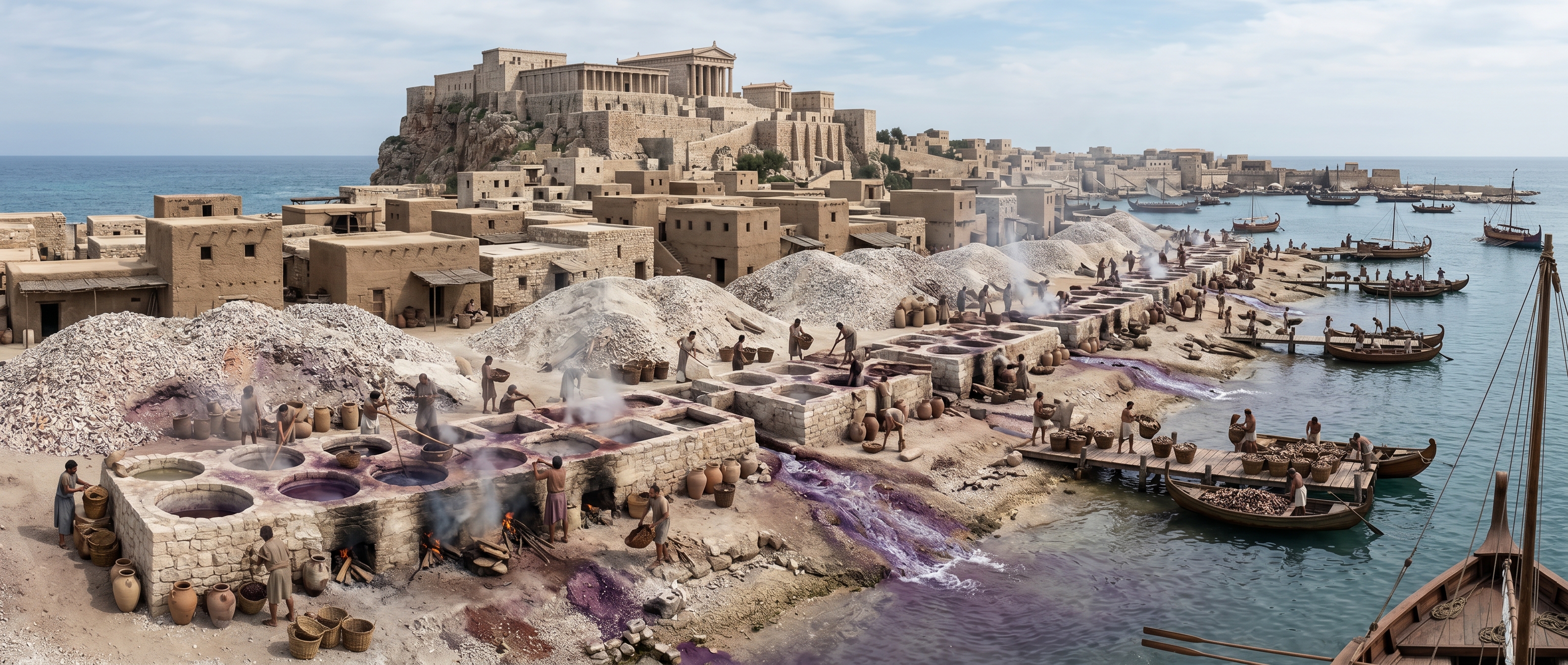
Approaching Tyre: the purple quarter as a coastal frontage
From the water the purple quarter read like a deliberately arranged frontage: a pale ribbon of stone vats and white shell-hills framing the quay, with the palace and the Temple of Melqart rising directly behind. The strip made production legible to every arriving captain — 20–40 low, stone-lined basins laid end-to-end, dune-like middens three to five metres high, and barges pulling up at temporary landings.
Boiling smoke and the metallic tang of salt hung over the shore; workers moved baskets of live murex, while runnels of stained rinsing water flowed back to the sea. Those whitened middens did more than advertise capacity. As shells piled up they altered nearshore currents and created shoals, forcing captains to approach at particular angles and tying navigation to the city’s industry. Above all, the sightline up to the temple terraces made purple production a public fact, not a hidden workshop tucked away from the quay.
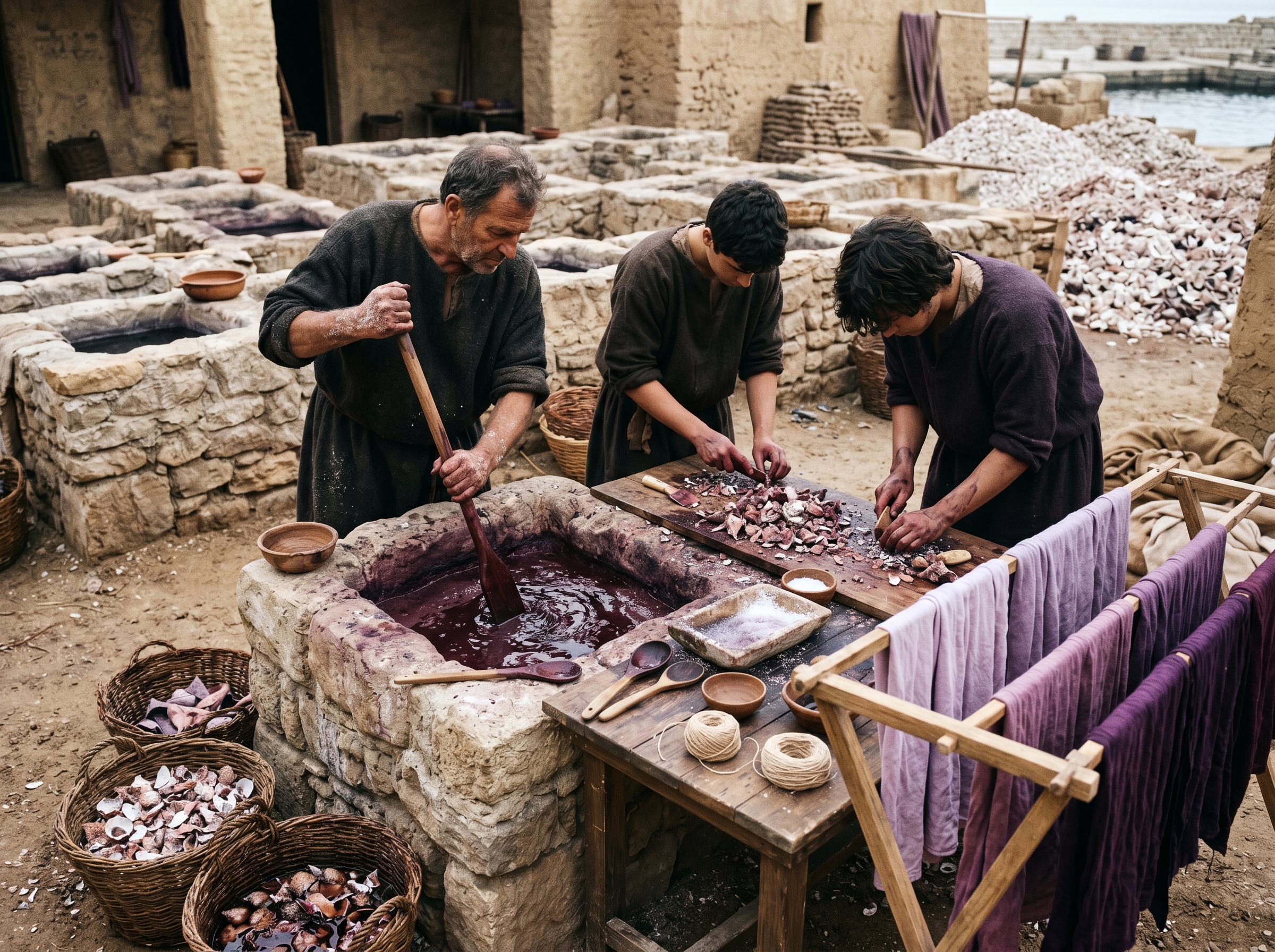
Hands in the vat: the murex-boiling and scraping process
At a single vat the work felt like deliberate, filthy chemistry: hands plunged into hot brine to free a tiny gland’s secretion, and hours of boiling, scraping and oxidation turned that secretion into a dye worth crossing seas for. A few metres of shallow, stone-lined basin would host a master managing the heat, an apprentice raking crushed shells, and another worker laying damp cloth across wooden frames to soak up the deepening color.
The labor was exacting and wasteful by design: on the order of 10,000–12,000 shells went into an elite cloak. Wooden paddles stirred viscous, dark liquids; scrapers removed gland tissue on a stained table; rinsing troughs salted the cloth before it dried. The odor was immediate — hot brine, a bitter tang of animal tissue, and the sour steam of repeated boils — and the work left hands raw and stones blackened where fires had burned for years.
Producing a single high-status garment consumed the shells gathered by whole morning crews and months' worth of careful boiling and scraping.
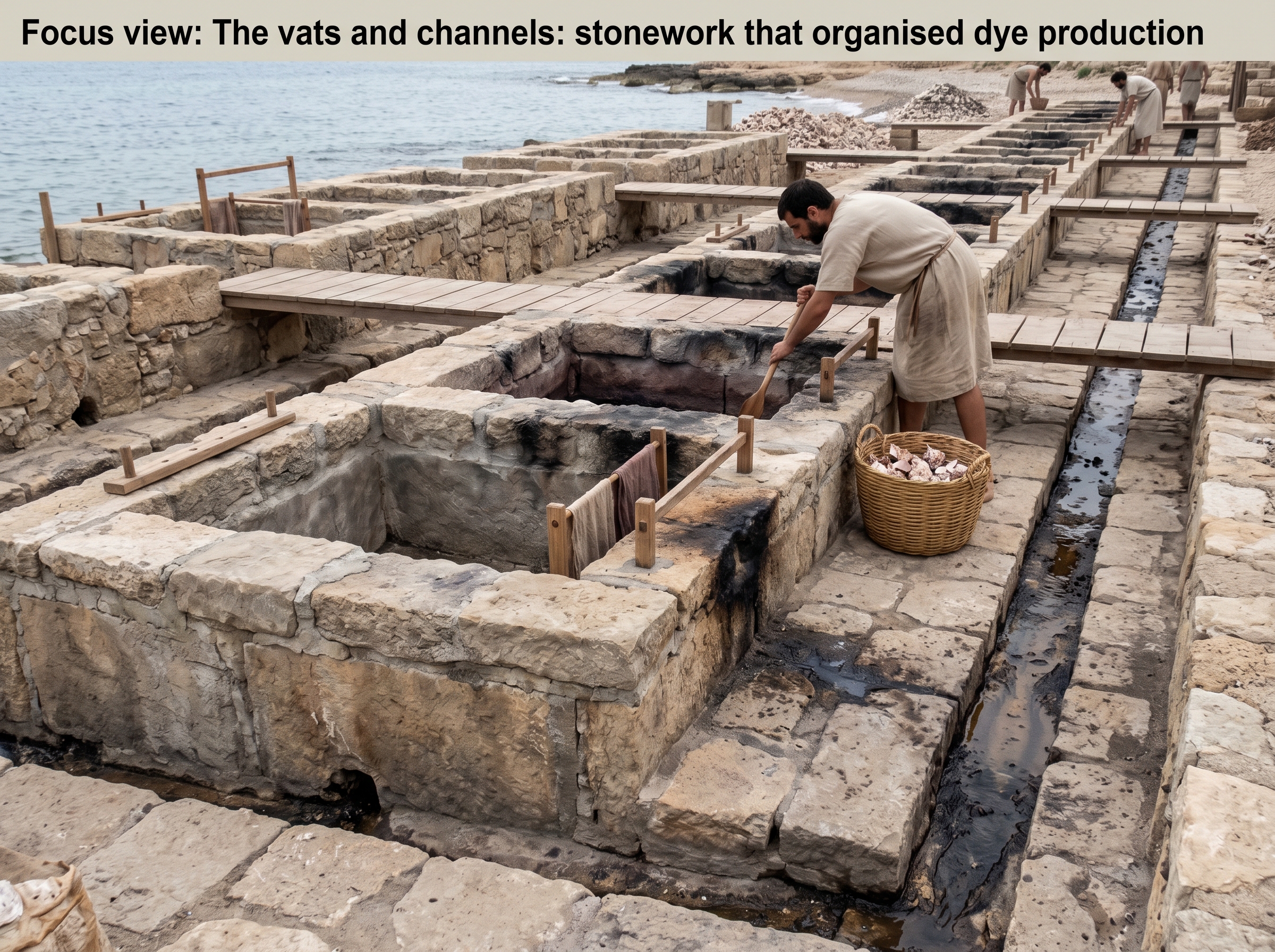
The vats and channels: stonework that organised dye production
The vats were an engineered sequence, not isolated pits: mortared stone slabs formed shallow rectangular basins, low thresholds and wooden planks bridged their tops, and narrow channels sloped seaward to carry off rinsing water and sediment. Wear patterns and patched joints showed repeated repair — a production line repaired and reused over decades.
Small details made the system legible. Pegs and simple frames held cloth racks in place; churn marks and mineral staining recorded years of concentrated dyeing; sediment built up in the drainage channels where salt and crushed shell settled. The arrangement also encouraged batch work and reuse of baths so that dye concentration increased through sequenced processing, which explained why some vats were black with use while others still held paler residues from recent rinses.
The combination of thresholds, channels and patched masonry revealed a long-lived, purpose-built system rather than temporary coastal activity.
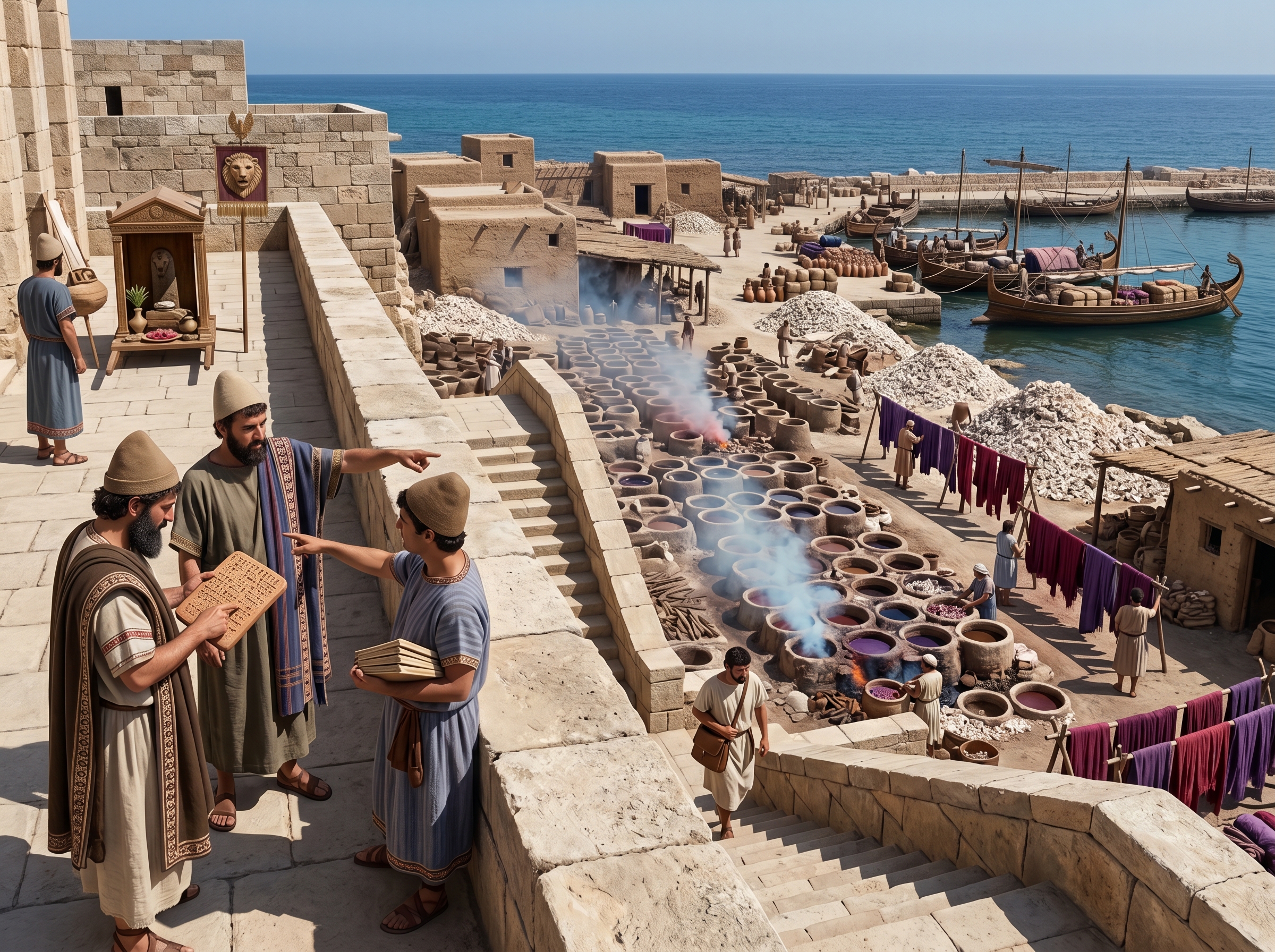
Overlook from the Temple of Melqart: surveillance and ritual oversight
From the terraces of the temple and palace the dye quarter read as policy as much as manufacture: officials kept ledgers, clerks carried seals, and a messenger with a stamped tag could be seen threading down toward the warehouses. That visual relationship made production part of civic order — the temple’s gaze regulated who shipped cloth and how consignments were certified for export.
On the terrace a small group of priests or administrators compared dispatch lists and affixed tokens to crates; below them the vats steamed and middens rose. Those sealed tags functioned like a mark of authenticity for long-distance trade, a short written record that merchants in distant ports could use as evidence of origin and privilege. The terrace’s neat stone steps and ordered tables contrasted with the messy strip of industry beneath, turning supervision into a visible link between craft and authority.
Clerks used sealed tags or tokens to link specific consignments to temple or royal authorization — an early form of product authentication for overseas markets.
City context
The purple quarter sat where the island’s quays met the shore. Merchant barges pulled up beside the workshops; warehouses and emporia clustered a short walk uphill; and the palace-temple terraces looked down across the vats. A visitor stepping off a ship would see not only trading warehouses but the active machinery of Tyre’s reputation: boats arriving with shell-laden baskets, crews hauling them to the vats, and piles of white shells forming a pale strip against the darker rock.
Ordinary citizens encountered the quarter as part workplace, part marketplace. Women and men spun and finished cloth nearby; town criers and brokers negotiated the sale of dyed textiles; priests or royal agents monitored export consignments and registered privileges. The quarter’s rhythms were tied to tides and to the sailing season: mornings brought deliveries, afternoons saw long boils and scraping, and ships took finished goods away on the next favorable wind. When the sea lane closed, that rhythm stopped — not only trade but the daily labour that kept thousands fed.
Sources
ancient text
- Pliny the Elder, Natural History (sections on Tyrian purple and dyeing)
- Accounts of Alexander’s siege in classical histories (for the later change in coastal geometry that affected shoreline industries)
book
- Glenn Markoe, The Phoenicians (a concise survey of Phoenician economy and craft specializations)
- Sabatino Moscati, The Phoenicians (discussion of Tyre’s commerce and purple production)