At a glance
What made Tyre a power at sea was not a single harbor but a tightly packed maritime quarter where slipways, quays, timber yards, vats, and ropewalks funneled craft and labor into ships authorized by kings and priests. Reading those basins changes Tyre from a passive island fortress into an active workshop of long-distance reach — equal parts dockyard, customs office, and sacred port.
What did it take for an island to become a hub that reached across the Mediterranean? The answer lived in the narrow ring of working waterfronts that circled Tyre’s island: low quays for unloading amphorae and finished cloth, shallow sheltered basins where hulls sat half-submerged on wooden slipways, racks of sawn planks and long ropewalks unfurled along the shore, and lines of long vats where murex dye was boiled. From the water the city read as a purpose-built node; from the quay it felt like a machine whose parts were all visible at once.
Physically, the place was compact and noisy. Shipwrights hammered bent frames on sloping slipways; their mallets sounded against oak and cedar. Timber stores smelled of resin and sawdust; pitch and tar were heated near the sterns of vessels being caulked. Dye-workers ladled purple from steaming vats while middens of whitened shells rose in small hills behind the workshops. Anchors clanked as small merchant hulls maneuvered into basins that sheltered larger transports. Everything was arranged so wood, rope, labor, and finished goods met the ships in a single, efficient line.
Tyre resembled other Mediterranean maritime centers in its commercial mechanics — building hulls, assembling cargoes, stowing stores for long voyages — but the harbor was different in how closely it tied to civic power. The narrow spine from main quay up to the palace and the temple of Melqart put ritual authority literally over the docks: crews made vows, contracts were sealed, and privileges were issued in a space where the sacred and the commercial overlapped. That fusion made the harbor both an engine of projection and a lever political leaders could pull when negotiating with empires or founding colonies.
Three questions this place forces you to ask are simple: how did Tyre move so much across the sea from such a small island; how did craft organization and ritual authority shape who profited; and how vulnerable was that geography when a land power could change currents and access? The harbor’s physical details — slipways oriented into sheltered basins, concentrated timber and rope infrastructure, vats and shell-middens visible from the water — are the evidence. Read them together and the harbor stops being just where ships tied up; it becomes the operating system of the city.
Closer looks
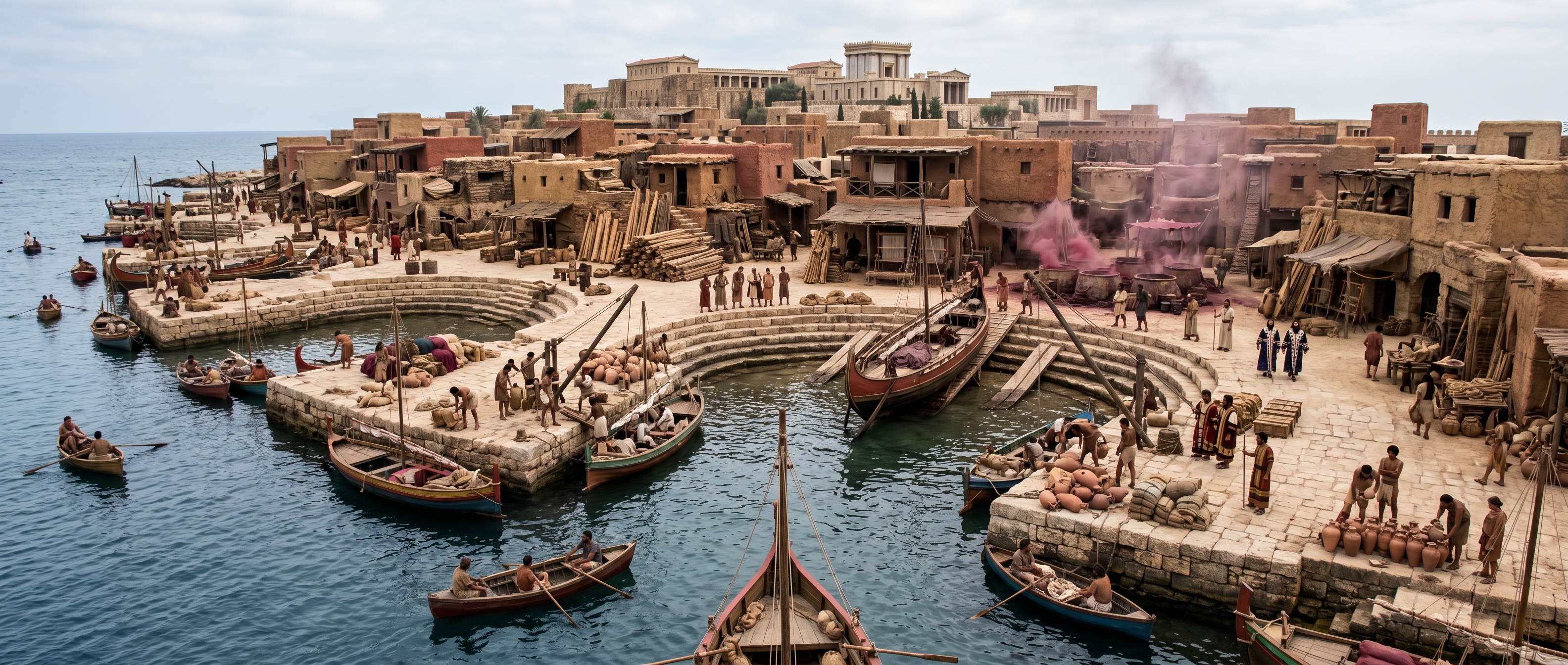
Approach from the water: the island’s working ring
From the water Tyre read as a single, purposeful belt of activity rather than a distant fortress. Low stone quays ran like a continuous finger around the island, broken only by curved basins where hulls sat half out of the water on slipways and small boats threaded in between larger transports. Behind those quays came the workshops: stacks of sawn planks, the long lines of ropewalks, and rows of steaming vats with white shell-middens rising behind them.
Because the palace and the temple rose directly above that ring, visitors could see who controlled departures before a ship even tied up. Sailors waited beneath temple steps to swear oaths; scribes counted amphorae on the quay while priests walked past. Tidal windows and narrow berths made turnaround fast — cargoes had to be loaded at the right hour — so the island’s rim functioned like a timed machine, every element placed to meet the sea.
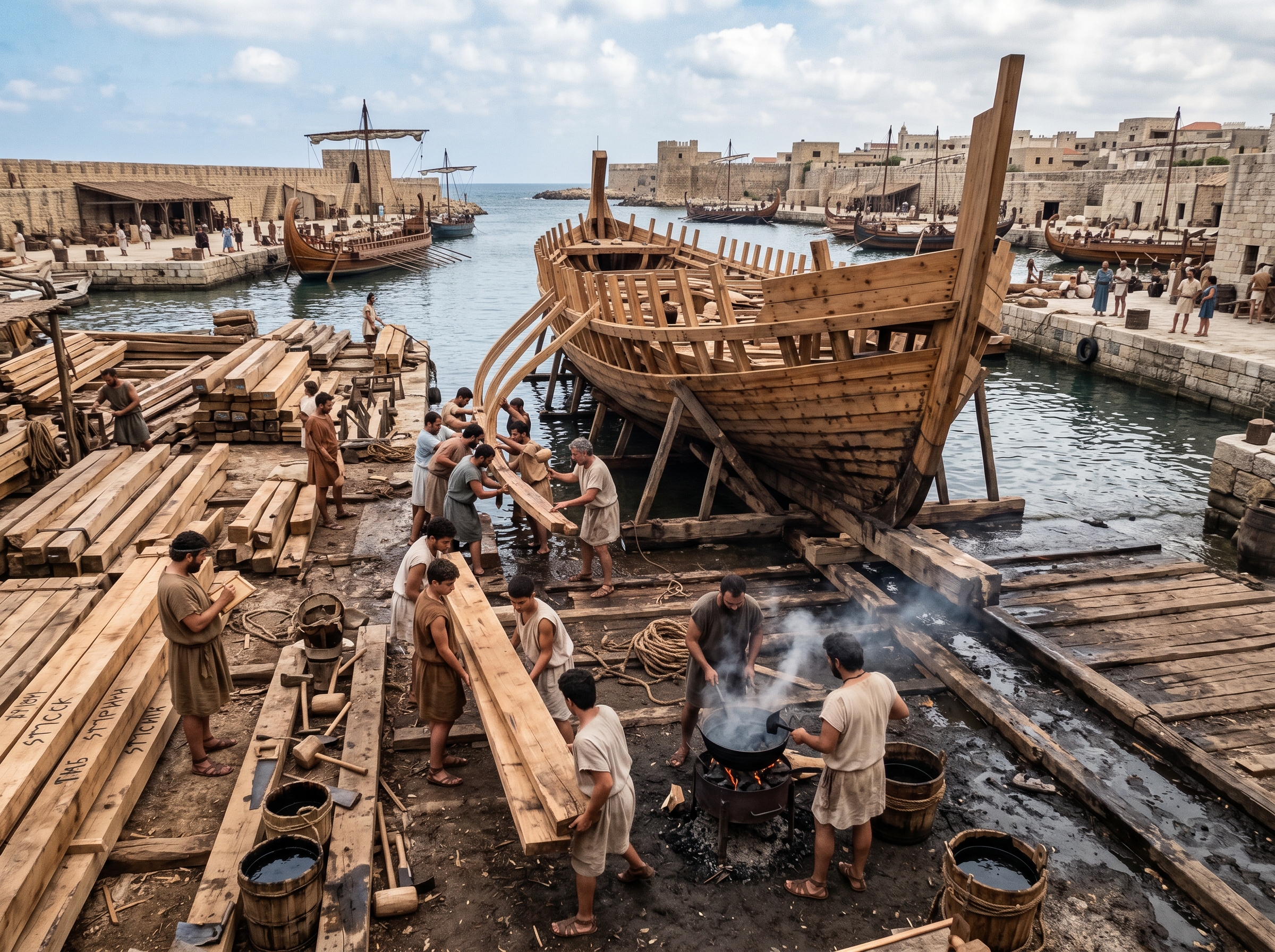
Shipwrights on the slipways
Ship construction at Tyre happened in teams and in public view: carpenters bent ribs on wooden cradles, apprentices passed planks, and others heated pitch for caulking while a supervisor ticked progress on a dock-side ledger. Keel and frames lay exposed on a sloping slipway so the hull could be launched into shallow water when the tide turned; it never sat as a finished, floating object until late in the process.
Work required coordinated timing — bending frames needed steam or heat, planking demanded precise joinery, and caulking waited for calm tides. Typical shipwright gangs numbered in the dozens because tasks ran in parallel: shaping, fastening, sealing, and rigging. Proximity to timber stacks and ropewalks cut days or weeks from outfitting, so repair and construction fed directly into the harbor’s rhythm rather than happening at some distant yard.
Shipbuilding was a synchronized, tidal choreography: big teams and nearby supplies kept vessels moving from frame to sea quickly.
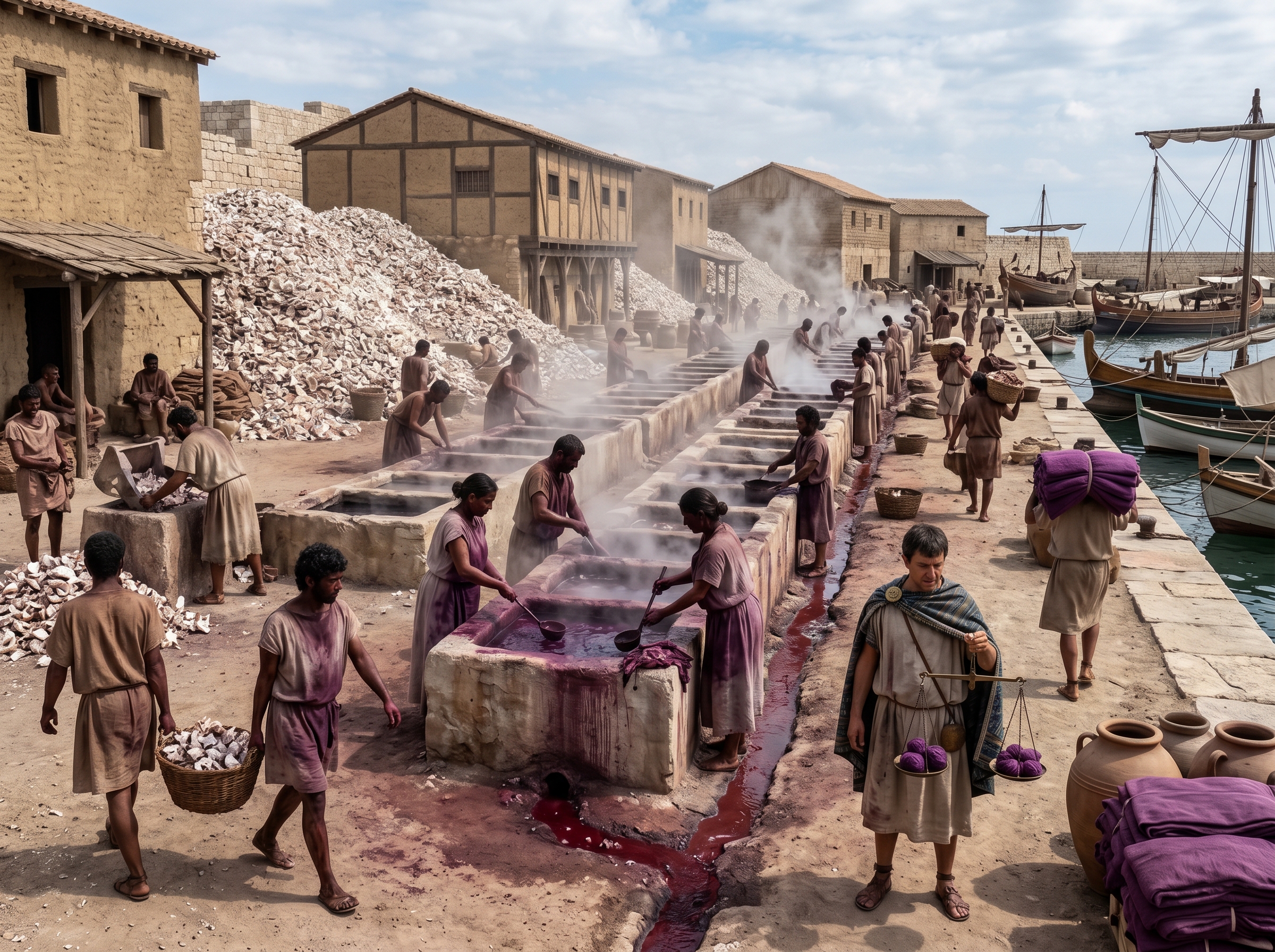
Dye-works: vats, steam, and middens
Dye production was loud, smelly, and exacting. Long shallow vats boiled murex flesh into concentrated purple while workers ladled the brew and stirred cloth; hands and hems stained a deep, stubborn hue. Behind the vats rose neat white middens of crushed shells — the visible residue of an industry that consumed tens of thousands of mollusks to dye a single cloak.
The vats sat cheek-by-jowl with the quay so finished cloth could move straight into warehouses and onto ships. Runoff channels carried tinted water toward the docks and left streaks on stone; supervisors weighed batches and recorded output so privileges and export loads could be calculated. The smell and the piles of shells announced Tyre’s specialty to any approaching captain long before negotiation began.
The shell-middens were a visible ledger: they recorded how much purple production had happened and signaled the city’s export asset to arriving merchants.
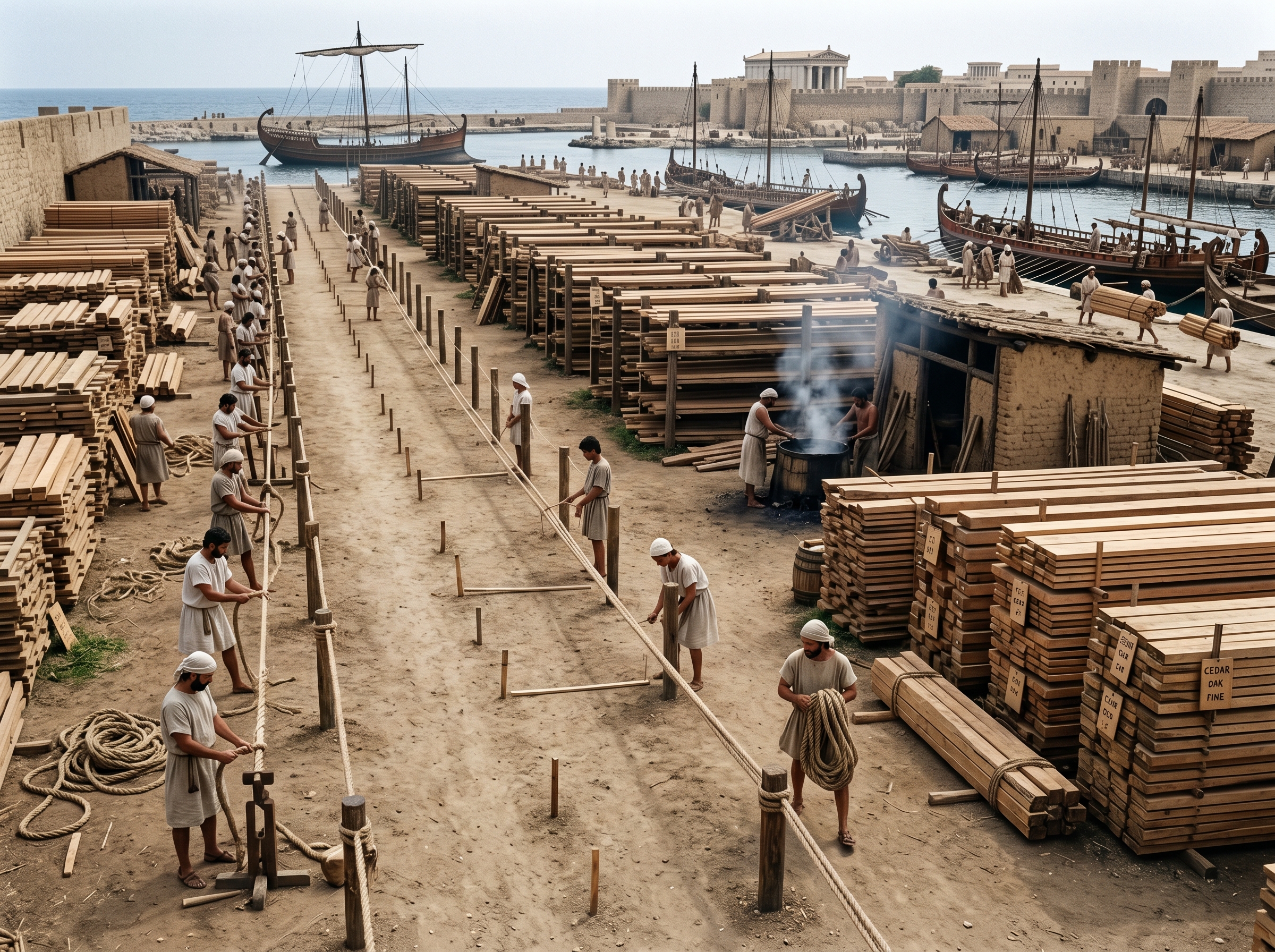
Ropewalks and timber stacks: linear infrastructure
The ropewalk was literal: a long cleared strip where apprentices stretched fiber, secured it with stakes, and twisted it into continuous lengths used for rigging. A single long line produced ropes without knots or joins, which mattered for masts and running rigging; the walk’s length determined the maximum unbroken line a ship could carry.
Parallel to that strip, timber yards kept planks organized by species and purpose, each stack marked with simple signs or cuts indicating size and origin. Workers bundled timber and dragged coils of rope straight toward a moored hull. The spatial logic was efficient: linear production lines met the quay so outfitting a vessel required little internal transport and could proceed up to the last tide.
Ropewalk length constrained rigging design: longer walks produced single-piece lines that reduced failure risks at sea.
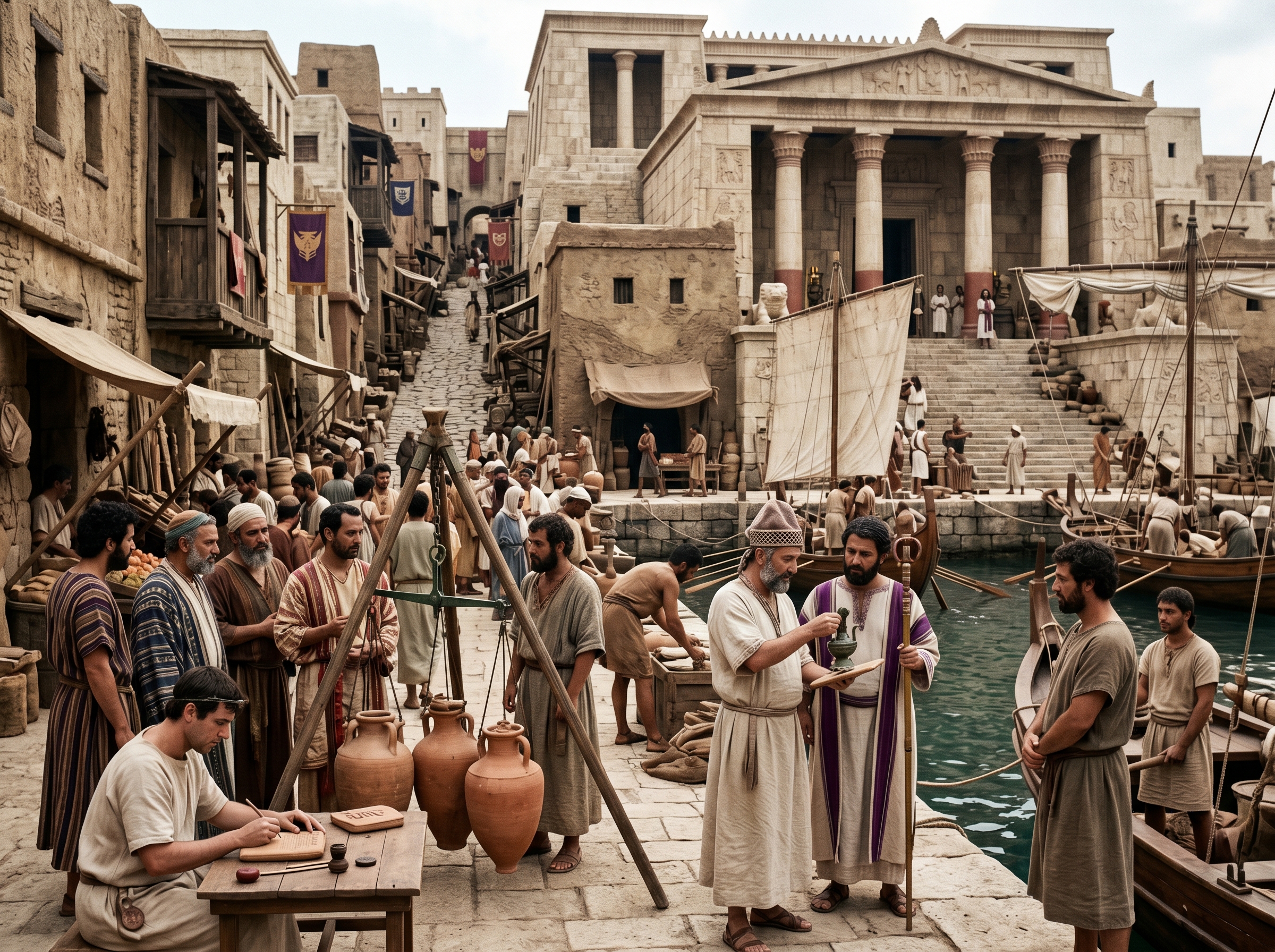
Quay beneath the temple: law, ritual, and loading
The quay functioned as an open court where commerce, ritual, and royal power collided. Merchants balanced amphorae on weigh-staffs while scribes copied quantities onto wax tablets. A priest or an official might step down from the temple steps to inspect a manifest, take a seal impression, or ask a captain to repeat a vow before departure.
Seals, tablets, and brief ritual acts were not theatrical; they enforced contracts. A sealed tablet could be read back at the palace or the temple if a dispute arose, and oaths sworn before a cult object carried legal weight. That proximity — temple over the quay, officials on the stones — made the harbor a governed space where economic advantage required permission as much as skill.
Contracts were enacted on the quay: seals and sworn oaths turned commercial transactions into enforceable civic facts.
City context
The harbor basins and shipyards sat at the interface between Tyre’s island heart and the wider world. Ordinary workers spent their days here: boatmen hauling lines at dawn, carpenters shaping keel timbers during the highest tides, women tending vats where crushed murex steamed into a pungent purple. Merchants paced the quays with weigh-staffs and tablets; dock managers assigned berths and tallied cargo; priests and royal envoys moved along the same docks to inspect convoys and confirm privileges.
Daily life followed the sea’s rhythm. Loading and unloading concentrated around tidal windows; ropewalks ran as long straight lines of twisting fiber where apprentices measured out yards of line. Departure was also a ritual moment: before a long voyage captains and crews sought blessing at the temple of Melqart, swearing oaths in front of witnesses who could enforce debts or privileges back on shore. When the sea lane was cut — whether by enemy blockade or political constraint — the harbor quieted not only as an economic loss but as a civic one: the city’s ability to feed itself, to project power, and to sustain its specialized crafts all unraveled together.
Sources
interpretive
- City essay on Tyre (interpretive summary of urban form, economy, and ritual authority)
archival
- Landmark record: Harbor basins, quays, and shipyards (planning notes and significance)