At a glance
Between 379 and 335 BCE Thebes turned temples and tight, disciplined infantry into instruments of state power: a city that made public ritual and a new style of hoplite warfare into its claim on Greece. Its skyline was the Cadmea and temple roofs; its politics moved through the agora and the Boeotian synedrion, while fields beyond hosted the battles that decided its fate.
For a few explosive decades in the fourth century BCE Thebes did something unusual: it braided sacred display, federative politics, and a new kind of heavy infantry into a single civic project. The city did not separate its religion from its ambitions. Processions and votive stands on the Ismenion hill, ritual dedications on the Cadmea, and an agora arranged to receive visiting delegates all worked as public proof that Thebes belonged at the center of central Greek affairs. That public face was physical as well as rhetorical—stone podiums, painted temple pediments, and the red-brown sweep of terracotta roofs made the claim visible on approach.
The Cadmea sat on a low, broad plateau above the town and organized sightlines across the plain. From any main street the citadel’s stone mass rose above one- and two-storey houses whose upper walls were often lime-washed and whose roofs carried fired tiles. Most domestic façades used mudbrick on stone footings; important public buildings and gateworks were cut in local limestone. A procession heading from the lower town to Apollo Ismenios climbed a clear axis: market stalls and stoas gave way to a paved approach, then to tripod bases and the temple podium on the Ismenion hill. Those axes were the city’s political arteries—where victory dedications, federal decrees, and festival crowds met the visible signs of power.
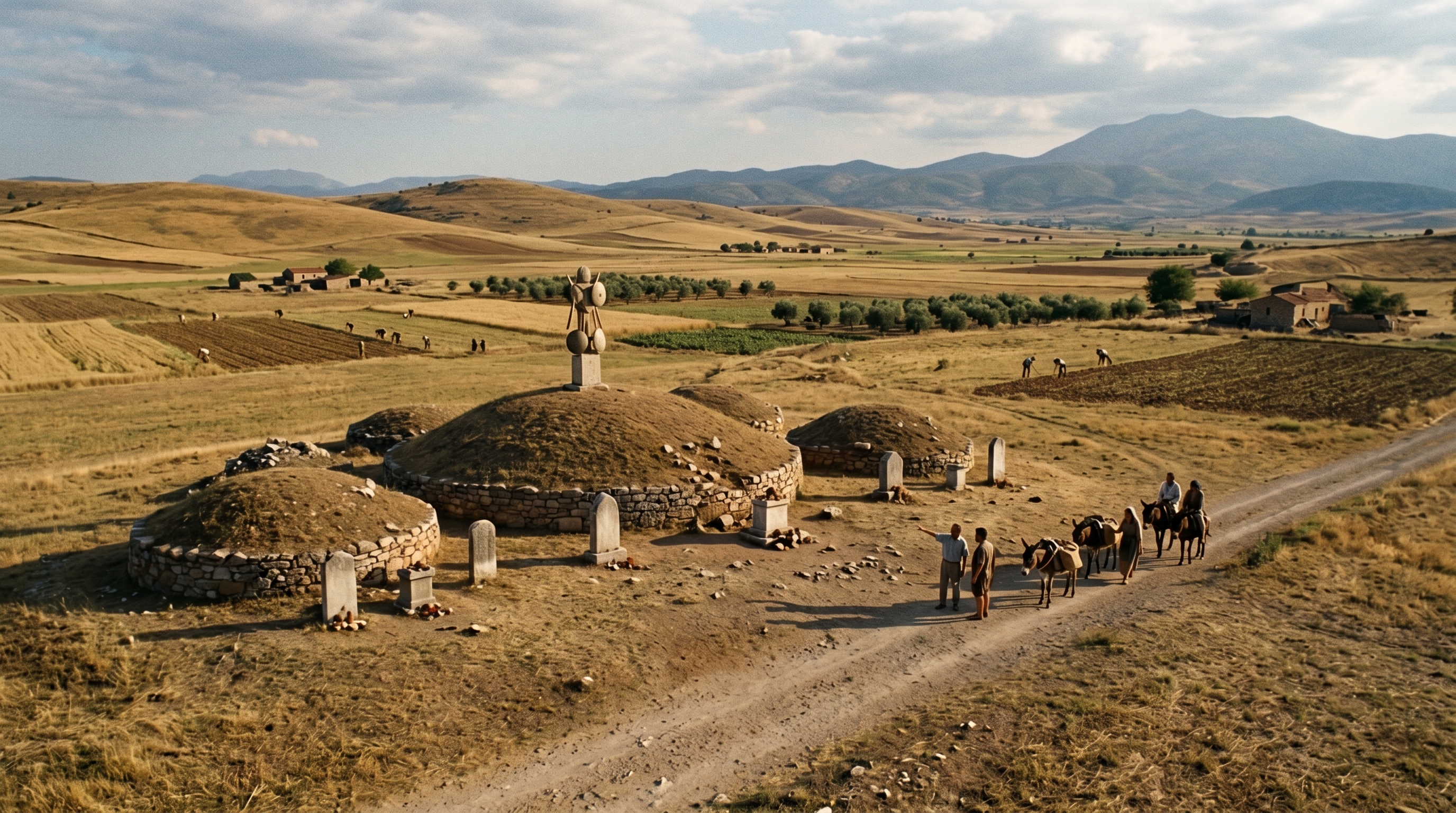
Military life threaded through ordinary streets and the plain beyond. The Sacred Band—a tight cohort of paired warriors—was not only an army unit but a civic emblem. Training grounds and muster routes ran from the lower town toward the Cadmea gates; when Theban tactics changed on the plain at Leuctra, the effect was felt back in temple courts and on civic rostums. The battlefield itself became an extension of the city’s stage: after Leuctra and later after Chaeronea tumuli and stone markers turned fields into places of memory, visible from the road as proof of Theban daring and sacrifice.
>Politics in Thebes relied on federative architecture as much as on banners. The Boeotian synedrion met in a formal locus near the agora where benches, inscriptional bases, and stoas provided the setting for voting and bargaining. This made Thebes different from Athens’ tribute empire: power here moved through assemblies and negotiated parity among neighboring poleis rather than through a distant fleet. Against Sparta the contrast was even sharper—Sparta organized citizenship by lifelong military discipline; Thebes concentrated military prestige within a civic grammar of cult and council.
The final truth about Thebes in this period was fragility beside grandeur. Tactical brilliance produced dramatic gains; those gains exposed the city to larger, better-resourced rivals. The annihilation of the Sacred Band at Chaeronea and the later punitive razing converted Theban monuments and streets into a lesson in political risk. Walking the city imagined for this project you feel not only a skyline and material palette—stone, red tiles, white plaster—but a sequence of choices: to build authority through arms and rites, to bind federated allies under public procedures, and to place visible memorials where enemies could find them. Those choices make Thebes worth exploring: each street, sanctuary, and battlefield is a problem the city tried to solve and, in the end, a story about how built form and politics trade leverage in the struggle for power.
Key moments
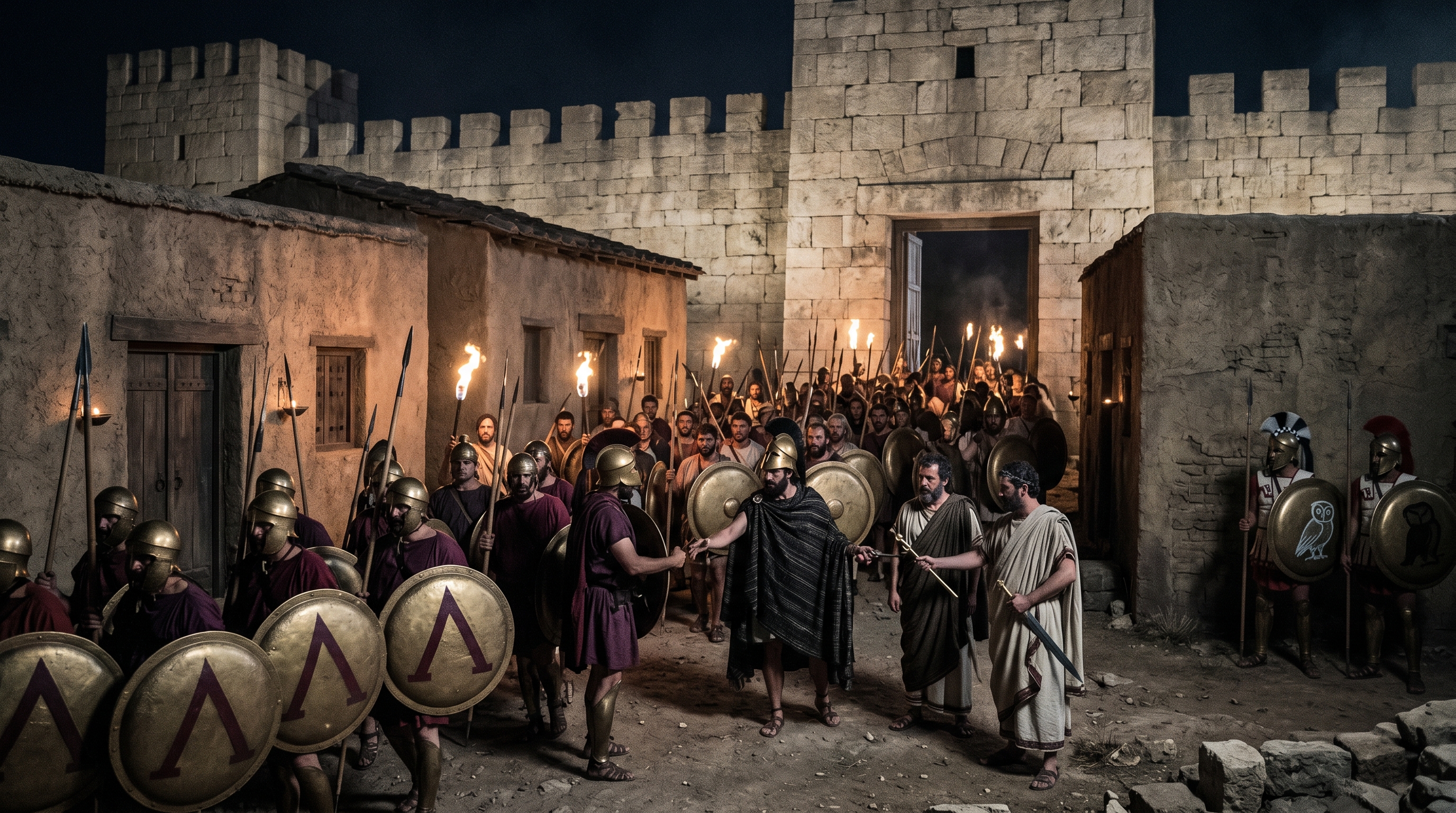
The Cadmea liberation and the Theban opening (c. 379 BCE)
A night-time uprising ejected a Spartan garrison from the Cadmea and put Pelopidas and his allies back in control of the citadel; possession of that stone stronghold converted a handful of conspirators into the city’s governing force and made Thebes able to reorganize its politics and army.
The moment illuminated how Thebes treated built form as political muscle. Taking the Cadmea was not merely a military action; it was a public transfer of visible authority. By the end of that night the citadel’s gate, previously a symbol of foreign dominance, read again as the place where Theban magistrates met, offerings were dedicated, and federated delegates would look for leadership.
The operation moved through the city’s tight geometry. Conspirators crept along narrow lanes between mudbrick houses with lime-washed upper walls, slipping into the civic quarter to silence pro-Spartan figures in their homes and to seize a small armory in the lower town. Torches and lamps cut shapes across limestone facades; the metallic click of short blades and the hoarse whispers of the insurgents were followed, once the deed began to show, by the clatter of spears and shields as armed citizens streamed out from doorways. At the Cadmea approaches a compact crowd gathered—men who had been called from workshops and stoas—while the Spartan harmost negotiated withdrawal rather than risk street fighting that would turn the citadel into a ruin.
What happened that night explained how Thebes later worked. Control of the citadel reunited ritual and politics: triumphal return-processions could pass from the agora up to the Ismenion and then onto the Cadmea podium, turning military success into cult display. It also gave reformers the physical means to re-equip hoplites and to host the Boeotian synedrion near the agora’s benches and inscription bases, so that federal bargaining had a fixed setting. Those same decisions—making power visible in monuments and fielding a concentrated heavy infantry—would bring Thebes rapid influence and, in time, expose it to larger conflicts whose consequences the city later felt in the ruined streets and memorial tumuli beyond the plains.
- Setting: Cadmea gate and adjacent lower-town lanes; narrow streets, magistrates’ houses, a small armory targeted inside the lower town
- Participants: Pelopidas and a small group of exiled conspirators, armed citizen cohorts rallied from neighborhoods, the Spartan harmost and his garrison
- Time of day: Night (winter narrative in sources); torch and lamp-light crucial for movement and identification
- Movement and staging: Stealthy infiltrations into key houses, seizure of an armory, sudden massing of armed citizens at the Cadmea approaches, negotiated evacuation of the garrison
- Objects in view: short swords and knives used in close work, torches and oil lamps, hoplite spears and shields reissued from caches, lime-washed façades and the stone gate of the citadel
- What made it distinctive: The act shifted control of a sacred-military focal point back to city hands, turning a night-time coup into a public claim that enabled both ritual leadership and military reorganization
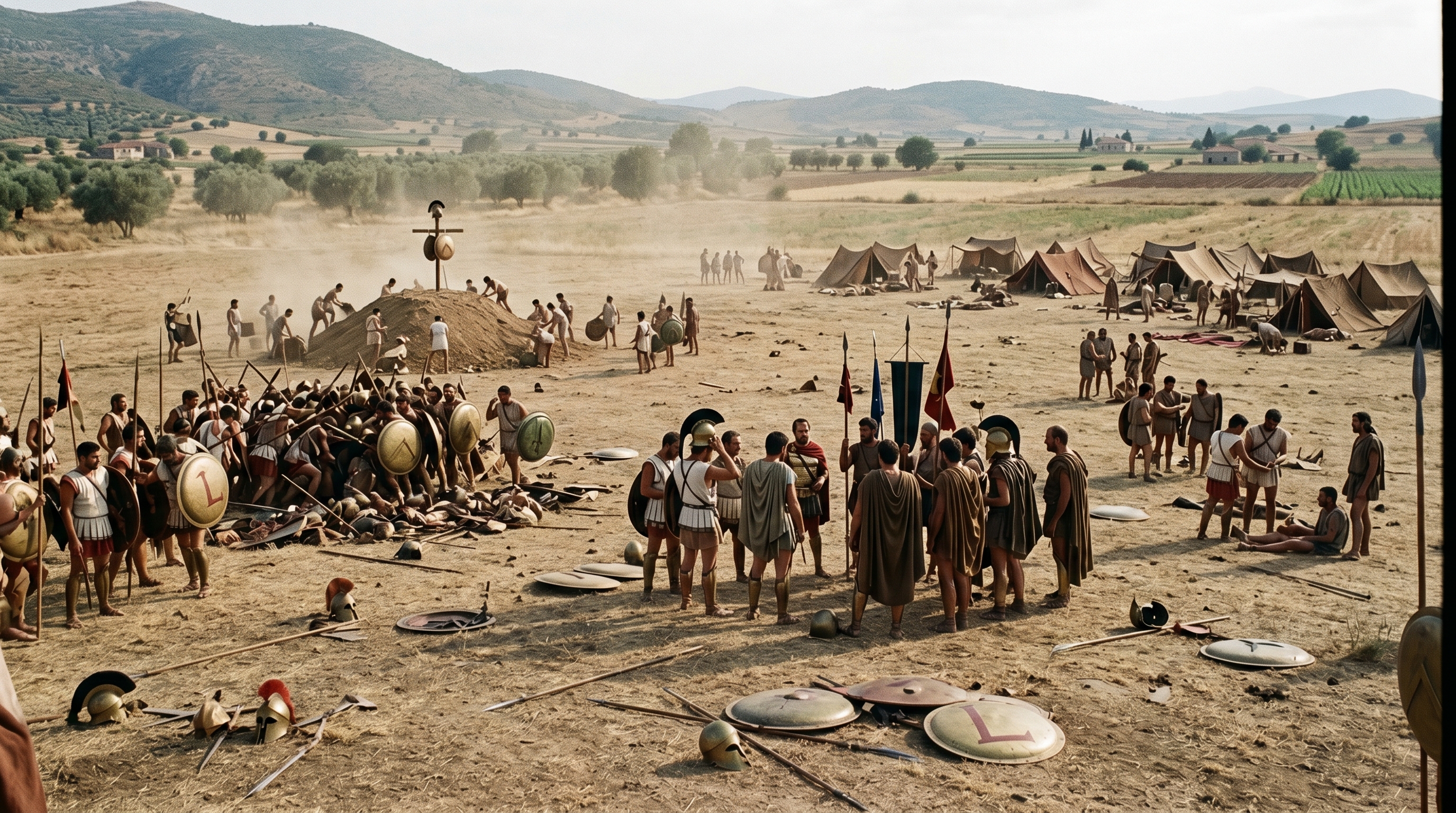
Battle of Leuctra (6 July 371 BCE)
At Leuctra Epaminondas smashed Sparta’s main wing by driving a unusually deep Theban column into the Spartan right, an audacious tactical gamble that converted Theban military practice into immediate political advantage.
The clash at Leuctra revealed how Thebes did politics with arms. The city’s investment in a dense, well-drilled core of hoplites—the Sacred Band and other heavy contingents—was not just military staffing; it was a public resource Theban leaders could deploy to reshape who counted in central Greece.
On a sunlit plain near Leuctra the Theban left advanced in an unusually deep, oblique column, ranks piled shoulder to shoulder toward the Spartan right. Trumpet blasts punctured the heat; shields rang with bronze; dust rose in a brown sheet that hid the front ranks as they closed. The Spartans stood in a longer, shallower front, expecting a more even meeting. Instead Epaminondas put his weight on a narrow point, the Sacred Band and companion phalanxes hitting like a concentrated wedge while light troops and cavalry skirmished on the flanks.
The rout produced immediate, visible consequences. Spartans fell back in disorder; bodies and banners littered the field. In the weeks and years after, Thebes marked the ground with tumuli and tropaia that travelers and allied delegates could see from the road and from the Cadmea’s outlooks. Those monuments turned a battlefield into a piece of civic argument: Theban military innovation translated into bargaining leverage in the Boeotian council and into the city’s public identity.
- Setting: Gentle rises on the Boeotian plain near Leuctra; open ground chosen to favour a concentrated assault.
- Participants: Theban army under Epaminondas (including the paired warriors of the Sacred Band), Spartan king’s division and allied contingents, light troops and cavalry in supporting roles.
- Time of day: Daytime in summer (traditional date given as 6 July 371 BCE); sun and dust affected visibility and heat.
- Movement: An oblique, very deep Theban left advanced as a focused shock column against a shallower Spartan line, producing a localized breakthrough and general collapse.
- Objects in view: Bronze helmets and aspis shields clashing, trumpets and standards, later commemorative tumuli and tropaia visible from the road.
- What made the scene distinctive: Deliberate concentration of manpower on one flank—an organizational choice that turned a civic military resource into immediate geopolitical leverage.
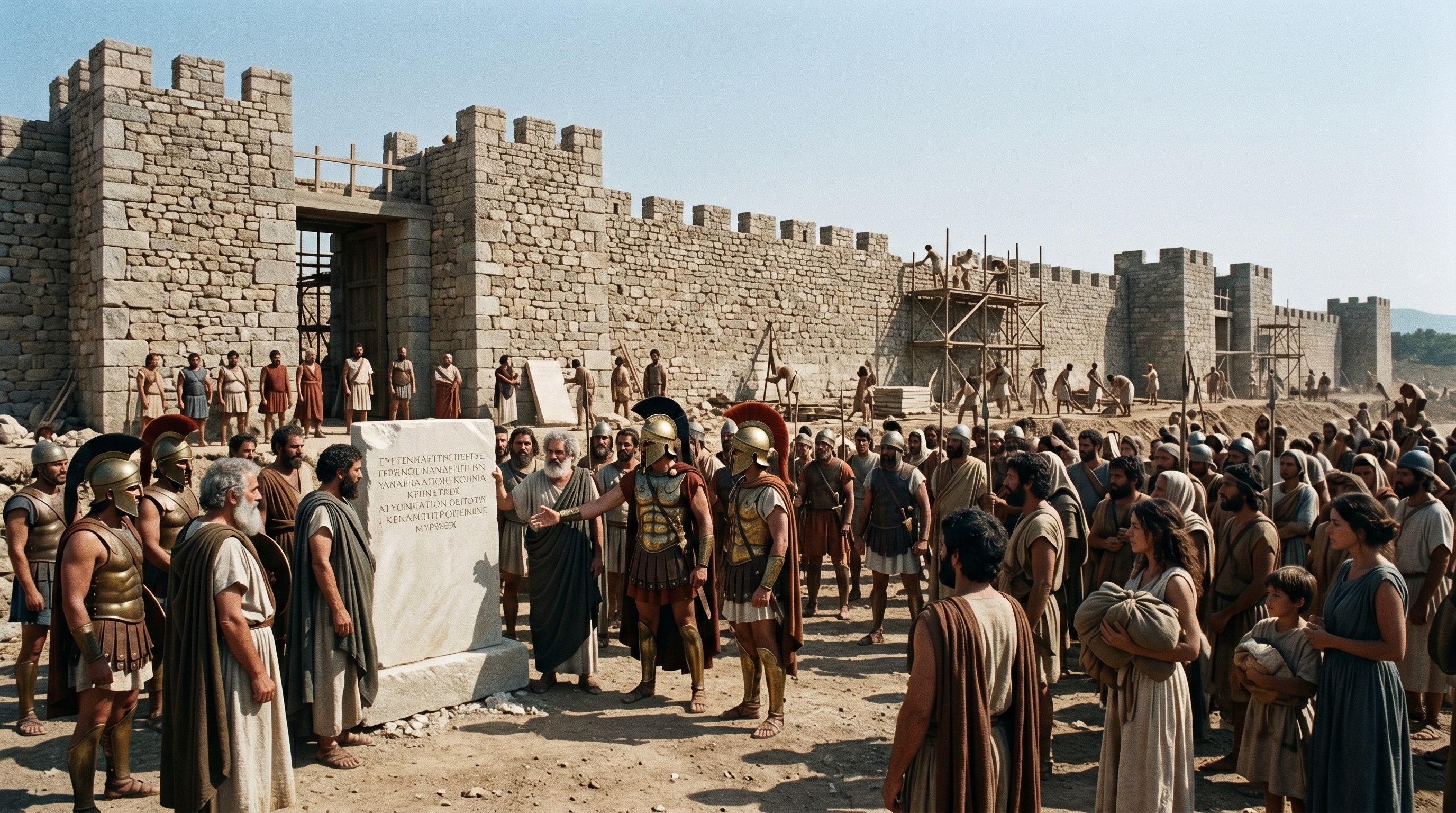
Theban campaigns in the Peloponnese and the refounding of Messene (c. 369–362 BCE)
Theban armies did more than fight in the Peloponnese; they laid out a polity. By helping refound Messene and erecting its walls, Thebes exported a compact mix of military support, civic architecture, and ritual legitimacy to break Spartan land control.
This scene revealed how Thebes treated city-building as a tool of policy: not merely a prize of war but an instrument to reorder neighbours. On a hill above the Peloponnese plain men hammered and dressed stone while elders and young families worked out who would occupy which quarter. The new walls and a grid of streets were meant to hold people and to fix a new political reality in place.
Construction was noisy and elemental. Carpenters sawed scaffolding timbers, masons struck off lime mortar and fitted squared blocks into coursed faces, and engineers measured alignments with a sounding rod. Theban officers moved among the crews with inspection notes; allied troops guarded supply lines. When the formal foundation arrived, priests led a small sacrifice at a provisional altar, names of oath-taking citizens were read aloud, and dedicatory bases with short inscriptions were set into the earth or offered to local sanctuaries.
Back in Thebes, copies or mentions of those dedications were displayed in civic sanctuaries and council spaces so that foreign policy became part of the city’s visible story. The refoundation of Messene fit into a larger Theban pattern: winning on the plain and then turning those victories into institutions—walls, councils, and cults—that could rewire regional loyalties. That work was effective but risky; building a fortified polis within Sparta’s sphere was a public provocation, one whose consequences were still visible in Theban shrines and decrees long after the masons left the site.
- Setting: Newly enclosed hilltop site at Messene with fresh foundation trenches, wooden scaffolds, and an emerging stone circuit wall (c. 369–362 BCE).
- Participants: Theban commanders and engineers, Messenian resettlers and elder oath-takers, allied hoplites on guard duty, local priests conducting sacrifices.
- Time of day: Daytime: labor and measurements in the morning; formal founding rites and oath ceremonies in the afternoon.
- Movement: Teams of masons and carpenters shifting along the wall line; processional approach from the provisional agora to the altar during the foundation rite.
- Objects in view: measuring rod and plumb line, lime-smeared trowels, bases for votive tripods, carved inscriptional slabs recording citizenship oaths and dedications.
- What made the scene distinctive: The fusion of military logistics, civic planning, and ritual acts: walls and cults worked together to cement a new political order beyond Thebes’ borders.
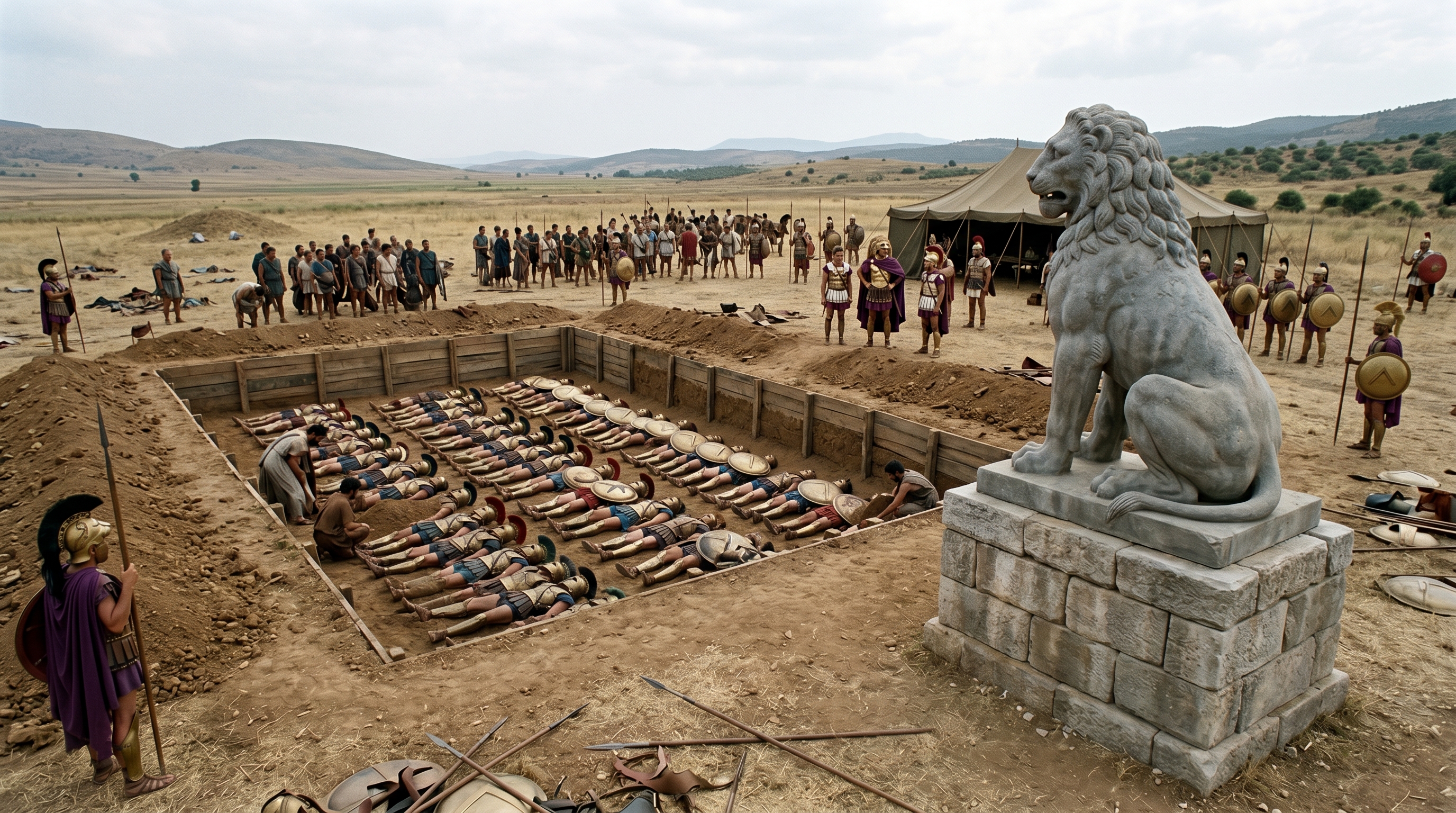
Battle of Chaeronea and the annihilation of the Sacred Band (338 BCE)
At Chaeronea in 338 BCE the Theban Sacred Band—three hundred paired hoplites that embodied the city’s military and civic pride—was routed and killed; their bodies were buried together and later marked by the Lion of Chaeronea. The loss shattered Theban military prestige and cleared the way for Macedonian dominance over the Greek poleis.
The battle revealed how Thebes had folded religion, public ceremony, and military spectacle into a single claim on power. The Sacred Band was not an anonymous regiment; it was a civic emblem you could point to in the agora or on the Ismenion hill. At Chaeronea that civic image was exposed as vulnerable: the unit that stood for Theban daring died in a single day and left a concentrated grave where the city’s politics and cult could no longer defend it.
On the low plain northwest of Thebes the fighting was close and physical. Hoplites slammed shields and thrust spears in a dust-stung roar; trumpets cut through the clang. The Sacred Band fought in tight paired files, each man pressed against his companion, wearing bronze helmets and cuirasses. Opposing them were Philip’s Macedonian troops—phalangites using longer reach and a widening tactical system that dragged the fight out of the kind of pitched, honor-bound engagement Thebans favoured. Contemporary accounts emphasised the short, bloody collapse of Theban ranks rather than a drawn-out maneuver campaign.
After the slaughter Thebans gathered the dead into ordered rows and buried them in a communal tomb on the plain. A stone lion was later set above the polyandrion so riders and visitors on the road could not miss the place where the city’s elite had fallen. That monument turned a military catastrophe into a visible argument about who Thebes had been and what it had risked: a city that made military prowess part of its public grammar, and that paid for that choice with a loss that reshaped its fate and how other Greeks remembered it.
- Setting: Chaeronea plain, northwest of Thebes; an open, gently sloping field later marked by tumuli and the Lion of Chaeronea.
- Participants: Theban Sacred Band (≈300 paired hoplites), Theban and allied contingents, Macedonian army under Philip II with Alexander present.
- Time of day: Daylight engagement; classical sources do not fix an exact hour but describe rapid, decisive fighting.
- Movement: Close-quarters clashing broke the Theban line; the Sacred Band was enveloped and cut down; bodies were later interred in rows in a common grave.
- Objects in view: Bronze helmets and cuirasses, hoplite shields and spears, Macedonian sarissas at the edges of the fight, and later the lion monument crowning the burial.
- What made the scene distinctive: An elite unit functioned as a civic symbol; its concentrated death and communal burial turned a battlefield into a public, roadside memorial that reframed Thebes’ political identity.
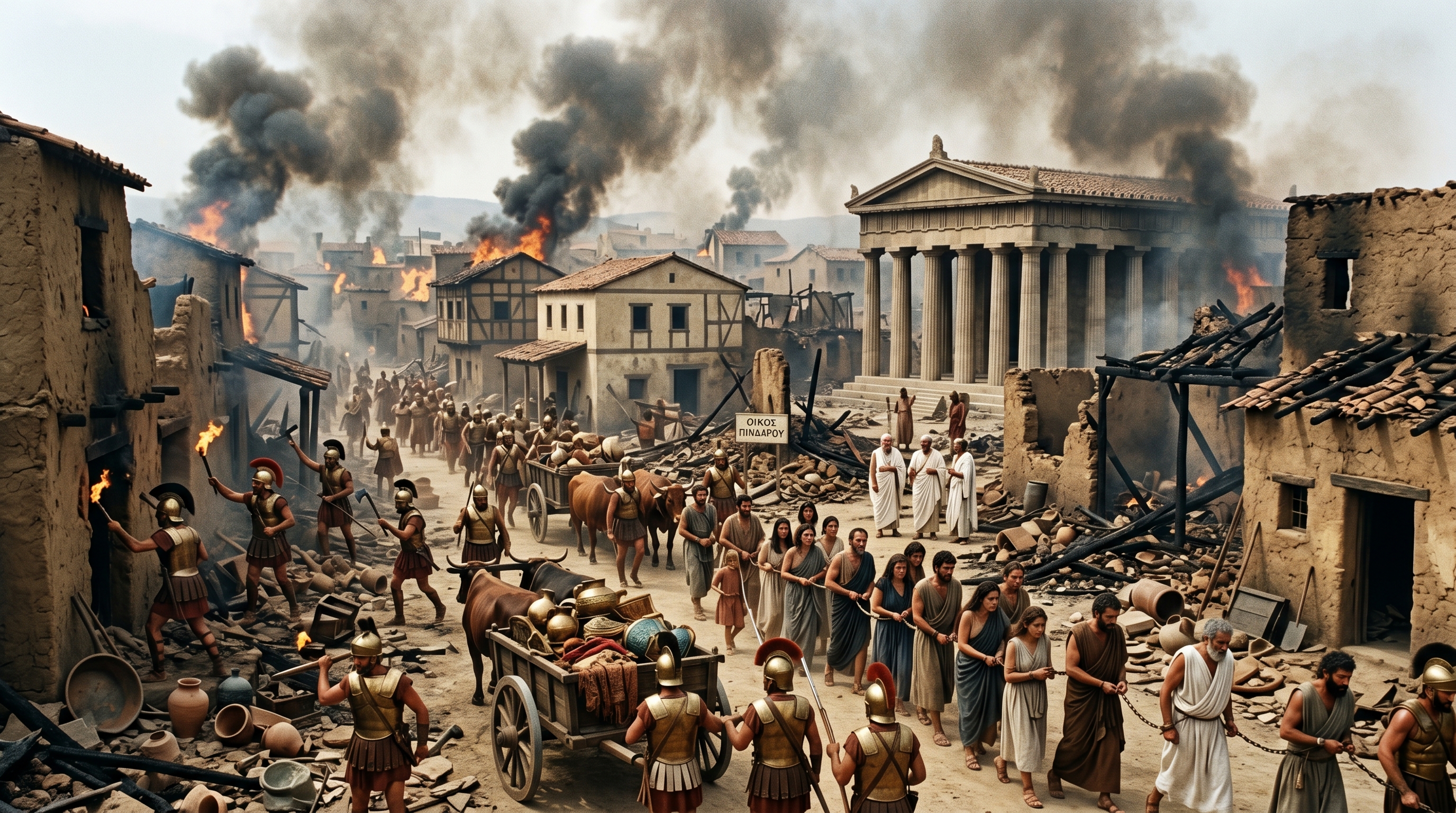
Alexander’s sack of Thebes (335 BCE)
Alexander turned a military punishment into a public performance: he burned large swathes of Thebes, enslaved survivors, and deliberately spared selected sanctuaries and notable houses to send a clear political message that Theban supremacy was over.
The scene revealed power as city-making in reverse. Soldiers did not only fight; they curated the aftermath. Rows of rooftiles smoldered while temple columns stood unscorched nearby, and that contrast was meant to be read by anyone coming up the road toward the Cadmea: some things would remain intact to prove control, while most civic life would be erased.
You would have heard shouted orders, the creak of laden carts, and the clank of iron on stone as chains and ropes were readied. Macedonian officers moved through narrow alleys with torches and axes; soldiers forced people into lines and dragged out portable votive goods. Priests ran between altars and Rome-like podiums—appeals for sanctuary met with selective mercy. Contemporary reports singled out a few spared addresses by name, Pindar’s house among them, and those choices turned private dwellings into public statements.
The action only made sense against Thebes’ prior practice of tying religion, assembly, and military prestige together. Temples and the agora had been visible proof of Thebes’ claim to lead the Boeotian league; Alexander’s work unstitched that claim physically. Afterward the city’s surviving stoas, inscriptions, and dedications no longer projected federation or independence in the same way. The burned streets and the intact sanctuaries together told a civic story about how architecture could be used to build authority—and how, in this case, deliberate destruction rewrote that story.
- Setting: Inner-city neighborhoods around the Cadmea and the sanctuaries on the Ismenion hill, where market approaches met temple podiums.
- Participants: Macedonian soldiers and officers executing orders; Theban inhabitants — priests, families, and captives — pressed into public view.
- Time of day: Described as a rapid, punitive operation that unfolded quickly; accounts emphasize spectacle and speed rather than a drawn-out siege.
- Movement: Systematic burning and looting of houses, lines of captives led toward carts, priests attempting to protect sanctuaries while officers directed which buildings to spare.
- Objects in view: Torches and axes, carts piled with plunder, chains and ropes on captives, charred roof tiles and intact temple columns or tripod bases left standing.
- What made the scene distinctive: Selective preservation: deliberate sparing of certain temples and named houses turned the destruction into a public political message rather than chaotic plunder.
Military innovation and martial identity
Thebes welded battlefield innovation to civic ritual: shock formations like the Sacred Band and Epaminondas’ oblique echelon were as much public performance as military technique, visible in temples, gates, and the voting benches of the Boeotian federation.
Theban military change showed up as architecture and choreography. Unit drills, veteran tombs, victory dedications and federative meetings all happened along the same sight-lines—from the Cadmea’s stone ramparts down main streets and up to Apollo Ismenios on the Ismenion hill—so that success in battle fed authority inside the city and across Boeotia.
That arrangement made military life a civic routine. Men trained and paraded in open grounds and on paved approaches. Councils read battlefield honors in the agora. Later, tumuli and the Lion of Chaeronea turned fields into moving public evidence of sacrifice and defeat; those visible claims shaped Thebes’ power and its risks.
At Thebes martial identity was not confined to barracks or the field. Training routes and muster-ways threaded the lower town toward the Cadmea gate. You would have seen tile roofs and whitewashed façades flank a paved approach where citizen-soldiers marched with shields and spears. The Cadmea itself occupied a broad stone plateau and acted like a theatrical backdrop: garrison drills on its ramparts, magistrates ascending its courts, and processions leaving from its gates made military display part of civic circulation. Materials mattered. Stone foundations and ashlar podiums framed public speech. Mudbrick houses kept the streets low so temple pediments and tiled roofs read clearly from a distance; that visual economy let trophies, tripod bases and painted pediments act as short-hand for Theban claims.
Inside the city the performance had a politics. Federative benches, stoa façades and inscriptional bases near the agora provided a fixed place where martial news became law and alliance. Delegates from allied poleis met in a formal locus where decree stones and honorary bases received the offerings brought from campaigns. Victors did not simply display spoils; they set them on pedestals and read them into policy. Military commanders returned expecting sanctuary space for dedications on the Ismenion hill or a public rostrum to recount victories. That routine—fight, dedicate, legislate—was how Thebes turned battlefield initiative into bargaining power without a distant imperial fleet.
There was a darker flip side. The same surfaces that broadcast victory also advertised vulnerability. After Leuctra the plain acquired tumuli and tropaia that travelers passed by for years. After Chaeronea the Lion and the polyandrion with roughly 254 skeletons became pilgrimage points; they also marked where the city had placed its claim too visibly. When Macedonian reprisal came the city’s mudbrick quarters burned and collapsed into charred heaps, while stone temples and a few houses were left intact as theatrical counterpoints. Thebes’ martial identity produced spectacular highs—tactical experiments that rewrote Greek warfare—and spectacular exposure: the city’s architecture, processions and memorials made both prestige and risk legible at a glance.
Federal politics and the Boeotian League
Thebes used a deliberate mix of ritual architecture and federative procedure to turn battlefield success into regional leverage: public temples, inscriptional podiums, and a formal assembly locus made the Boeotian League feel like something people could see, touch, and debate together. In practice, federal power here was made and remade in processions, council sessions, and the everyday movement of soldiers and delegates through the city’s built axes.
Theban federal politics looked less like imperial command and more like a repeated, visible performance. Councils met where the agora met the citadel; delegates sat on stone benches beside carved decree bases and watched votive tripods collected from distant places. Authority circulated through speech and display as much as through arms.
That combination shaped what you actually encountered in the city: broad, paved approaches for processions; stoas and inscriptional walls where decrees were posted and read; a formal locus for the Boeotian synedrion where benches, heralds, and scribes turned negotiation into public action. Military parades, festival sacrifices, and the arrival of dedications all fed the same civic script.
Federal politics in Thebes unfolded along visible lines. A delegation did not slip into a private office; it walked a route. Visitors approached down a paved axis framed by stoas and market stalls, passed inscriptional bases that advertised past decrees, and entered a formal meeting place where benches and a rostrum made voting legible to any onlooker. Stone surfaces absorbed the noise: the scrape of sandals on flagstones, the whisper of wax tablets being unrolled, the harried calls of heralds. The materials mattered. Stone podia and inscribed slabs gave permanence to decisions. Terracotta roofs and whitewashed façades made the city’s public face coherent from a distance, so allied envoys saw not only a civic argument but a built argument for Theban leadership.
The institutional choreography was repetitive and therefore convincing. Each festival season reset political rhythms: processions climbed to the Ismenion temple with tripod bases waiting in bedrock cuttings; votive offerings arrived from the Peloponnese after campaigns; magistrates read decrees in the open square; scribes copied decisions onto stone for public display. Delegates lodged close by. They heard the same announcements, saw the same dedication sequence, and weighed their votes against the visible record of Theban victories and dedications. Military rehearsal entered those same circuits. The Sacred Band trained on routes that led to the Cadmea gates and then, after a triumph or a funeral, the unit itself became a moving emblem in processions and a subject for commemorative stelai on the plain.
The central tension of Theban federal politics appeared in ordinary moments. The city converted military reputation into federative influence through ritualized display and procedural openness. That approach created fragile gains. A victory produced a new trophy base in a sanctuary and persuaded an ally; at the same time the visibility of triumph invited reprisal. You could see that risk in the city’s choices: tumuli and the lion on the plain advertised courage and loss; inscriptional walls preserved policies for all to read and quarrel about. The result was a politics that worked by being seen, heard, and continually re-enacted across the Cadmea, the agora, and the sanctuaries that anchored Thebes’ claims to regional leadership.
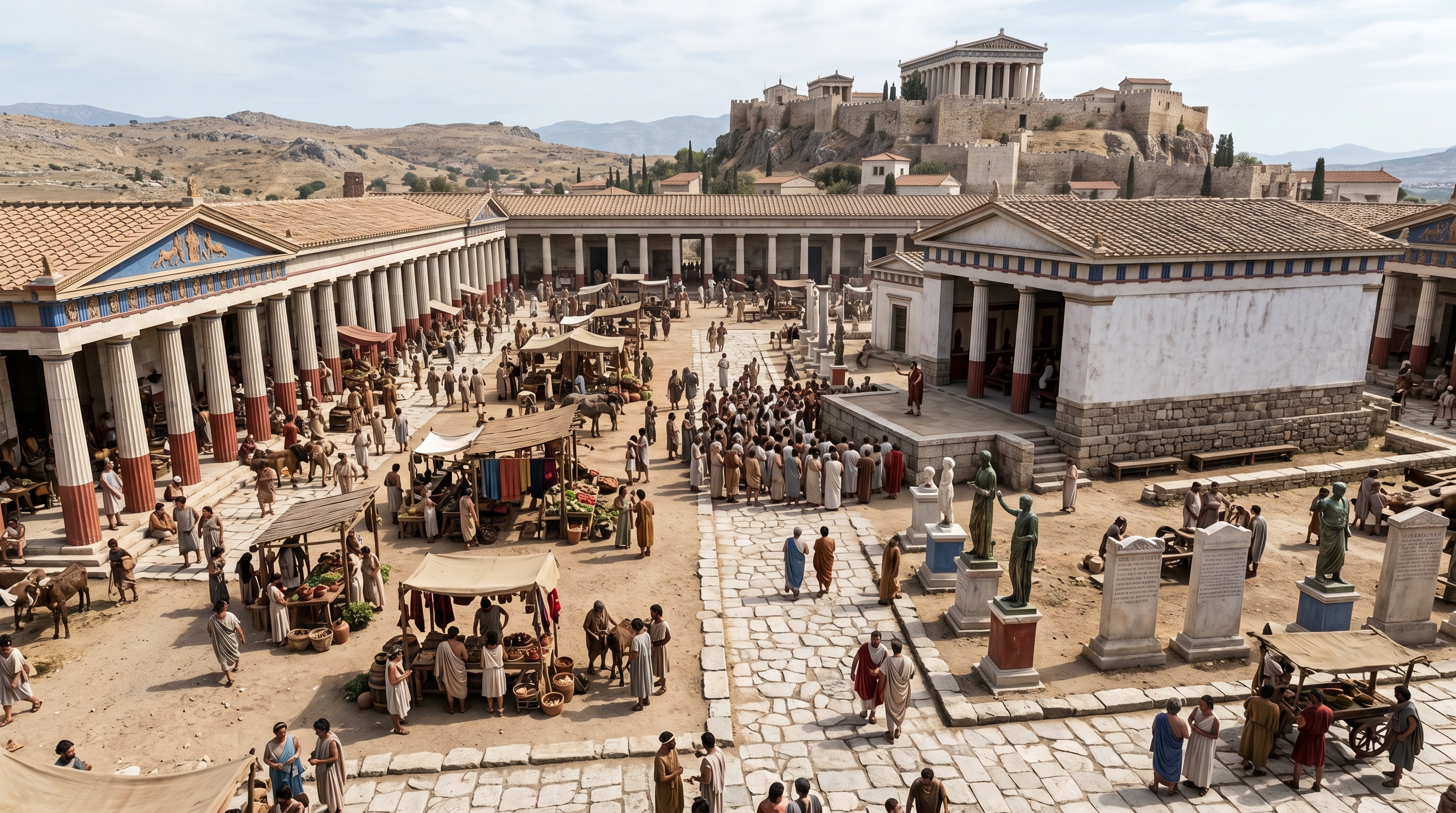
Agora and stoa (market and assembly precinct)
A market square built to host assemblies: stoas, inscription walls, and benches turned trade into public politics.
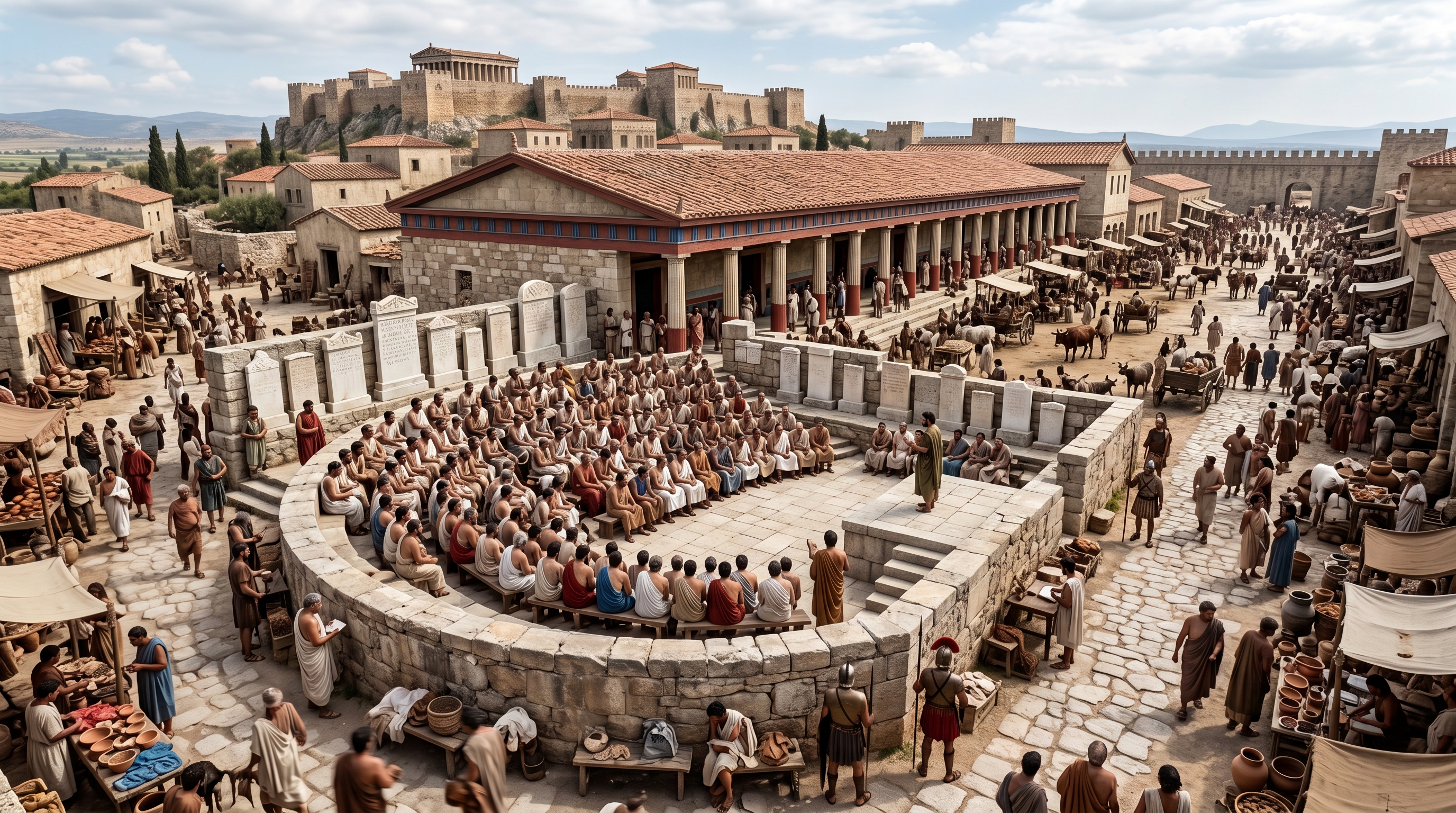
Boeotian synedrion locus (federal assembly space)
A modest hall by the agora where Thebes turned voted decrees and votive slabs into the visible machinery of federal rule.
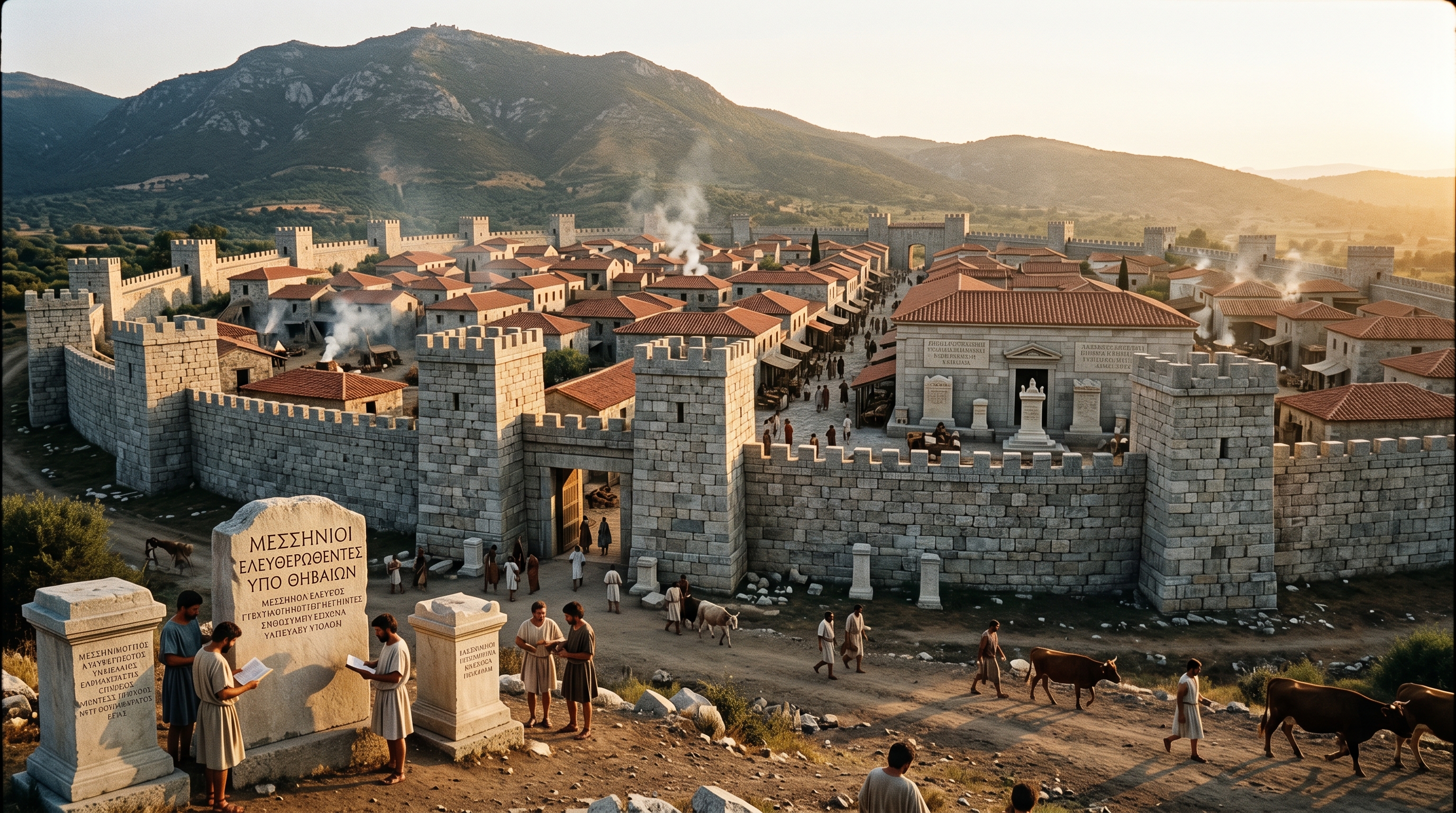
Refoundation records and Messene connection
Thebes built a city at Messene and turned its walls and inscriptions into political proof of anti‑Spartan power.
Ritual, sanctuaries, and civic memory
In Thebes ritual and sanctuary practice was political infrastructure: public rites, votive displays, and memorials were organized to make claims about power and alliance visible in stone, tile, and procession. Those visible claims bolstered federative bargaining and soldierly prestige but also exposed the city to rival reprisals.
Religious sites in Thebes were not tucked away oddities; they were civic stages. Temples on the Cadmea and the Ismenion hill, tripod bases cut into bedrock, and inscriptional podiums in the agora turned worship into evidence—evidence that an ally had stood with Thebes, that a victory had been won, or that a community had the right to speak in federal councils.
The texture of those stages mattered. Stone podiums and ashlar gates rose from bedrock. One- and two-storey houses with red-brown terracotta roofs framed approach routes. Processions climbed defined axes from the market to the Ismenion; federative benches and inscriptional bases made the city legible to visiting delegates as an organized polity, not merely a garrisoned town.
The core tension inside this dimension was visibility. Thebans put their claims where they could be seen: votives on a hill anyone could climb, funerary mounds on the plain anyone could pass, decree-bases in the open market. That choice created leverage. A tripod offered by a Peloponnesian ally stood in the Ismenion forecourt and functioned as a public signal that Thebes had reach and reverence. The same visibility created risk. Open commemorative markers on roads and fields invited inspection by enemies and made the city’s successes into targets.
Ritual life unfolded in predictable rhythms that tied private acts to public consequence. When a campaign returned, the procession did not simply unload spoils. It filed up the approach to the Ismenion or into the Cadmea, placed dedicatory bronzes and tripods on stone bases, and left inscribed honorific slabs near stoas so the alliance could be read aloud at the next synedrion. Annual festivals repeated those motions. Priests prepared sacrifices on raised podia, heralds announced decrees from inscriptional walls, and delegates took their seats on benches beside the agora to ratify agreements that had a visible, cultic record.
Those rituals depended on material choices as much as on people. The Cadmea’s stone circuit and raised temples physically dominated the low domestic roofline. Terracotta tiles made a red-brown sweep across the cityscape and signaled which buildings were invested in public display. Tripod bases were sometimes cut directly into the Ismenion’s bedrock so votives could be arrayed like a gallery. When the Sacred Band drilled along muster routes or processed past magistrates’ houses, the sight of paired warriors in full panoply walking beneath whitewashed façades and tiled eaves was itself a civic argument: Theban arms were disciplined, visible, and linked to sanctified space.
If you walked Thebes in the fourth century BCE you would have seen sequences meant to be read. A visitor arrived under the Cadmea silhouette, turned into a paved axis toward the agora, and then watched a delegation mount benches to debate. From there the approach to the Ismenion led up to a forecourt where tripods and inscribed dedications completed conversations begun in council. Battlefield milestones did the same work beyond the walls. Tumuli on the plain and the Lion at Chaeronea converted recent bloodshed into civic memory that a passerby could identify from the road. Ritual practice, material form, and political choreography were braided together; they made claims that were persuasive precisely because they showed, in public and in stone, who Thebes claimed to be.
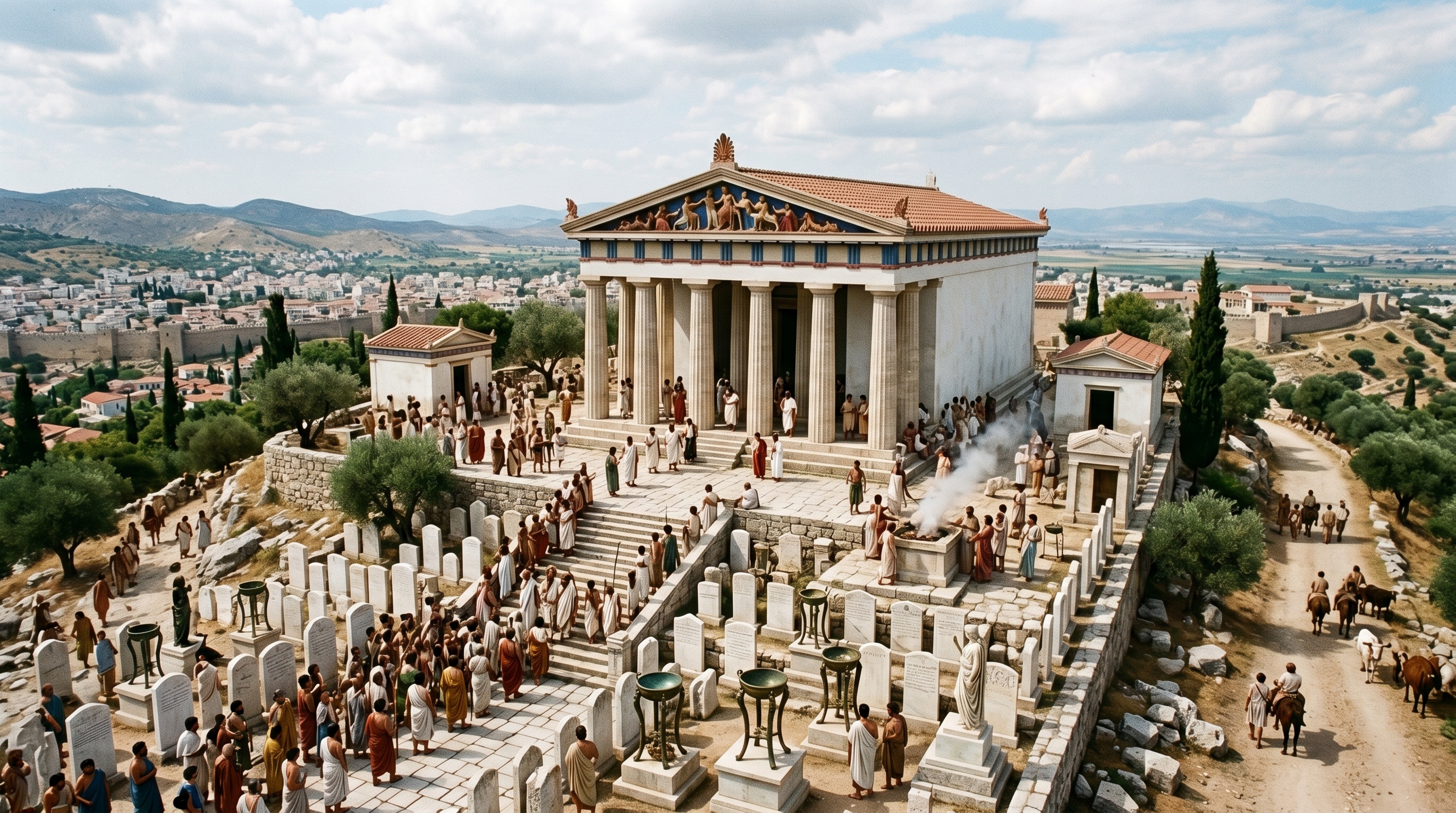
Temple of Apollo Ismenios (Ismenion hill)
On Ismenion hill Thebes turned tripods, painted pediments, and procession routes into a public ledger of alliances.
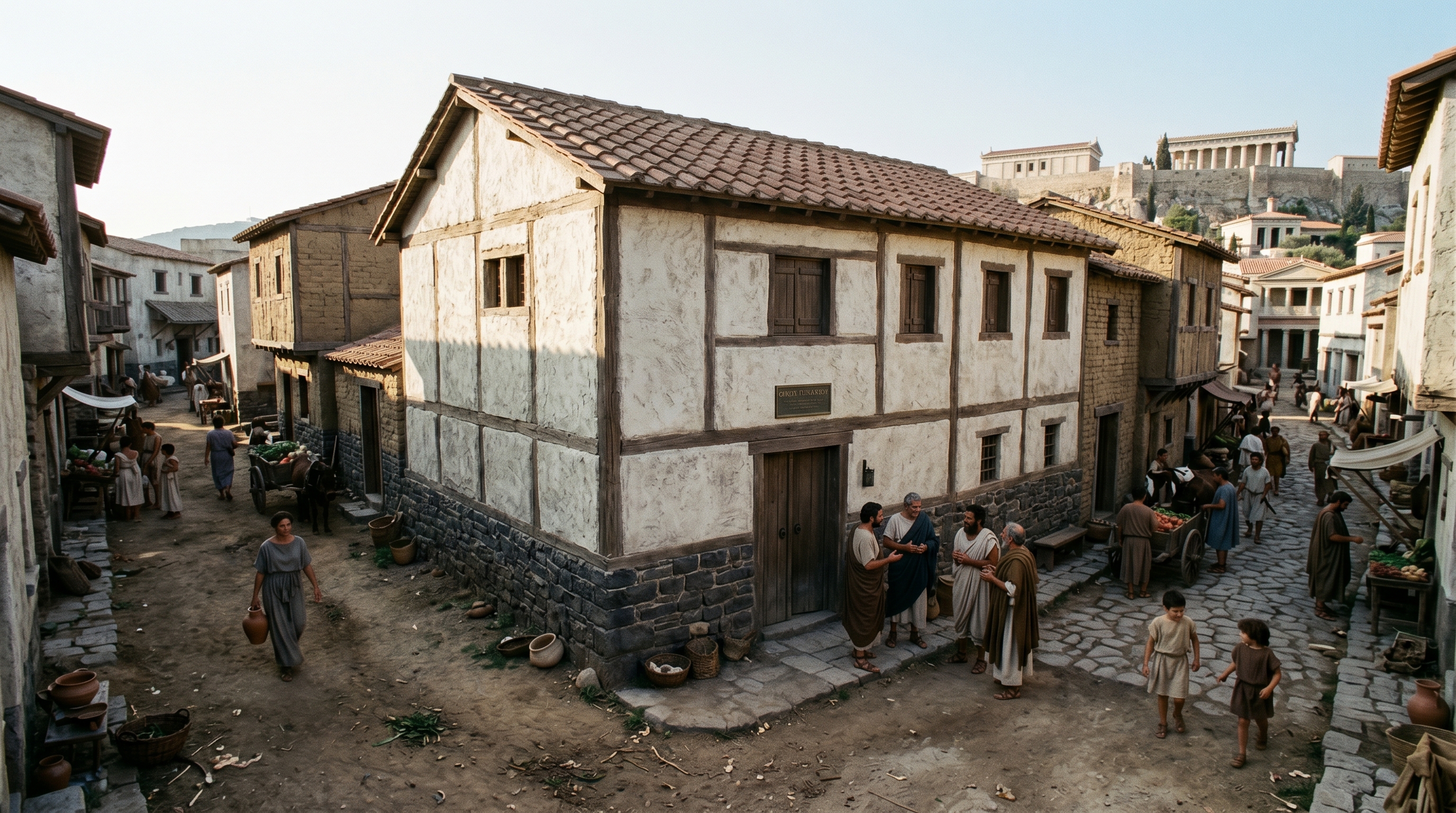
House of Pindar and sanctified domestic memory
A modest whitewashed house became a public object—Alexander spared Pindar’s home, turning private memory into political theater.
Urban fortress and infrastructure
The Cadmea and the city's fortifications turned political theater into built things: gates, paved axes, and walls made Thebes’ claims about power legible in stones and processions, even as that same legibility exposed the city to attack and punishment.
Thebes arranged defense, religion and federal politics so that they overlapped in physical space. A low stone plateau held the Cadmea; broad sightlines led from market streets up to temple pediments; fortified walls, gate complexes and stoas framed public life. Walking those axes showed you who controlled the city and who expected to keep it.
Materials were straightforward: a stone plinth for walls and podia, mudbrick houses on those footings, timber and red-brown terracotta roofs, and painted stone at the most public shrines. Those choices produced a city that read as both a working place and a staged claim — a place where ritual, council, and muster all met in the same streets.
What mattered here was connection: routes that funneled people and objects between three kinds of places. Citizens moved along paved approaches from the market toward the Cadmea; priests and processions climbed to the Ismenion sanctuaries bearing tripods and votive bases cut into the bedrock; federative delegates gathered under stoas where inscriptional bases and benches defined who could speak. Those corridors were not neutral. They were engineered sightlines — a tile-roofed skyline, a temple pediment, then the stone bulk of the citadel — arranged so that a visiting envoy or a returning army encountered public proofs of Theban authority as they arrived.
Defense and display overlapped uneasily. The Cadmea’s stone circuit and the outer wall foundations used local limestone and large ashlar blocks; above them rose mudbrick courses and timber roofs. The obvious effect was scale: temples and the citadel rose above one- and two-storey houses. The less obvious effect was vulnerability. Tropaia, tumuli and the Lion at Chaeronea lay in view from the main roads. They acted as mobile billboards of victory, visible as you left or entered the city — clear proof of prowess, but also easy targets in hostile campaigns. After Chaeronea and after Alexander’s razing those markers read differently: as evidence of what could be taken or destroyed.
Daily routines made the infrastructure real. Sentries paced parapet walks; armourers repaired hoplite gear in the citadel yards; porters hauled tripod bases and inscribed stelai up the procession routes to the sanctuary forecourts. On mustering days the Sacred Band and citizen contingents moved through the same market streets that merchants used every morning; shields scraped pavement, trumpeters called commands, and oxen carts delivered tile and grain to storage courts inside the Cadmea. Meetings of the Boeotian synedrion borrowed the agora’s stoas, forcing federal politics into spaces designed for exchange and exhibition rather than secrecy. That compression of rituals, councils and military life is why understanding Thebes’ walls and axes explains so much about its politics: civic power was enacted where people passed, prayed and prepared to fight.

Cadmea (the citadel) and its approach
A stone plateau where Theban myth, magistracy, and garrison met and were made public on every approach.
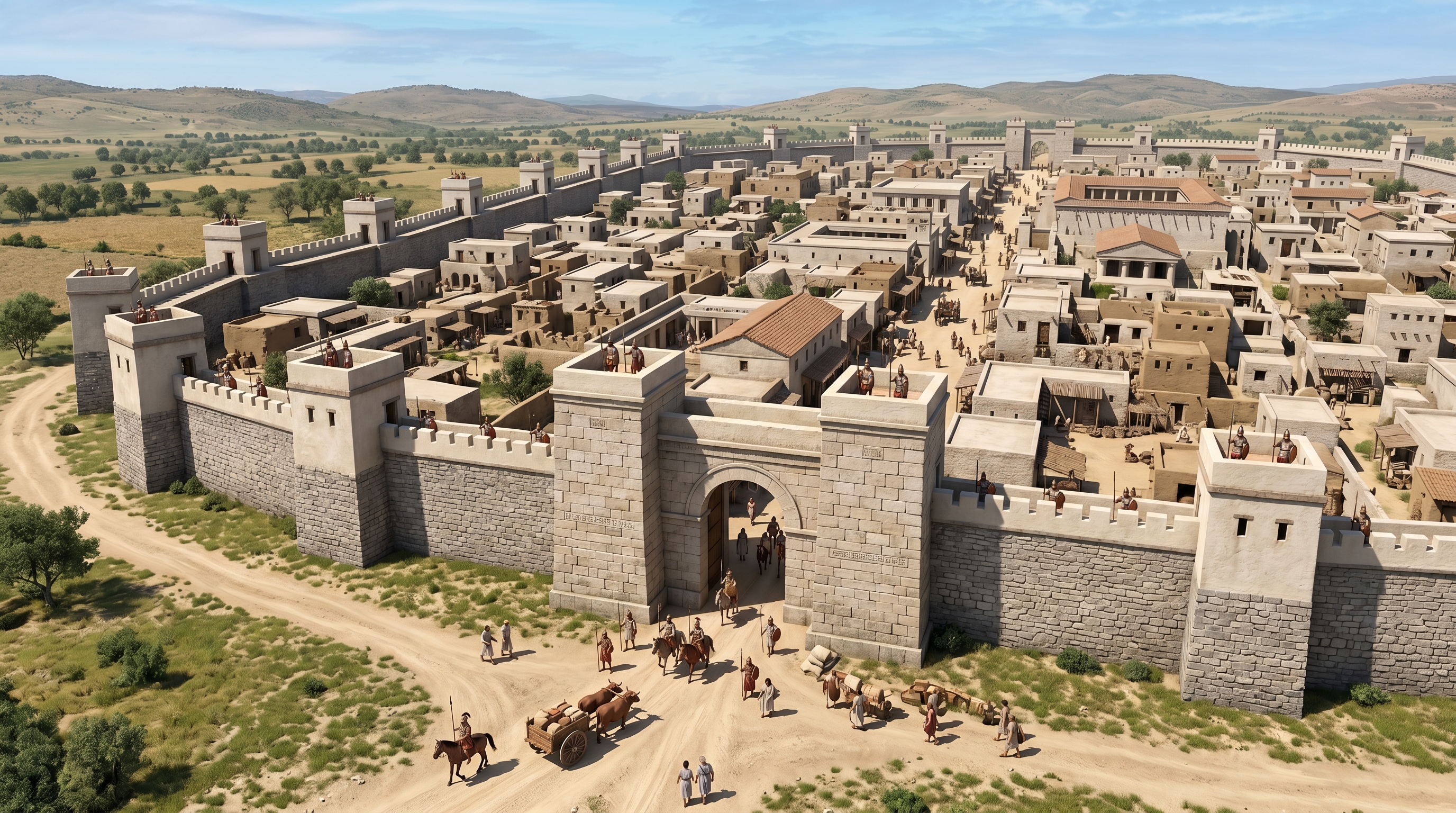
City walls and 4th-century fortifications
Thebes’ walls were a working frontier: stone plinths, limewashed parapets, and gates that organized musters, processions, and the city’s public power.
Memory, monuments, and the politics of destruction
In Thebes public memory and public violence worked together: monuments, processional axes, and federative meeting places made political claims in stone and paint, and those same visible claims could be erased by spectacular destruction to produce a rival story.
Thebes used built form to argue about power. Temples on the Ismenion, a raised Cadmea with stone podia, inscriptional bases in the agora and a field of tumuli and a lion on the plain turned victories, delegations, and sacrifices into things you could see from the road or from the citadel.
That visibility also created vulnerability. After Leuctra the city scattered commemorative mounds and stelai across the countryside; after Chaeronea a mass grave and a lion turned loss into a focal object of civic mourning; after 335 BCE the charred ruins and the pockets of spared sanctuaries narrated Alexander’s punishment and mercy aloud in the city’s fabric.
Memory in Thebes worked like urban choreography: processions moved along fixed axes and depositions happened where passersby could read them. A procession from the lower town climbed a paved approach to the Ismenion, passed tripod bases set into bedrock, and mounted the temple podium where a votive stand or painted pediment would catch the eye. Those material choices mattered. Stone podia and ashlar foundations registered permanence; whitewashed walls and red-brown terracotta roofs signaled civic upkeep; painted pediments and bronze fittings gave cult sites a color and weight that ordinary houses lacked. People used these cues. Priests, magistrates, visiting delegates, and ordinary Thebans paced these routes during festivals and federal meetings, and their gestures — setting down a dedication, reading a decree from an inscriptional base, seating themselves on a stoa bench for a synedrion debate — translated ritual and diplomacy into visible proof of authority.
Military memory threaded into the same visible world. The Sacred Band functioned as a parade unit and a training cohort; their march routes, drill grounds, and the Cadmea gates where they mustered tied martial prestige to civic ceremonial spaces. After victories officers planted tropaia on the plain; after defeats the city staged burials. At Chaeronea the polyandrion contained roughly 254 skeletons laid in rows; nearby a carved lion on a plinth created a single object you could see from a traveler’s road. Those graves and markers invited civic visits: relatives and city representatives left offerings, inspected inscriptions, and turned battlefield loss into a public story that continued inside the city’s sanctuaries.
Violence could erase that story just as effectively as monuments made it. The 335 BCE razing left burn horizons across residential quarters — blackened collapsed mudbrick, charred beams, debris-filled streets — while accounts claimed that selected temples and named houses were left intact. That contrast was deliberate. Sparing a cult site or a poet’s house while burning the adjoining roofs framed Alexander’s action as both punishment and mercy. Visitors after the sack encountered a city whose fabric argued about consequence: where stone temples survived, ritual life could continue; where a burned street opened onto the agora, the cost of political choice was visible in soot and carted-off goods. In Thebes memorials, federative benches, temple podia, tumuli, and burned streets were not passive backdrops. They were statements made in stone, pigment, and ash about who could command, who could be remembered, and what happened when a city’s public face provoked a larger power.
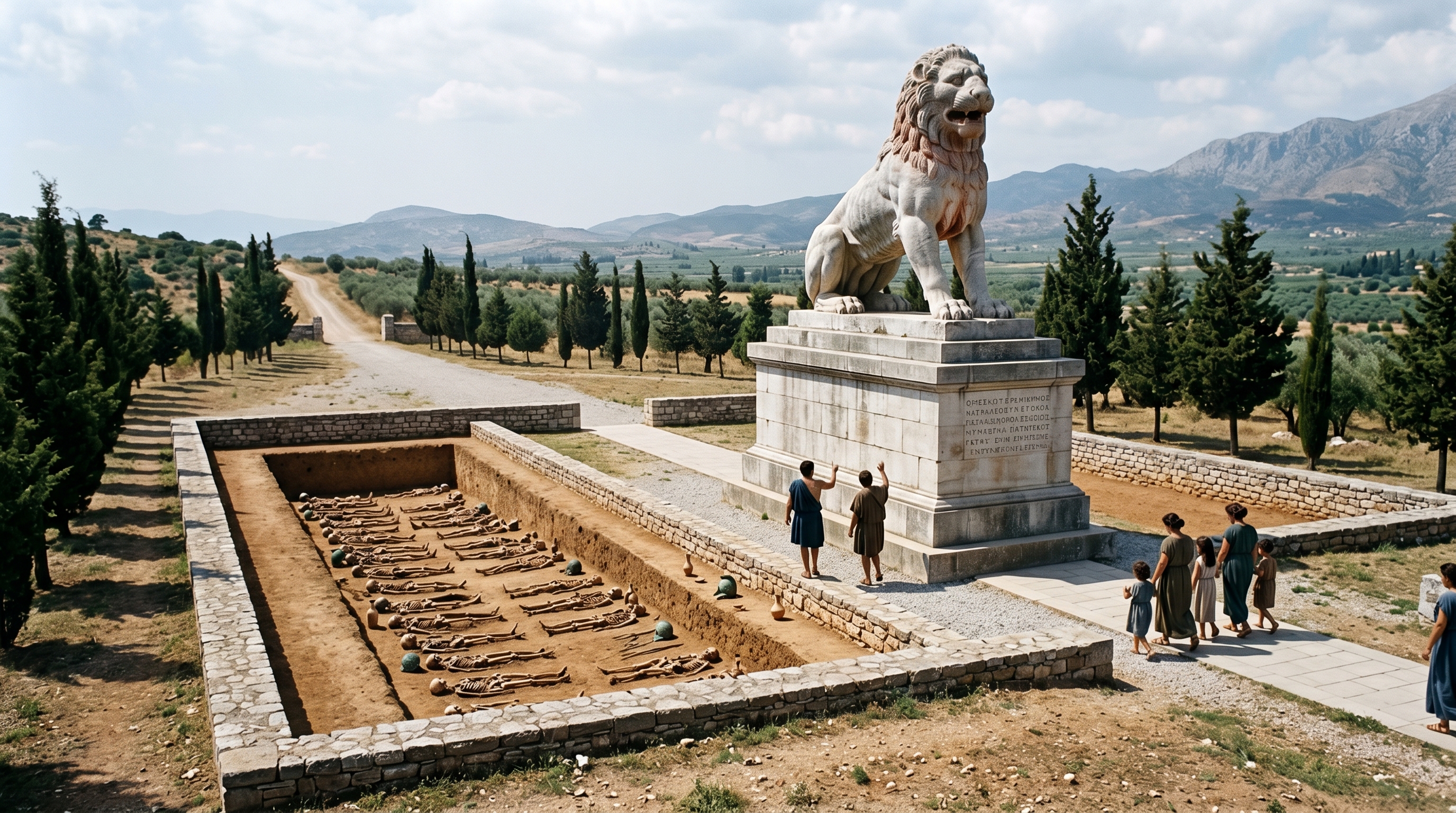
Lion of Chaeronea and the Sacred Band burial
A carved marble lion watched over roughly 254 ordered graves, turning the slaughter at Chaeronea into Thebes’ most public act of remembrance.
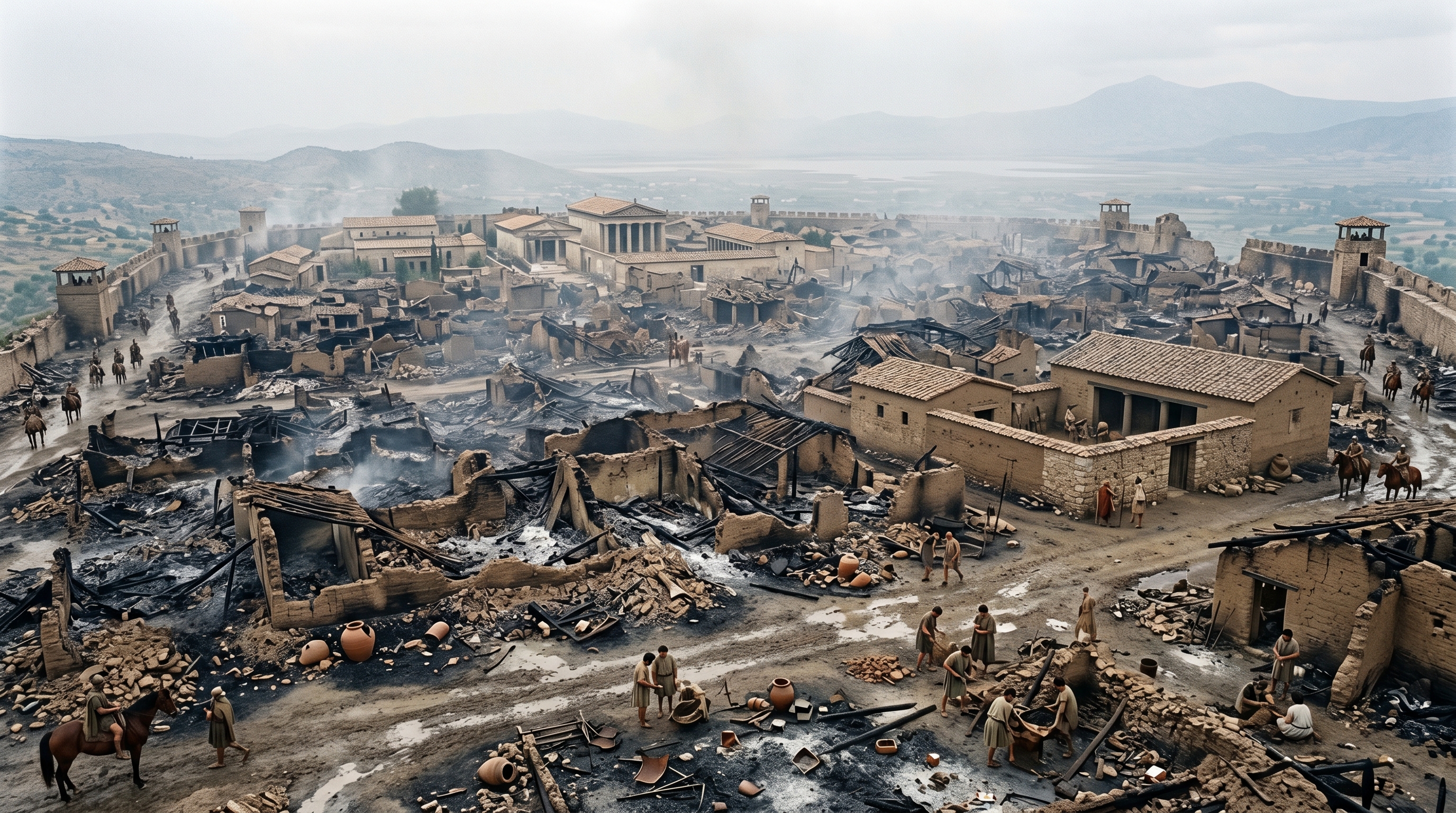
Razed neighborhoods and Alexander’s sack (archaeological horizon)
Blackened streets and intact sanctuaries: Alexander’s 335 BCE sack left Thebes’ civic map rewritten in ash.
sound
Bronze helmets and shields clinked in training grounds; heralds’ trumpets and the measured chanting of sacrificial prayers rose from the Ismenion; delegates murmured over decrees beneath stoa roofs.
smell
Olive oil and cooking hearths mixed with the resinous smoke of sacrifices on temple slopes; near the plains there was the dry dust of summer and the faint marshy tang from low-lying waters.
light
Bright Mediterranean sun glinted off whitewashed walls and red terracotta roofs by day; torchlight picked out cut-stone at night during processions and sudden, torch-lit coups.
touch
The Cadmea’s stone steps felt cool underfoot; courtyard plaster was rubbed smooth by hands and weather; streets gathered a fine grit that clung to sandals and shield rims.
Sources
research-essay
- City essay: Thebes (fourth-century civic project that braided cult, council, and infantry).
web
- American School of Classical Studies at Athens, 'Surprises in excavations on the Ismenion hill' (news release)Link
interpretive essay
- City essay: Thebes (interpretive frame on federative politics, processions, and urban sightlines)
reference
- Encyclopaedia Britannica, entry on the Boeotian LeagueLink
- Britannica, "Battle of Leuctra"Link
- Britannica: Battle of Chaeronea (338 BCE)Link
- Britannica, "Theban expansion" (entry on Thebes and its Peloponnesian campaigns)Link
- Britannica: Alexander the Great — summary of military campaigns and actionsLink
- Cadmea — WikipediaLink
- Britannica: Battle of Chaeronea (context for Theban military fortunes)Link
essay
- City essay: Thebes in the fourth century (project corpus)
- Thebes city essay (interpretive project framing the sanctuary’s role in federative politics and military display)
ancient source
- Diodorus Siculus, Bibliotheca historica (account of Alexander's campaigns and the sack of Thebes)
- Plutarch, Life of Pelopidas (in Plutarch's Lives)
- Plutarch, Life of Alexander (passages on Thebes and actions after the city's fall)
- Quintus Curtius Rufus, Historiae Alexandri Magni (narrative of the sack and its gestures)
project essay
- Project city essay: Thebes in the fourth century BCE (urban politics, cult, and military identity)
epigraphic corpus
- Regional epigraphic records and decree collections for Boeotia (inscription slabs and public stelai)
site dossier
- Lion of Chaeronea and Sacred Band burial — site dossier (physical and contextual details)
research
- Landmark research: City walls and 4th‑century fortifications (project dossier)
landmark research
- Landmark dossier: Razed neighborhoods and Alexander’s sack (destruction horizon details and material patterning)
landmark-summary
- Landmark summary: Cadmea (physical details, materials, layout, and human activities).
archive
- Ismenion hill landmark research dossier (project materials)
site research
- Landmark research: Agora and stoa (market and assembly precinct) — physical details, layout, and reconstruction notes
primary
- Pausanias, Description of Greece, Book IV (accounts of Messene and its foundations)
- Plutarch, Life of Pelopidas
- Xenophon, Hellenica
epigraphic
- Corpus of Greek inscriptions and published dedicatory lists from Messene (inscriptional evidence linking dedications to Theban patrons)
book
- Hans van Wees, Greek Warfare: Myths and Realities (2004)
secondary literature
- Robin Lane Fox, Alexander the Great (modern discussion of Alexander's policies and cultural gestures)
online article
- American School of Classical Studies at Athens, 'Surprises in excavations on the Ismenion hill' (context on Theban sanctuaries and processions)Link