At a glance
What if a conqueror could write a political message into a city’s streets? In 335 BCE Thebes showed what that looked like: broad, blackened burn layers and collapsed mudbrick roofs across residential quarters sat beside sanctuaries and a few spared houses, turning destruction into a visible instrument of control.
What purpose did burning whole neighborhoods serve beyond simple plunder? The 335 BCE horizon in Thebes made a public argument. Thick, blackened strata of soot and ash cut across living quarters; piles of collapsed mudbrick and snapped roof timbers mixed with broken red tile fragments and overturned household goods. You could read the action in the colors and textures: bands of charcoal and ash where ovens, courtyards, and upper rooms had been, and pale limestone of temple walls left relatively untouched nearby.
Those contrasts mattered. Domestic façades that once wore lime wash lay smudged and raw; where market stalls and stoas fed processions up toward the Cadmea, streets now collected a fine grey dust of burnt clay and smashed ceramics. At the same time, the temple precincts and the reported preservation of certain honored houses—most famously the poet’s—created islands of intact ritual form within an otherwise ravaged urban fabric. The scene resembled other ancient burn horizons in its mechanics, but differed in pattern: this destruction was selective and readable, not random ash.
People left traces of their last moments. Displaced votive objects and overturned cooking vessels rested amid collapsed beams. Accounts and the material pattern point to two simultaneous actions: seizure and removal of captives, and ritual pleading or negotiation that won protection for some cults and specific houses. The result was political choreography—neighborhoods erased while sacred architecture and chosen homes remained—so that the very map of the city bore the conqueror’s decision about what to obliterate and what to keep.
Closer looks
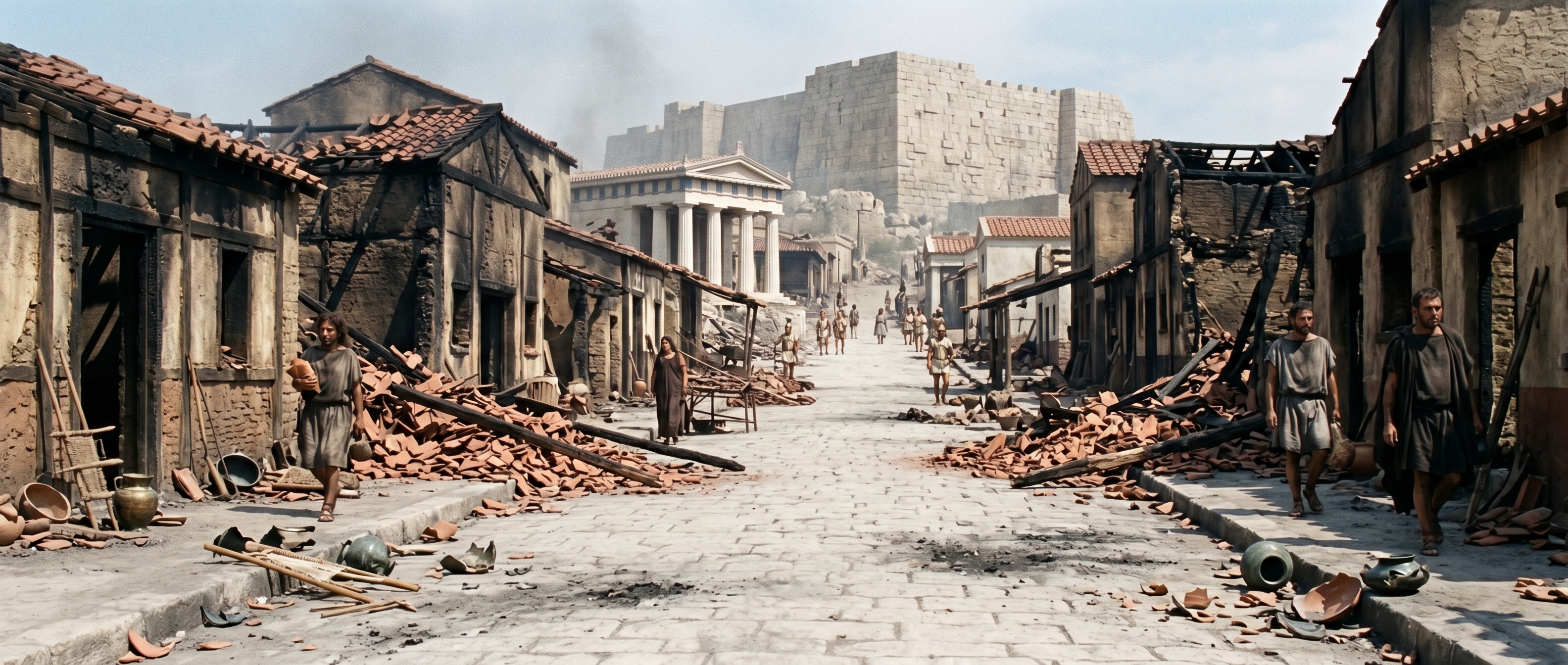
Ash-choked street looking toward the Cadmea
The city’s political argument was carved into its streets: broad ribbons of soot and collapsed roofs led the eye up toward the Cadmea’s stone mass, making destruction legible as policy rather than accident. Where a procession once climbed—paved approach, market stalls, then tripod bases—the paving now held a fine grey dust of burnt clay and scattered red tile fragments. Low mudbrick façades were reduced to smudged footings; in the middle distance a temple podium kept its clean limestone lines, creating a deliberate visual contrast between ordinary domestic quarters and civic-religious architecture.
That contrast mattered because anyone arriving by road read it quickly. The conqueror removed or destroyed what fed daily life while leaving the city’s civic skyline intact enough to be recognized: an image of authority without the people who made the city run. The visual message was practical too—ruined streets interrupted mustering routes and marketplaces, making rapid civilian recovery difficult even if some sanctuaries continued to function.
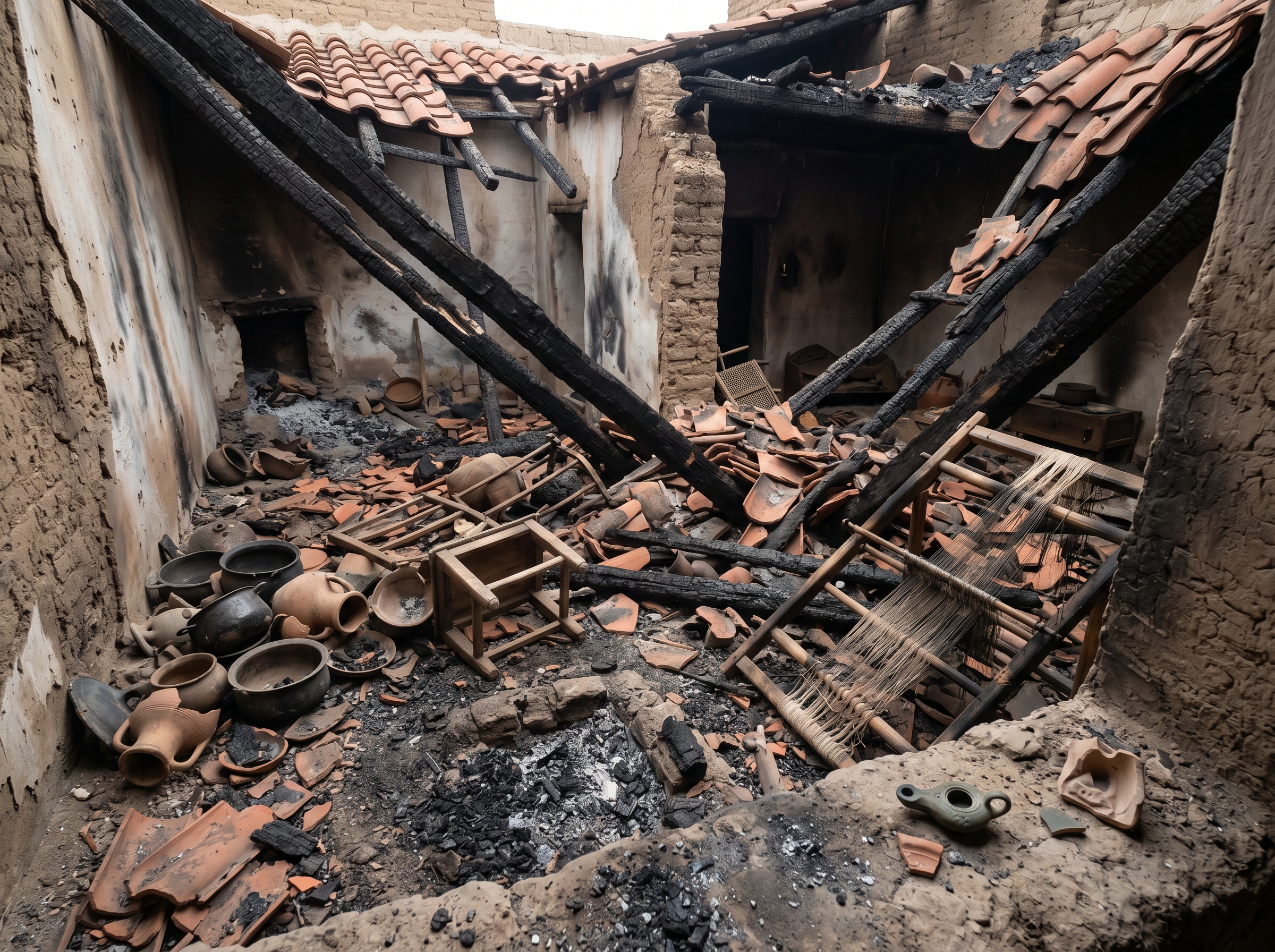
Collapsed domestic interior with in-situ belongings
A ruined room compressed the human consequences into objects. Collapsed mudbrick walls still bore smudges of lime wash; charred roof beams lay across broken terracotta tiles and overturned cooking pots. Tiny details conveyed abrupt departure: a bent oil lamp half-buried in ash, a loom component shoved beneath rubble, a votive sherd displaced from its niche.
Archaeology read those pockets of compacted ash like paragraphs. Heavier burning concentrated where upper rooms and hearths were located; floors showed crushed ceramics and domestic clutter where people had left quickly or been seized. This was not anonymous ruin. The pattern of personal belongings and smashed household goods traced routes of removal and offered glimpses of who had been taken, who might have negotiated their safety, and who had simply disappeared into the ash.
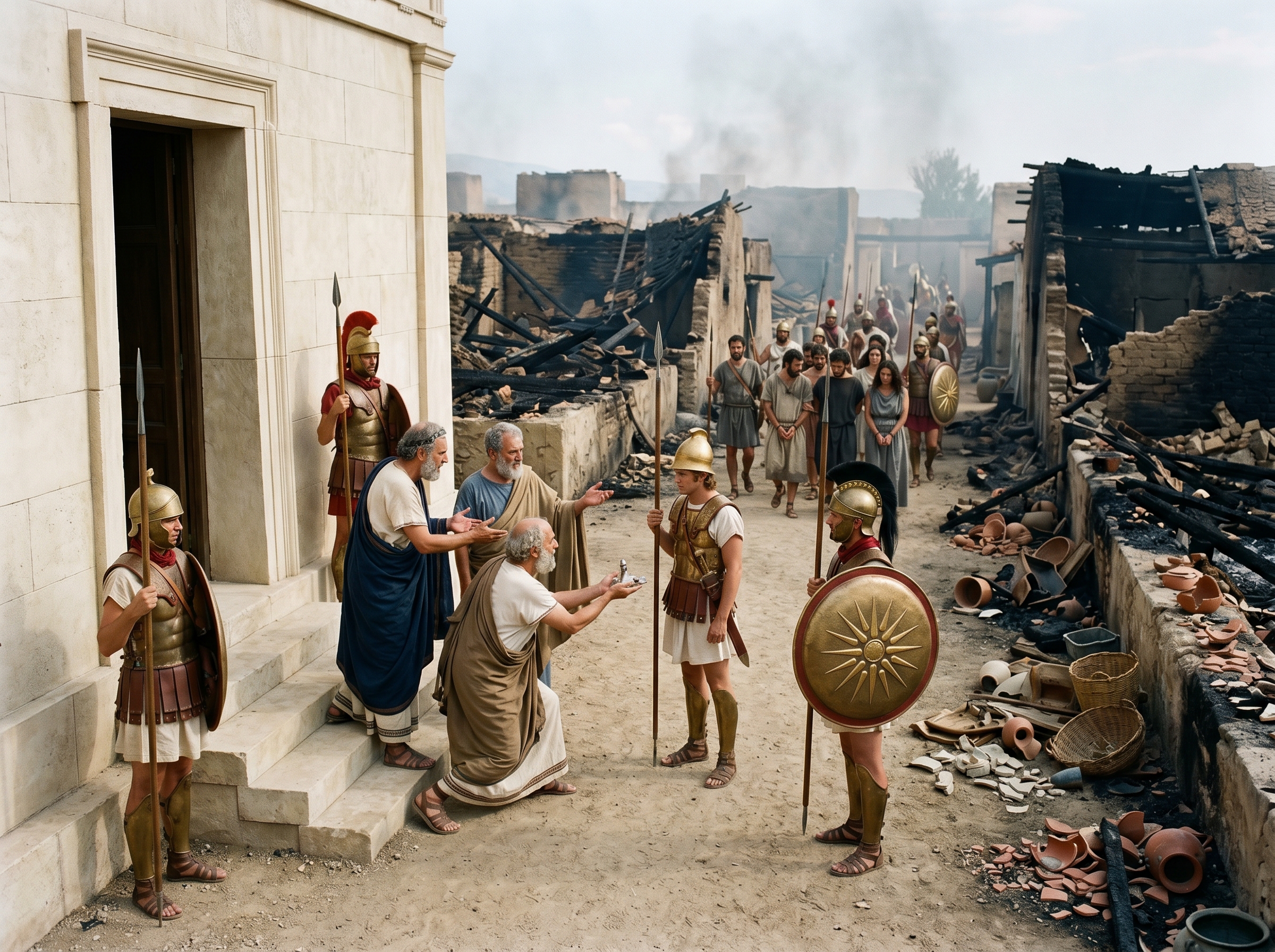
Ritual pleading at a spared sanctuary entrance
Some sanctuaries remained usable, and that selective preservation created stages for negotiation. At a spared temple entrance priests and elders could present votive objects, make ritual gestures, and plead while soldiers kept a measured distance. The podium’s crisp limestone lines contrasted with nearby piles of burnt clay, turning the sanctuary into a controlled opening where civic ritual and military authority intersected.
That choice was strategic. Allowing limited ritual activity maintained a veneer of normalcy that helped manage occupied populations. It also anchored who would carry on local memory: the sites left intact became loci where the conqueror’s grace—conditional and tightly policed—was recorded in public acts and in the placement of saved votives and honored houses.
Saved sanctuaries functioned as negotiated spaces: places where ritual, not force alone, shaped who could remain and who would be removed.
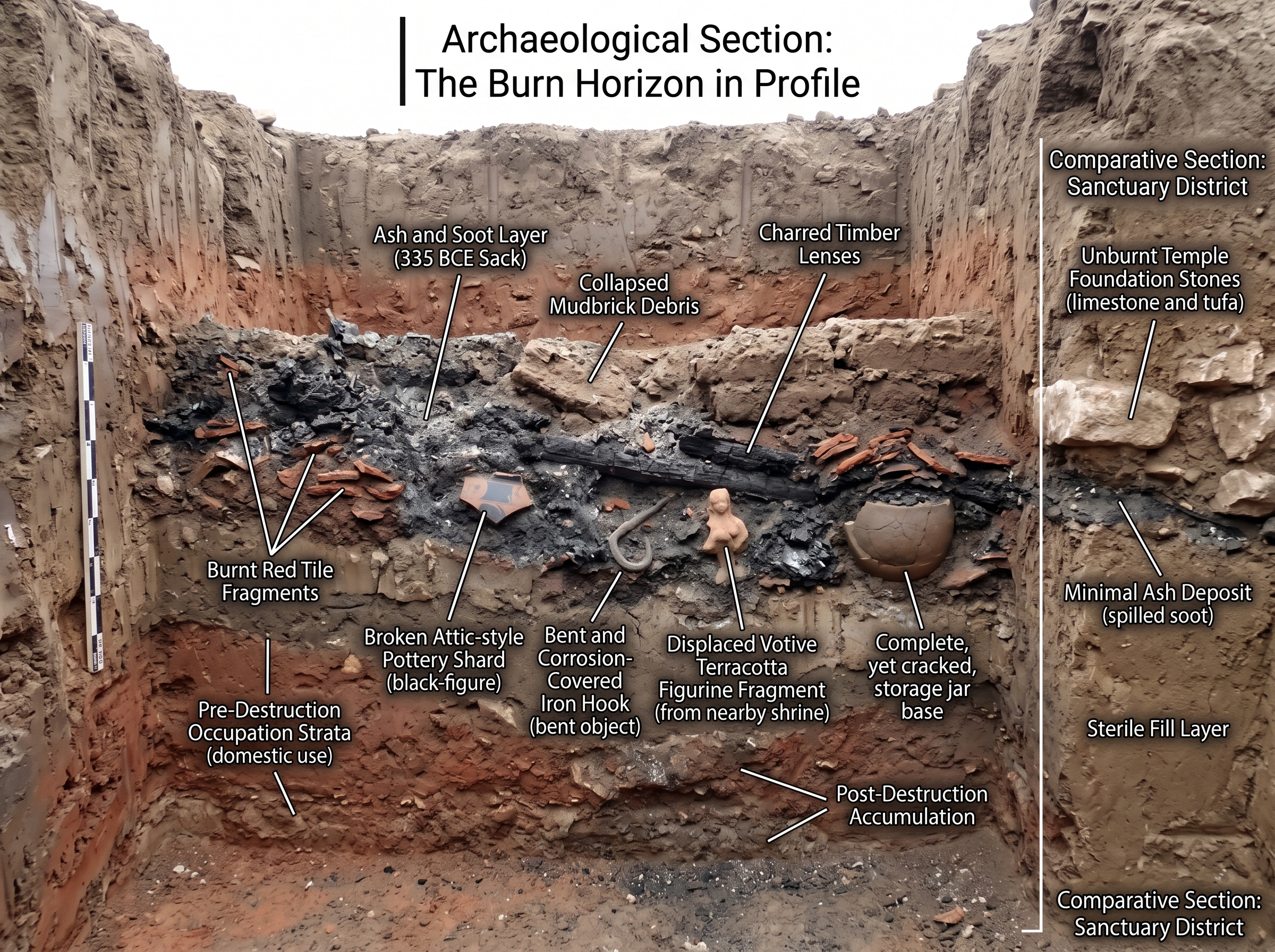
Archaeological section: the burn horizon in profile
A vertical trench made the event scientific rather than anecdotal. The burn horizon appeared as a sharp, charcoal-rich layer cutting across earlier occupation strata, with lenses of collapsed mudbrick and compacted tile fragments trapped inside it. In-situ finds—broken bowls, a bent iron object, displaced votive sherds—sat within that black band, anchoring the destruction to a moment in time.
Comparison with adjacent sections explained selectivity. Under temple foundations the soot layer thinned or vanished, showing that some stone structures interrupted fire spread or were purposefully spared during clearing. Mapping those contrasts across multiple trenches let archaeologists move from single-room stories to patterns of targeted destruction across the city—what was burned, what remained, and where the conqueror's decisions had physical effect.
The trench turned the sack into data: a discrete burn layer with trapped artifacts that helped separate chaotic loss from deliberate, spatially patterned destruction.
City context
The razed neighborhoods lay within the matrix of a city that had fused religion, federal politics, and military identity into its everyday routes. Processions that once climbed from market stalls and stoas toward Apollo Ismenios passed through streets whose upper stories and fired-tile roofs were now collapsed and blackened. The Cadmea’s stone mass still rose above the plain, but the network of houses and mustering streets that fed the city’s Sacred Band and civic councils had been interrupted by bands of ash and rubble.
For ordinary Thebans the sack rewrote daily rhythms. Where merchants had hustled small goods and where federated delegates had once walked to sit on inscriptional benches, smoke, splintered beams, and displaced household contents turned public routes into zones of removal and mourning. At the same time, congregants and ritual specialists could still gather at spared sanctuaries; those intact precincts became focal points for negotiation, ritual pleading, and the visible staging of mercy—precisely the places where the conqueror allowed civic and religious life to continue under controlled conditions.
Sources
project essay
- Project city essay: Thebes in the fourth century BCE (urban politics, cult, and military identity)
landmark research
- Landmark dossier: Razed neighborhoods and Alexander’s sack (destruction horizon details and material patterning)