At a glance
The Theban agora was less a neutral shopping square than a public stage where market trade, magistrates’ routines, and federated politics met in view of the temples. Its rectangular, stone‑paved square and surrounding stoas were arranged to hold both daily commerce and the benches, inscriptional bases, and procession routes required for Boeotian assemblies.
What happened when a marketplace had to host a federation? The Theban agora answered that question by folding clerks, visiting delegates, and votive display into the same open rectangle where bakers sold bread and amphorae changed hands. The square had a paved central axis and stone foundations for one or more stoas whose roofs used wooden beams and fired tiles; façades were whitewashed and painted signs marked magistrates’ rooms and public inscription walls. Bases for honorific statues and stone inscription panels lined one side, making official decisions impossible to miss.
The layout pushed events into view. Stoas gave shaded benches for sitting and speaking; magistrates’ offices opened directly onto the square so officials could step out from administrative work into public gatherings. The placement of inscriptional walls and statue bases made law and praise public property: a decree left on a podium was address, record, and display at once. Compare that to the Athenian Agora, where stoas organized commercial and social life; in Thebes the same architectural elements doubled as instruments of federative choreography, built to receive not just markets but guest speakers and regional delegations.
Daily life and ceremonial spectacle overlapped. Morning trade cleared enough space for an afternoon council; processions climbed from the agora up the main street toward the Ismenion hill, passing votive tripods and podiums erected after military victories. The soundscape shifted with the hour: merchants’ calls and the rattle of amphora handles gave way to the low, deliberate murmur of negotiators and the crisp reading of decrees from inscribed stones. That sequence made the agora a machine for turning private exchange and public decision into mutually visible acts.
Three questions follow from that arrangement. First, how did architecture shape who had voice and visibility in federative bargaining? Second, how did inscription and public display fix local and regional commitments where anyone on the square could read them? Third, how did this shared civic floor change ordinary Thebans’ sense of belonging when the city projected power through ritual and law at the same spot where they bought grain? Answering those questions shows the agora as a piece of civic strategy rather than only a market place.
Closer looks
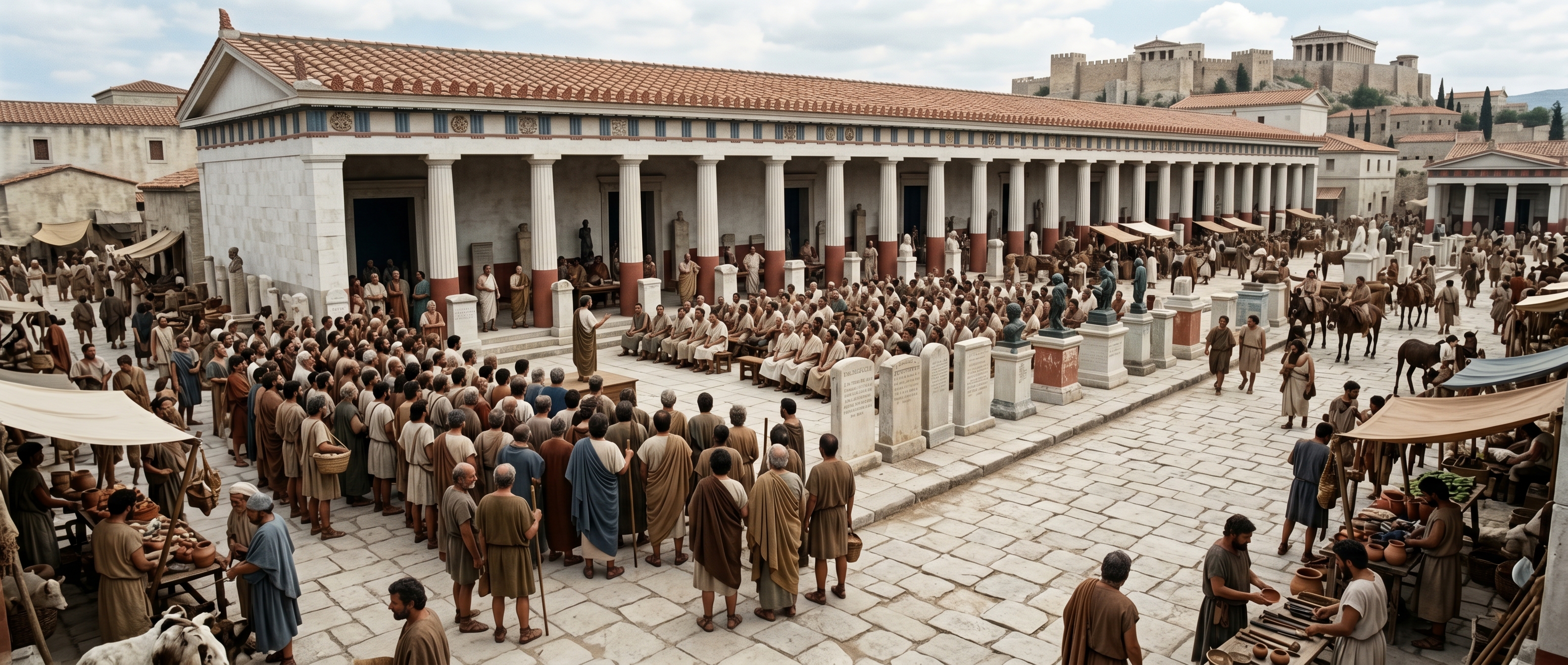
The rectangular square packed for an assembly
The agora worked as a single civic floor where daily commerce and federative politics folded into one another. A rectangular, stone‑paved axis cut across the plaza; stoas with whitewashed façades and red‑brown tiled roofs ran along at least one long side, and honorific plinths and inscriptional slabs framed the space so decisions could not be hidden from view.
Mornings the edges held merchants with simple stalls and the clink of amphora handles. By afternoon benches filled with local magistrates and visiting delegates and the same ground held readings of decrees aloud. The hard paving mattered: it kept sightlines clean and voices projectable so a magistrate stepping from his office doorway could address a crowd of a few hundred without a raised stage. That overlap—the baker’s bench beside a stone set with law—made Theban politics physically visible and practically awkward; private negotiations happened under the same roofline where public commitments were carved in stone.
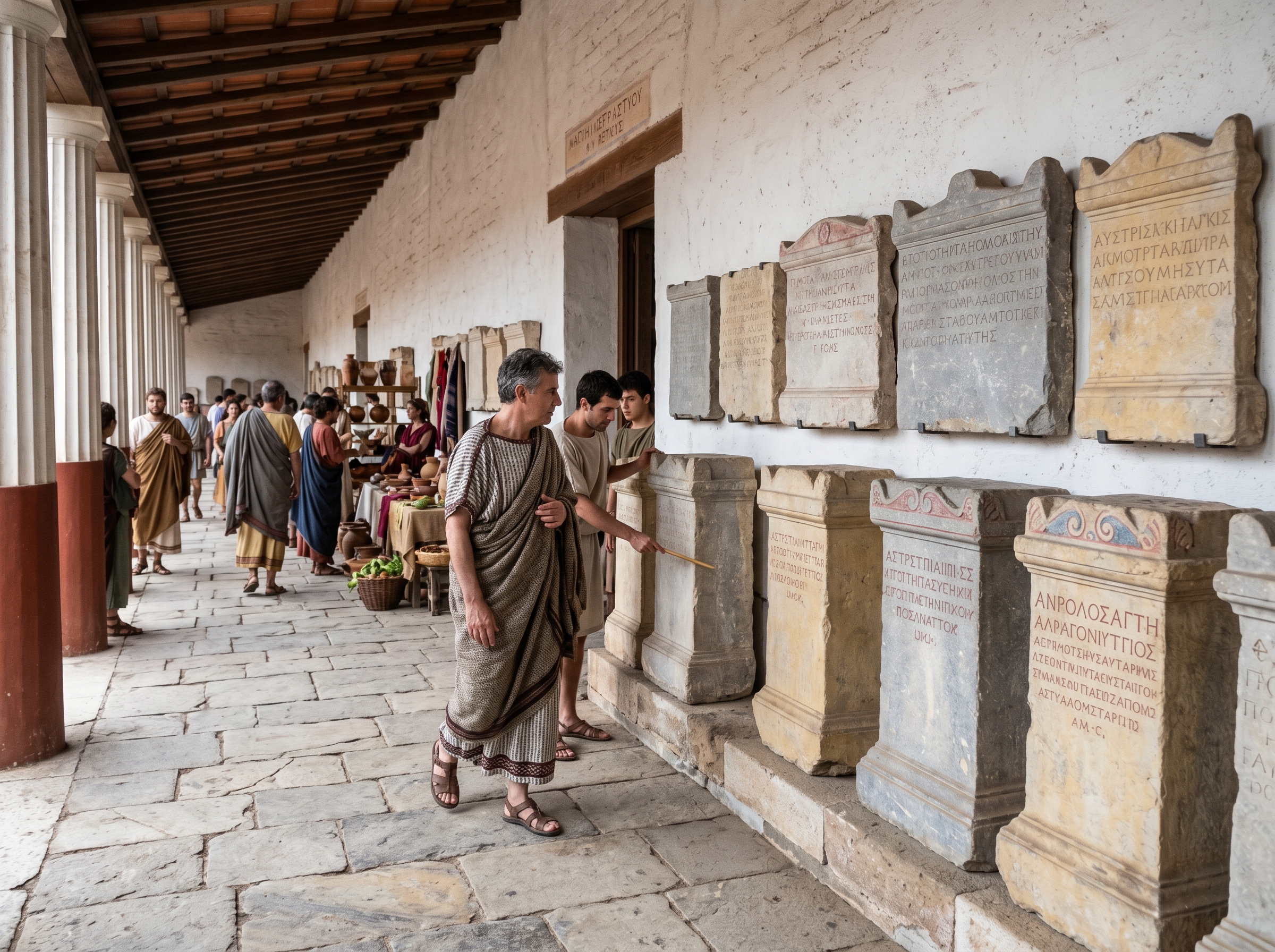
Inscriptional bases and decrees along the stoa
Public writing in the agora was not a marginal gesture but a deliberate, readable presence: carved slabs set against the stoa wall turned decrees and honors into objects people could approach and check. The incised letters were often painted in faded reds or blues so a line of text would read clearly from a few metres away; surviving parallels suggest letter heights in the range of roughly 4–6 centimetres, enough for a passerby to confirm a name or clause without stepping onto a bench.
Wear and the faint remains of pigment mattered as much as the words. Many slabs carried chips from handling, patched mortary lines where new texts were added, and vertical joins where fragments had been reset. Clerks and citizens used the stones as working documents: a magistrate might point with a stylus to a clause while a scribe copied it onto a wax tablet. Those practical interactions turned carved law into everyday evidence rather than distant rhetoric.
Some inscriptional fragments come from later contexts; the color and letter‑size estimations rely on well‑preserved examples from nearby Boeotian sites.
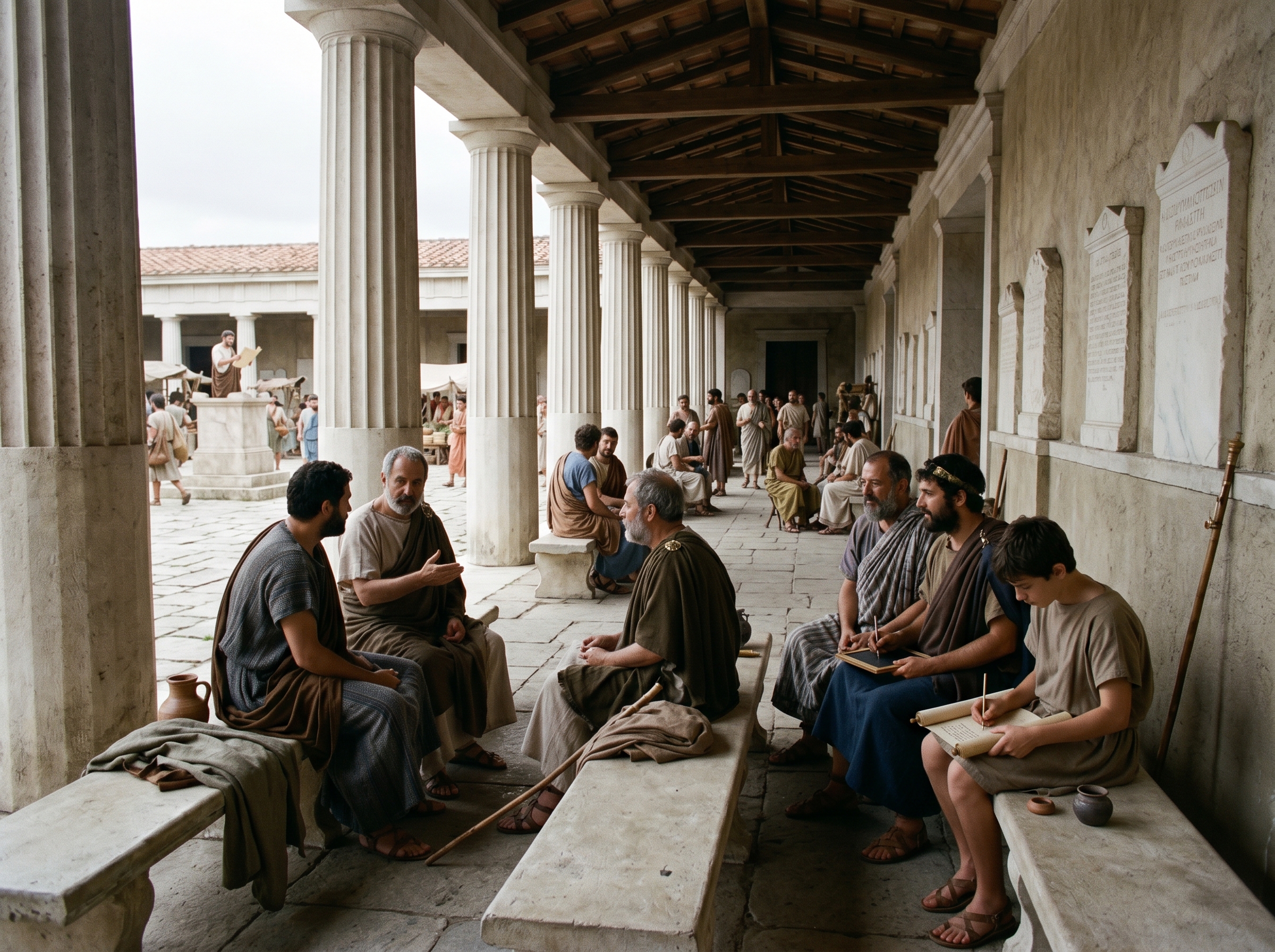
Delegates on the stoa benches
Stoas offered more than shade; their benches organized who sat, who listened, and how bargaining happened. Timber roof beams cast cool shadows over continuous stone seating where small groups of delegates—perhaps dozens to a low triple‑score—clustered with wax tablets, slip‑cases, and cloaks that marked their polis of origin.
Seating was semi‑public. Benches faced the square so a delegate could rise, cross the pavement, and make a point to a crowd or to another delegation. Proximity mattered: the benches closest to inscriptional walls and magistrates’ doorways were where higher‑status envoys chose to sit, giving them quick access to the official texts and the officials themselves. Speech was procedural, not theatrical: quiet exchanges, the scratch of styluses, a quick translation between tongues when needed.
Exact numbers and precise seating hierarchies are inferred from comparable stoas; local practices probably varied with occasion.
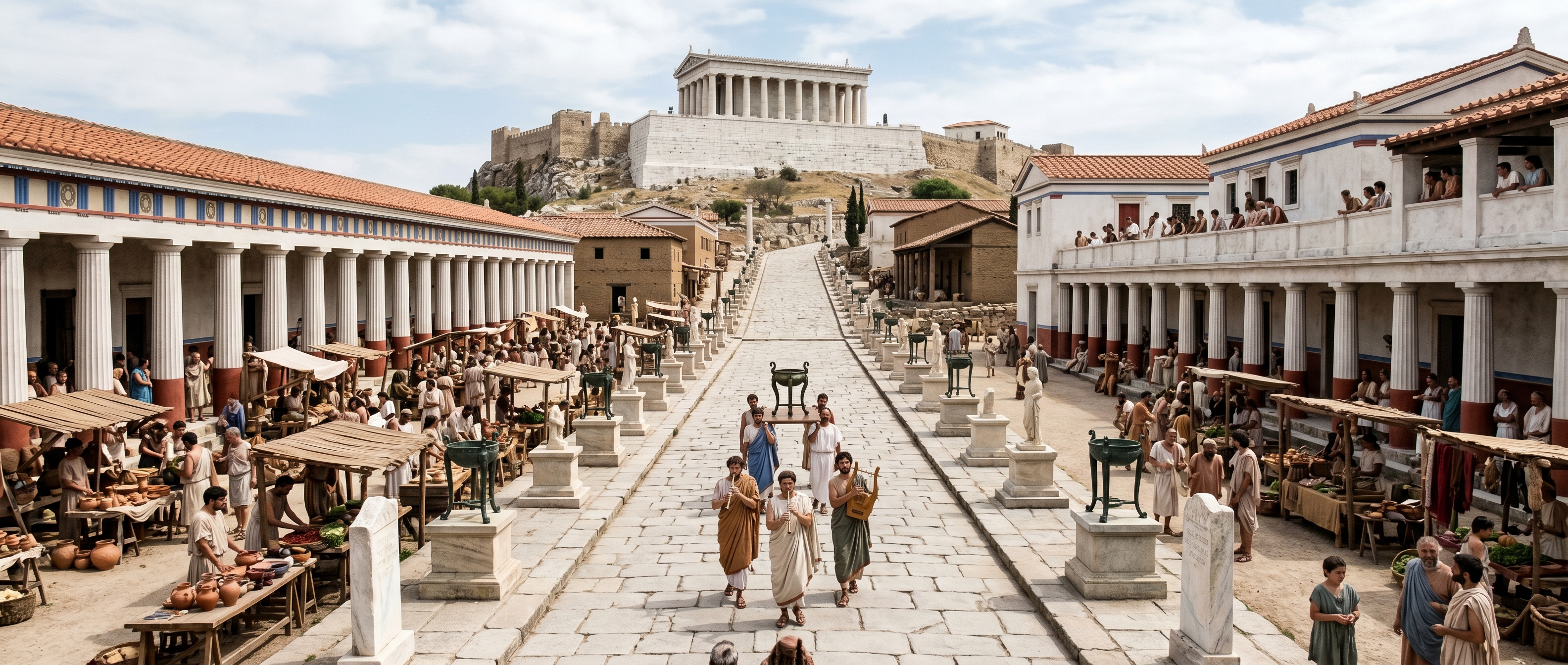
Processional approach up the civic axis
The route from the agora up to the Ismenion shaped how the city told its story to anyone approaching. A paved procession axis ran from the market past a line of tripod bases and votive stands and climbed toward the temple podium on the Ismenion hill, creating a visible sequence: market, offering, podium, shrine.
Processions mixed ritual and political claims. Small groups carried tripods and votive goods, musicians kept time, and townspeople watched from the stoa edges as the objects of victory or dedication passed within arm’s reach. Placing tripod bases along the approach made battlefield trophies and dedications legible at a distance; you did not need to enter the temple court to understand which victories the city wanted visitors to notice. The approach turned private triumphs into shared, continuous evidence on the road into town.
City context
The agora sat on the city’s political axis between the lower town and the Cadmea and linked to the procession route up toward the Ismenion hill. That location mattered: processions carrying victory offerings or sacrificial trappings moved from market stalls past painted facades and inscription walls before arriving at temples. The visual sequence—market, paved approach, tripod bases, temple podium—made ritual and politics legible to anyone entering the city.
Ordinary Thebans encountered the agora as a place of routine and interruption. Mornings it functioned as a market where merchants arranged wares under stoas and customers checked weights and coins. On scheduled days benches filled with delegates, and the same floor held the reading and display of Boeotian decrees. Soldiers and marching contingents used the square as a mustering point after battlefield victories, converting military achievement into public dedication visible to traders and magistrates alike.
Sources
interpretive essay
- City essay: Thebes (interpretive frame on federative politics, processions, and urban sightlines)
site research
- Landmark research: Agora and stoa (market and assembly precinct) — physical details, layout, and reconstruction notes