At a glance
Thebes refounded and fortified Messene not as a distant charity but as an active instrument of policy: a planned, stone-walled city that could fracture Spartan power and be paraded back into Theban civic life through dedications and records. Reading the inscriptions and fortification traces together shows Thebes aiming to make political change visible—both in the Peloponnese and on Theban rooftops and rostrums.
What did Thebes mean when it sent builders and delegations to found a city in the Peloponnese? The most striking answer was physical: Messene was rebuilt with a long circuit of cut-stone walls and a regular urban plan, roofed in terracotta, lined with public squares and inscription bases. These features transformed the act of founding into a durable military and civic object that could be pointed to in arguments about power.
The stonework mattered. The new circuit was not a temporary camp; it was a multi-kilometre ring of towers and gates that read from a distance as permanence. Inside, streets and public places were arranged so that dedications and decrees could be set in view. Inscribed bases and votive dedications named Theban patrons and recorded the presence of Theban delegations. Those inscriptions turned a foreign town into evidence you could carry home to the Cadmea and the Ismenion hill.
Think of this like other Greek refoundations where planning and walls went together, but with a different political grammar. Athens planted cleruchies to control trade routes; Thebes invested in a fortified polity intended to undercut Sparta’s territorial control and to provide an island of allied polity in enemy country. The comparison sharpens the question: was Messene primarily a military bulwark, a refuge for expelled groups, or a visible emblem of Theban federation-making? The physical choices—stone walls, prominent inscriptional space, and a planned civic heart—point to all three at once.
That overlapping intent is the place’s most interesting puzzle. Theban engineers, colonist assemblies, and ritual delegations all moved through the same program of building and dedication. When Thebes displayed Messene’s dedications in its sanctuaries or read its refoundation decrees aloud, the city converted an outpost into domestic political currency. Once you see Messene this way, Thebes stops looking like a city that only defended its plain; it becomes an outward-facing capital that used urban design to remake distant politics.
Closer looks
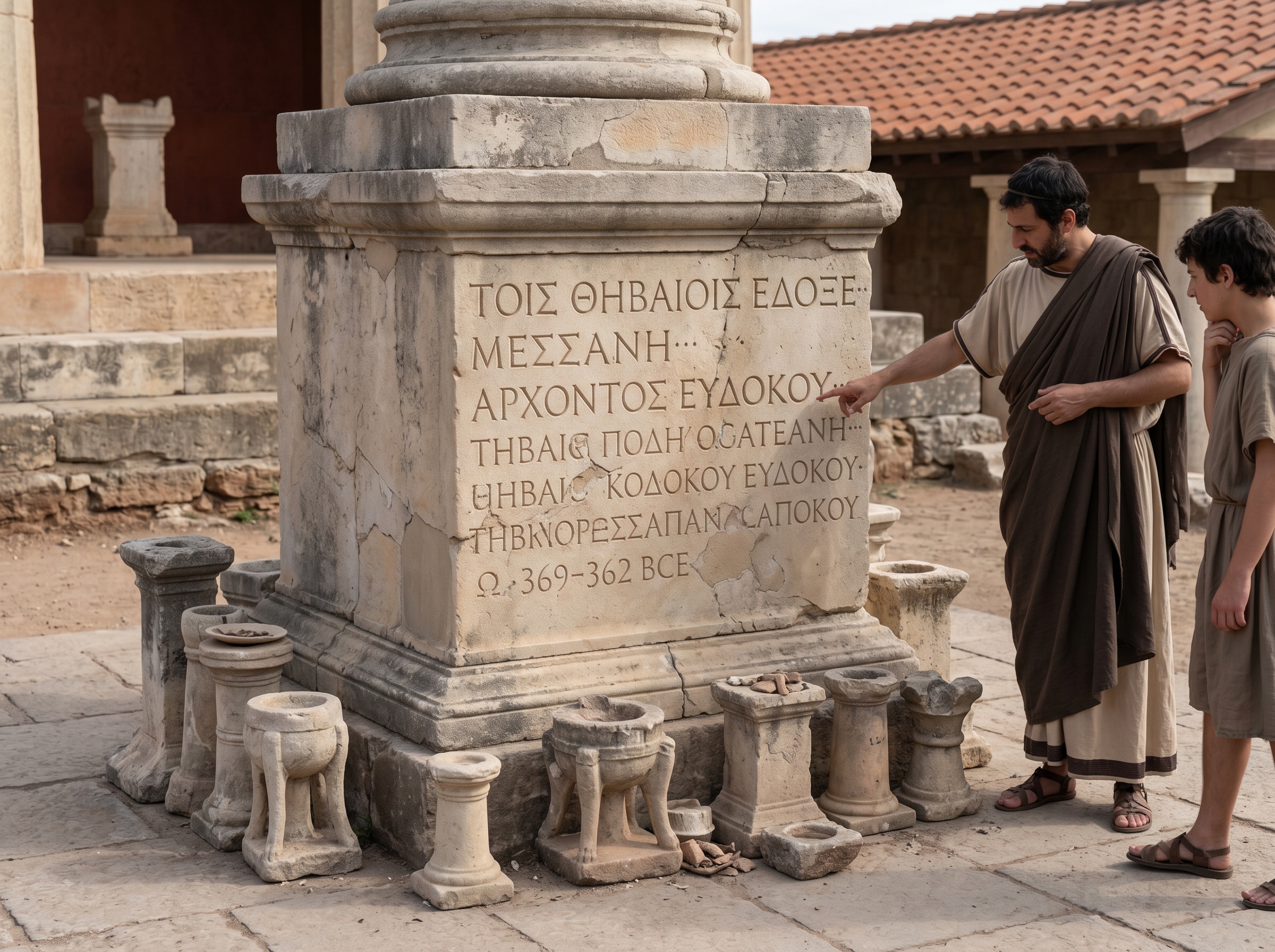
Inscribed dedication base on the Ismenion hill
Bringing a refoundation decree into the Ismenion court turned a distant political act into a piece of daily memory. The carved letters named Messene and listed Theban patrons; worshippers and delegates passed those names on their way to Apollo.
The block itself had lived a life. The chisel cuts were crisp where it had been freshly incised, but repair patches and old lifting holes showed it had been moved and reset at least once. Smaller tripod and votive stands clustered nearby, so the inscription read alongside offerings rather than in isolation. A magistrate would stop to point at a line while a worshipper lingered; the presence of named sponsors allowed reporters and scribes to copy the decree on official lists kept in the agora.
Those physical traces mattered politically. Reusing an inscription in a sacred approach proved Thebes could produce documentary proof—not a rumor—of activity in the Peloponnese. The stone’s weathering and tool marks also betrayed its itinerary: transportation scars matched administrative accounts that recorded which envoys had escorted the dedication home.
Surviving refoundation inscriptions often came to us piecemeal; their joins and repair marks helped ancient and modern readers reconstruct the political story they carried.
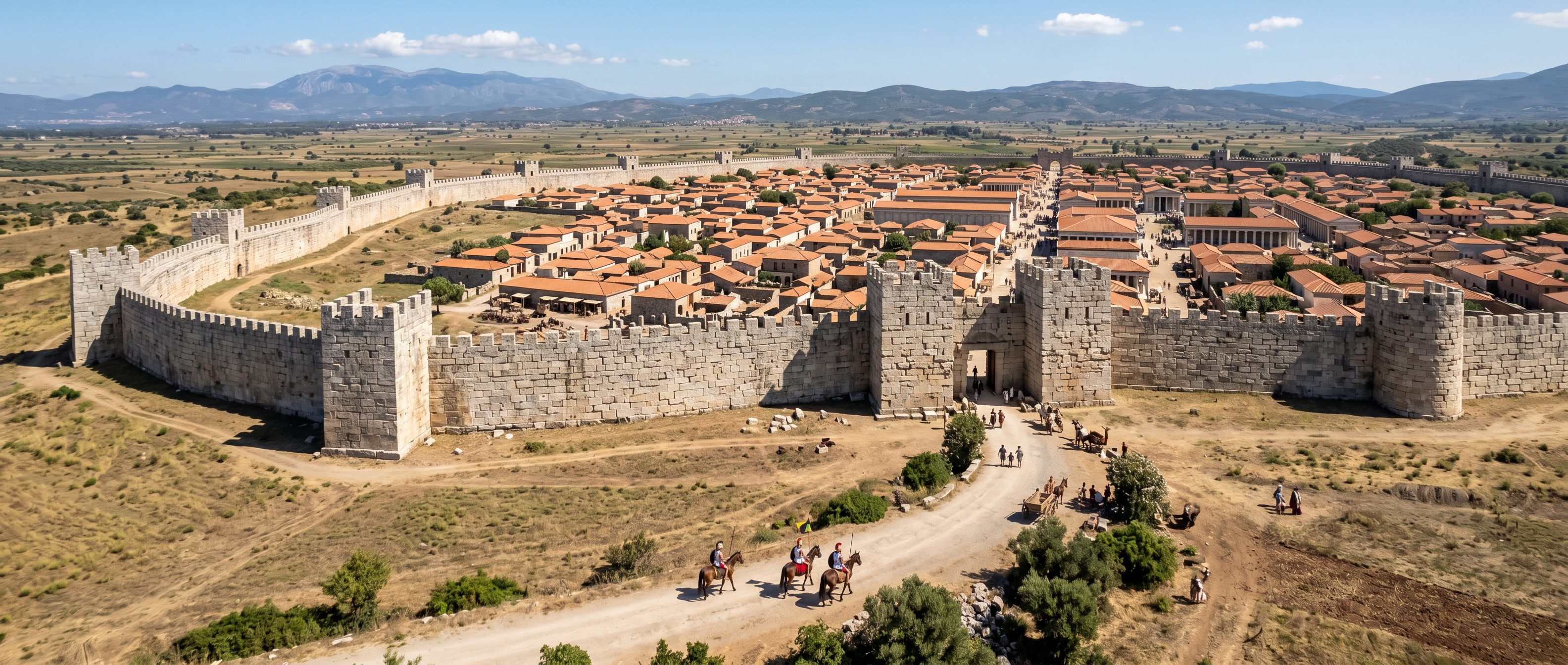
Approach panorama: the stone circuit of refounded Messene
The continuous sweep of cut‑stone wall was meant to be legible from the road: a military argument built in ashlar. From a distance the curtain, its regularly spaced towers, and a dominant gate read like a single sentence about permanence and control.
The wall’s construction showed intentional scale. Towers recurred at a steady rhythm, each projecting enough to create overlapping fields of fire. Behind the curtain the rectilinear roofs of terracotta tiles and the straight lines of planned streets peeked over the parapet. Two small Theban heralds riding toward the gate registered human scale: the fortification was both defense and a public announcement meant to be named in foreign councils and in Theban sanctuaries.
What mattered beyond sheer size was visibility. A Spartan or Peloponnesian traveler could estimate the investment simply by timing a walk along the approach: the uninterrupted length suggested coordinated logistics, quarrying, and a lengthy payroll. In that way the wall functioned as material bookkeeping of Theban effort.
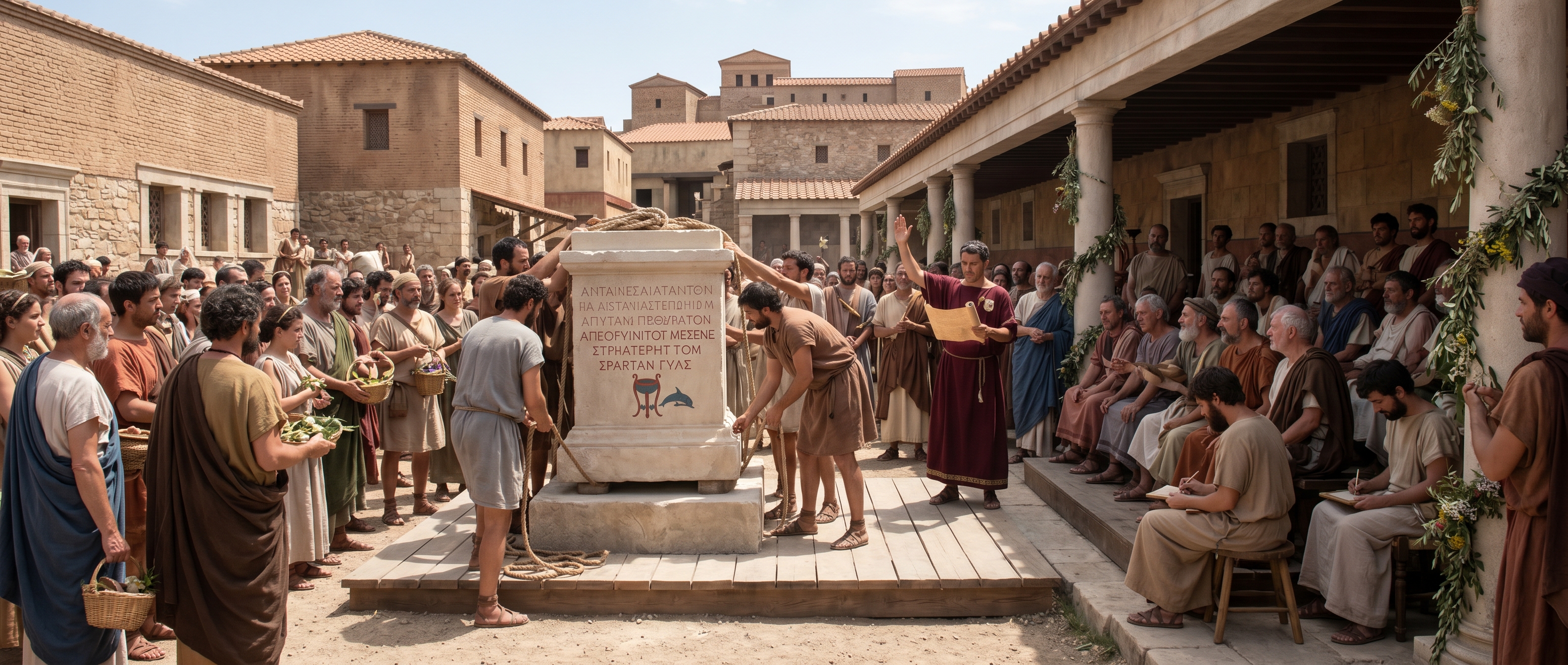
Procession and public display in the Theban agora
The public reading of a Messene decree in the agora turned an expedition into political ammunition. Placing an inscriptional base beneath the stoa and before the synedrion made the text a tool for debate: delegates could point to letters carved in stone while arguing for or against a policy.
The scene mixed ritual and bureaucracy. Benches for Boeotian delegates faced the raised pedestal while attendants unveiled a freshly lettered slab. Citizens clustered; Peloponnesian envoys stood at the margin. Scribes copied the text onto wax tablets, and a tripod offering sat beside the base as if to certify the act ritually as well as legally. The stoa’s open colonnade framed the exchange so that the inscription became both object and script for speech.
What this arrangement did, practically, was to turn faraway achievements into immediate leverage. A well-timed public reading could swing a vote in the synedrion, or be cited in negotiations with allies. The public display made documentary power portable and performative at once.
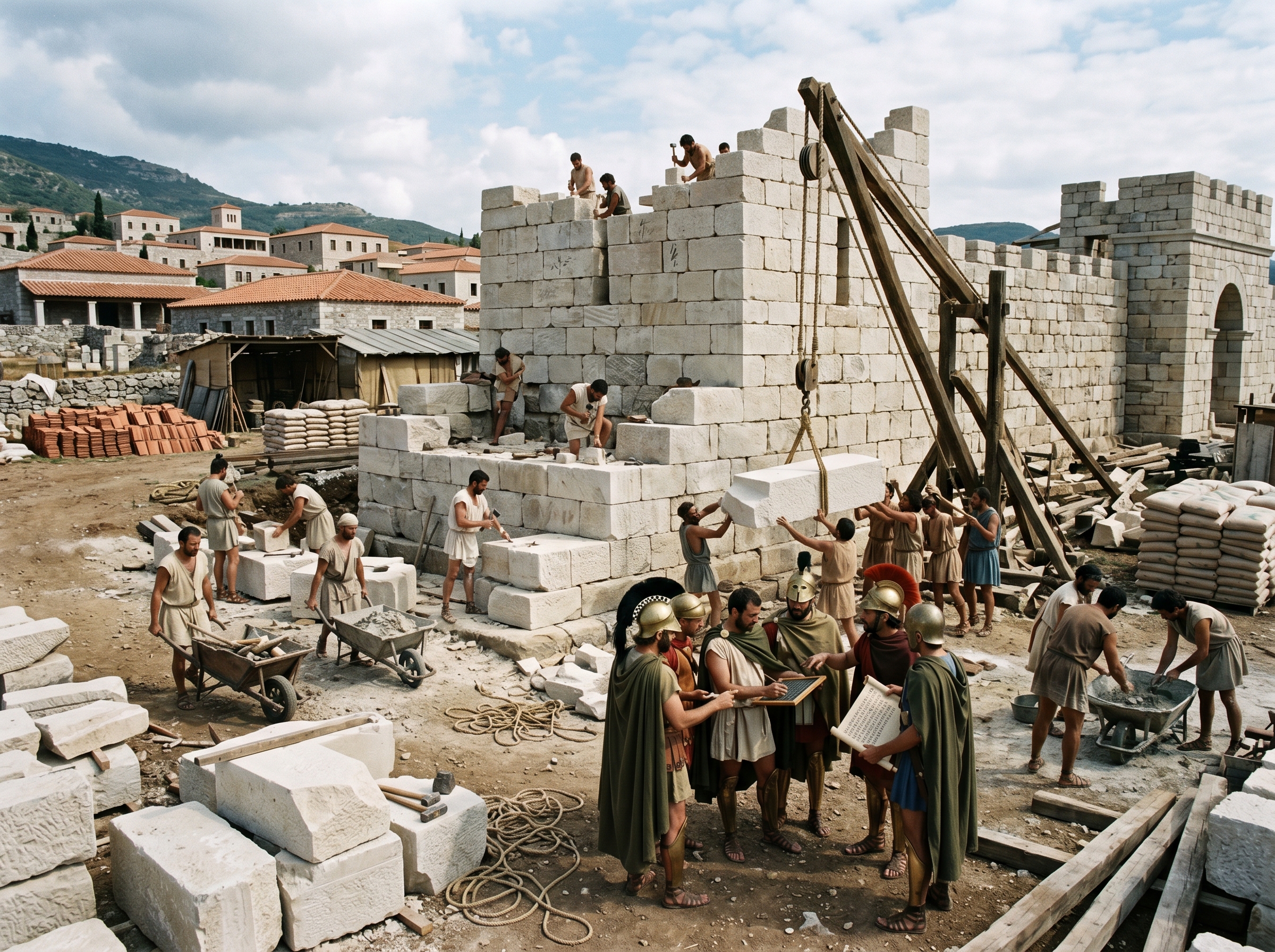
Engineers and colonist assembly at a Messene gate under construction
Refounding meant heavy, organized labor: the gateway and its towers were shaped by masons whose marks and methods left readable traces. Skilled work fused political orders into blocks of stone you could measure and count.
Masons dressed limestone faces with iron tools while wooden cranes and ropes lifted ashlar into place. A group of Theban officers kept tablets with lists of block dimensions and delivery dates; their presence linked each dressed stone to a payment and an administrative record. Piles of terracotta tiles and sacks of lime sat behind the scaffold, waiting for roofing and plaster finishes. Some stones carried quarry stamps and individual mason’s marks, small glyphs that identified crews and, by extension, who would be paid.
Those tiny marks were not decorative; they were part of a logistics system. Modern archaeologists used them to sequence building phases, and ancient officials used them to settle accounts. The making of permanence at Messene was therefore an administrative problem as much as a technical one.
Mason’s marks and quarry stamps on surviving ashlar helped archaeologists and ancient paymasters trace work phases and contractual responsibilities.
City context
Within Thebes, Messene’s refoundation entered civic life as narrative and display. Votive stands and inscriptional bases in Theban sanctuaries recorded the city’s role; visiting envoys and local magistrates could point to named dedications as public proof of Theban achievement. Those inscriptions altered processions and festival routings: parade routes that passed the Ismenion hill and the Cadmea now threaded past visible dedications commemorating success in the Peloponnese.
Ordinary Thebans encountered the project in everyday ways. Soldiers and recruits marched out along established muster routes toward the Peloponnese; craftsmen worked on terracotta tiles and lime-washed façades that matched the aesthetic of the refounded city; public councils in the agora discussed treaties alongside decrees recording the Messene operation. The effect was cumulative—Messene’s walls were far away, but its name and its inscribed dedications were present in the city’s civic vocabulary.
Sources
reference
- Britannica, "Theban expansion" (entry on Thebes and its Peloponnesian campaigns)Link
primary
- Pausanias, Description of Greece, Book IV (accounts of Messene and its foundations)
epigraphic
- Corpus of Greek inscriptions and published dedicatory lists from Messene (inscriptional evidence linking dedications to Theban patrons)