At a glance
Who held the Cadmea held Thebes — not just by force but by ritual and reputation. The citadel was a compact stone plateau whose walls, gates, and processionary approach braided myth, magistracy, and garrison into a single visible claim on Boeotian authority.
What did it mean for a city to keep its origin story and its army on the same hill? The Cadmea occupied a roughly 800 × 500 m plateau that rose above the town in a block of local stone, its foundation courses and circuit walls laid directly on the bedrock. From below its grey-buff walls and red-brown tile roofs read across the plain; whitewashed upper façades flashed back sunlight. That colour and mass were part of its argument: the citadel announced control before anyone reached its gates.
Physically, the Cadmea mixed durable stone footings with mudbrick superstructures and timber roofs for non-monumental buildings, while temples and halls at the high point carried pedimental sculpture and bronze fittings on doors. Gateways and towers punctuated the approaches; a paved axis climbed from the lower town, past market stoas and tripod bases, and reached the citadel where magistrates and priests moved between court and sanctuary. Votive stelai and dedicatory bases filled the open courts, so the approach to the citadel was also a corridor of claims — public inscriptions and offerings that announced who belonged and who had been honoured.
Think of the Athenian Acropolis, but less an isolated shrine and more a hub threaded into the city’s political streets. The Cadmea did not only watch the town; it intercepted processions and assemblies. Gate sequences controlled who could arrive at the high point; the layout made the act of entering into a civic role — a magistrate taking office, a delegation arriving from a Boeotian polis — a movement that passed through both security checks and ritual thresholds.
That blend of myth and muscle raises three pressing questions: how did embedding the foundation myth of Cadmus and the Spartoi in a fortification shape real political power; how did the citadel’s architecture scaffold federative negotiations and public assemblies; and how did a permanent garrison interact with ordinary religious practice? The Cadmea’s stones, roofs, and processional axis provide answers. Its visibility turned private authority into public theatre; its gates and podia converted movement into political procedure; and its courts held both votive offerings and soldiers’ gear — a small, hard fact about how the Thebans made their politics tactile and immediate.
Closer looks
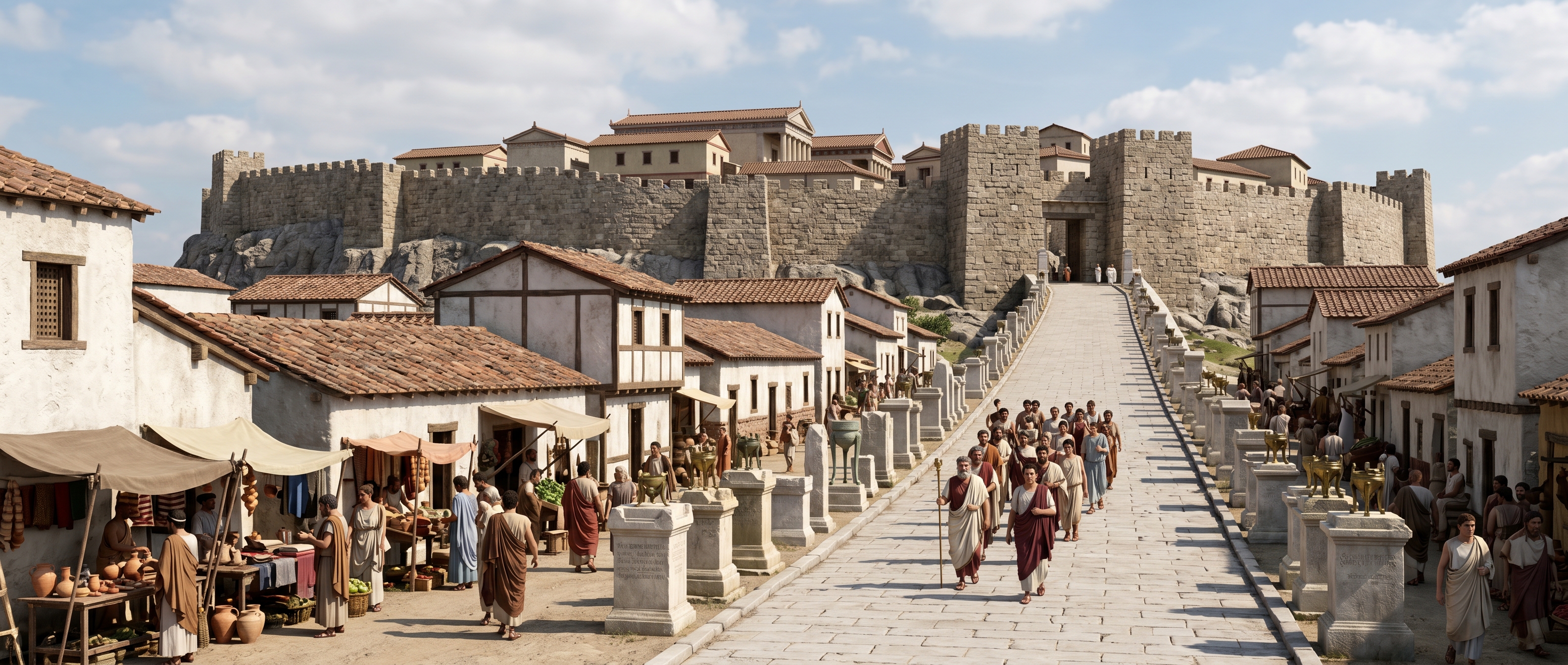
The processional approach — market, podiums, and the climb to the Cadmea
The approach turned movement into municipal speech: climbing the paved axis made private people into public actors. Market stalls and lime‑washed houses framed a single line of sight that ended at the Cadmea’s gate, so every procession read like an argument about who mattered.
Stalls gave way to a row of stone tripod bases and dedicatory stelai set against the curb; their carved surfaces and drilled bolt holes registered past honors and claimed audiences for new ones. Magistrates did not simply walk up the street. They passed inscribed bases where delegates stopped to touch or read inscriptions, chanters set the pace, and bronze fittings on temple doors flashed in the sun when a group paused to present offerings. The choreography made taking office or receiving a delegation an enacted proof, not just a piece of paperwork.
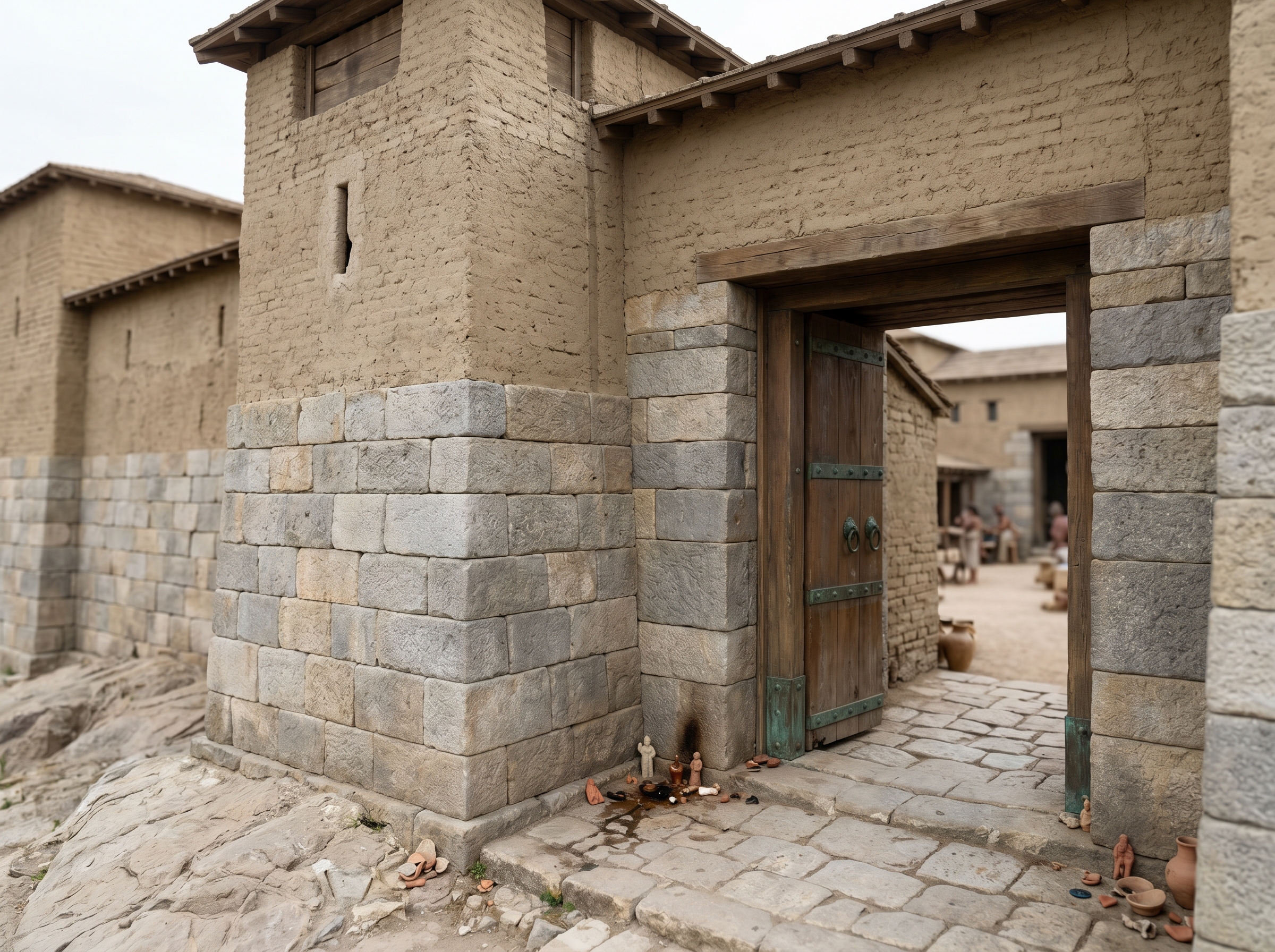
Gate and tower sequence — stone footings, mudbrick superstructure, and bronze fittings
The gate turned geology into authority: foundation courses sat directly on bedrock and made the threshold feel immovable. That visible junction between heavy stone and lighter mudbrick told visitors at a glance which parts of the citadel were built to last and which were lived in.
Coursed local stone rose from the rock, then yielded to mudbrick with timber eaves; a projecting rectangular tower carried narrow arrow‑slits and traces of a wooden hoarding where defenders could mount planks. Bronze ring handles and hinge plates gleamed where hands had pulled the gate leaf closed; the threshold stones bore shallow grooves from centuries of sandals. You could read ritual use in the same details as military practice—smeared oil at the jambs and small votive pegs left in crevices beside the door.
The visible wear on threshold stones often aligned with processional routes, so the deepest grooves matched the paths of magistrates rather than soldiers.
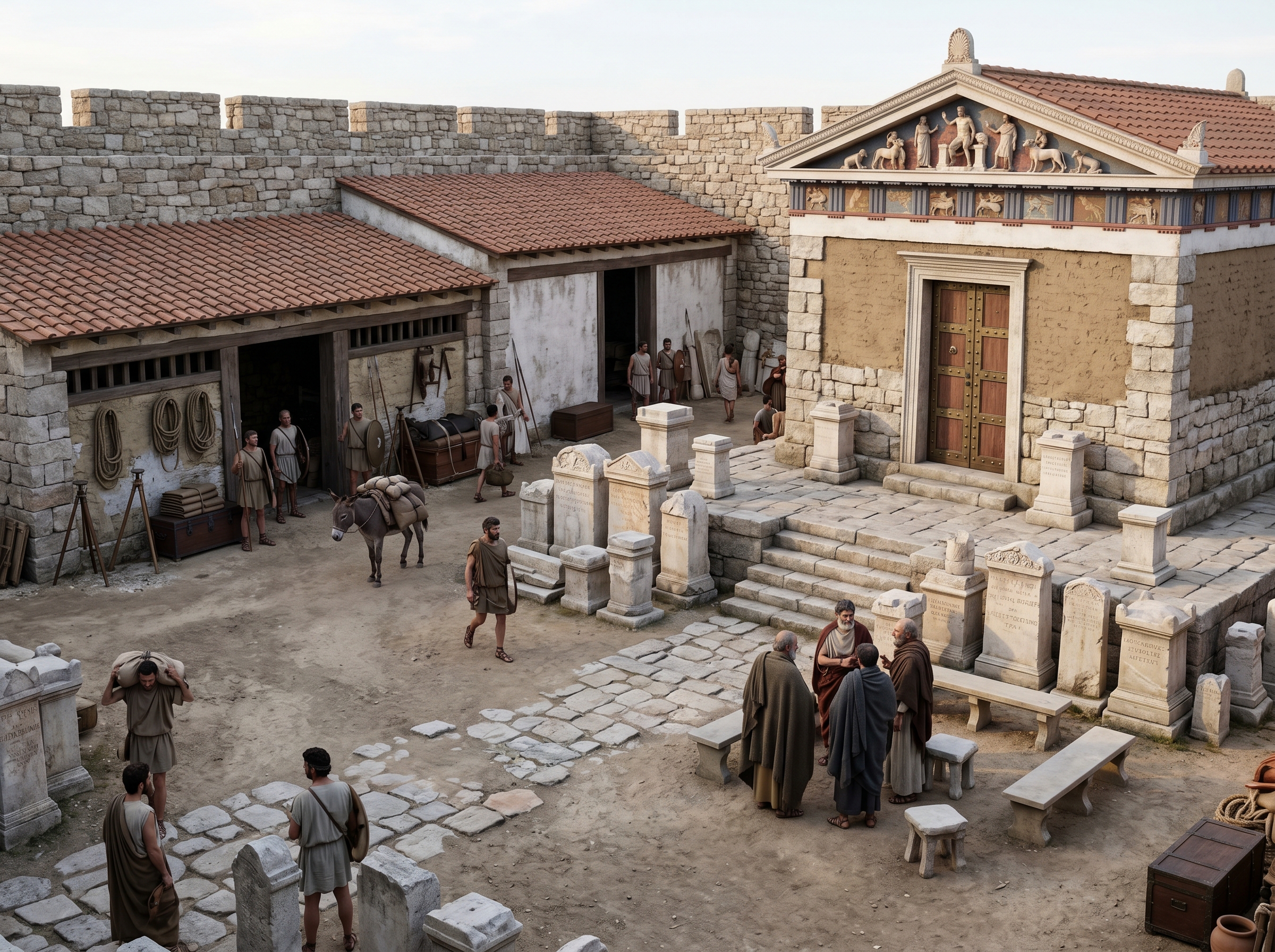
Open court inside the plateau — votive stelai, dedicatory bases, and the forum of federative politics
The Cadmea’s inner court flattened ceremony, memory, and administration into a single surface where people moved and records waited. Temple podia, dedicatory bases, and benches shared the same paved yards, so lawmaking happened inside the same room as reverence and commemoration.
A raised temple podium with painted sculpture faced ranks of votive stelai whose worn inscriptions still showed partial letters and drill marks. Benches and low stone stools provided voting places for federated delegates; clerks and magistrates stored chests and ropes near hall doors so the paperwork, the trophies, and the soldiers’ kit sat cheek by jowl. In practice that meant a decision could be sealed in sight of a god and an army chest at the same moment—public memory and political bargaining were literally adjacent.
Boeotian assembly benches were often placed so that delegates faced the temple podium, making votes visible to sacred sculpture as well as to other polities.
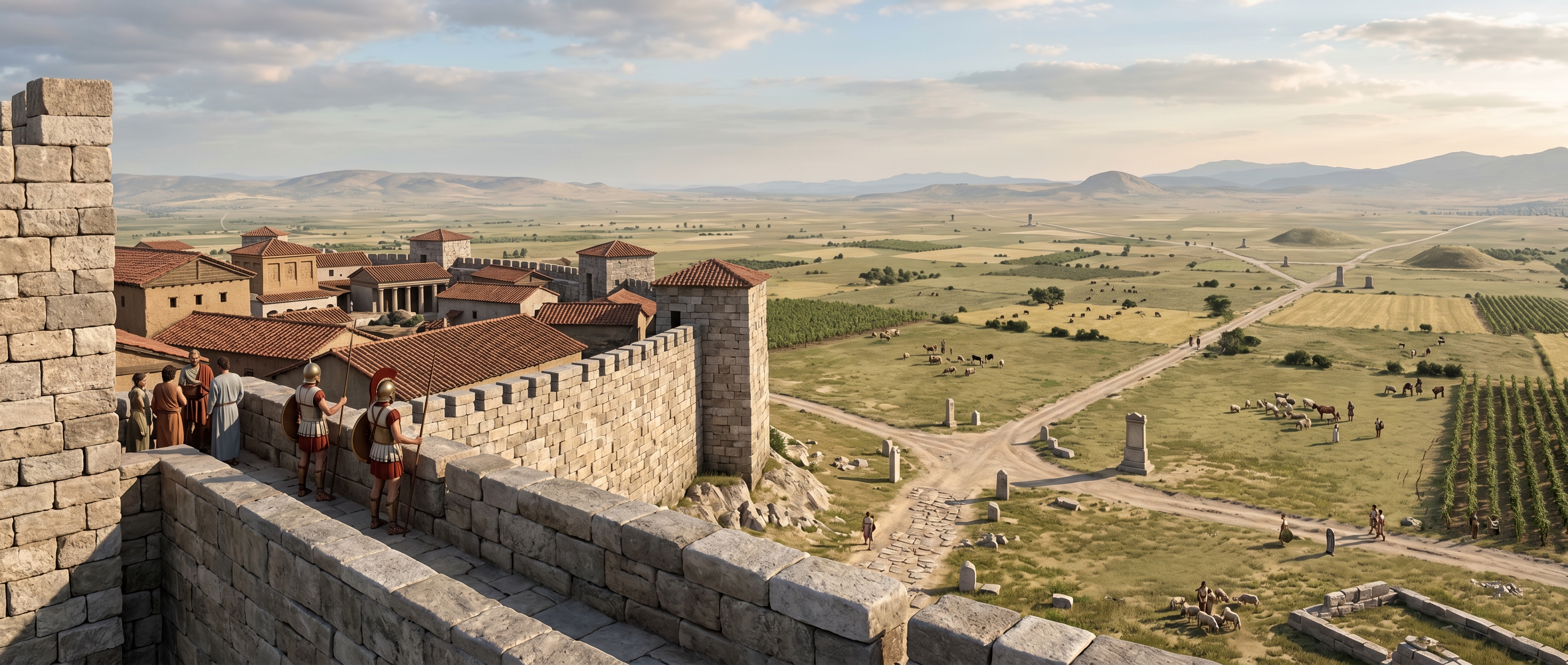
Lookout over the Boeotian plain — sightlines, battle memorials, and the cadence of visibility
From the Cadmea’s parapet the plain read like a ledger of claims and risks: small tumuli and stone markers dotted routes where Thebans had fought and died, positioned to be seen from the city. Those modest monuments made the past legible to anyone leaving or arriving by road.
Sentries leaned on the low circuit wall and watched a series of pale mounds and milestone‑like stelai aligning with clear road traces. The plain was used—farm plots, shepherds, travellers—so the markers competed for attention with ordinary traffic; that was the point. A tumulus was neither a dramatic pyramid nor invisible: it was a deliberate marker placed where travelers would read Theban courage before the gates had to prove it again.
City context
The Cadmea occupied the city’s high point and threaded into everyday Theban life through routes and sightlines. Main streets climbed toward it; market stoas and benches gave way to a paved approach that terminated in the citadel’s gates. Ordinary townspeople met its presence at multiple scales: a baker on a nearby street watched soldiers drill in the morning; festival crowds passed tripod bases on the climb to the Ismenion and then funneled toward the Cadmea; delegates arriving for federal meetings found the same sequence of thresholds that magistrates used.
Ritual and administration spilled into one another on the plateau. Processions arriving after military victories stopped at votive bases and temple podia before entering gates whose bronze fittings clicked shut behind them. The Cadmea stored votive dedications and hosted assemblies that ratified Boeotian agreements; control of its courts therefore meant control of visible honors and the legal forums where federative bargains were sealed. In quiet moments you would have heard sandals on paving, the clink of metal at doors, and the measured commands of a garrison; in charged moments — triumphal returns or emergency musters — those sounds tightened into political performance.
Sources
research-essay
- City essay: Thebes (fourth-century civic project that braided cult, council, and infantry).
landmark-summary
- Landmark summary: Cadmea (physical details, materials, layout, and human activities).
reference
- Cadmea — WikipediaLink