At a glance
The Boeotian synedrion locus showed how Thebes turned modest stone and inscription into regional power: a roofed hall or open stoa beside the agora where delegates met, decrees were posted on stelai, and ritual display helped make political bargains public. The place made federation tangible—votes, speeches, and votive slabs sat in the same visual frame as markets and processions.
What did a city do when it wanted to govern its neighbors without a distant fleet or a Spartan barracks? The Boeotian synedrion locus answered that question by concentrating the instruments of lawmaking, publicity, and ritual within a single civic setting. Visitors would have faced a compact, stone-built hall or an open stoa just off the agora, with benches or low stone seating and wooden fittings that had been painted to catch the sun. Inscription slabs and votive markers lined its edges—decrees in the light, offerings in the shadow—so that law and cult stood literally side by side.
The human choreography was unmistakable. Delegates arrived from about a dozen Boeotian poleis, scribes copied motions on wax tablets or draft papyri, and heralds read decisions aloud from a raised spot where a base or podium might have sat. The scrape of styluses and the low murmur of bargaining mixed with the sharper noises of the marketplace a few yards away: carts, sellers calling, and the clack of sandals on paved approaches. Compared to an Athenian tribute assembly or a Spartan military muster, this locus built authority by visibility and negotiation rather than by spectacle or discipline alone.
Three questions matter most here. First: how did public display—stelai, votive dedications, visible lists of decrees—convert speeches into enforceable policy? Second: how did a modest architectural frame create parity among unequal cities, making negotiation legible to crowds? Third: how fragile was that architecture of consent when military defeat or political rupture arrived? The physical details are the evidence: painted wood and limestone, a line of inscription bases, a single raised reading platform—small investments that amplified words into regional order.
Read in the context of Thebes’ wider program—processional axes climbing to sanctuaries, rostra and podiums for victory dedications, and plain-facing military memorials—the synedrion locus changed the city’s image. It made Thebes appear not only as a military innovator but as a city that managed power by organizing audiences and records. That fusion of cult, council, and inscription helps explain why Theban claims looked convincing from the road and why their loss felt so decisive when the Sacred Band fell or punitive action followed.
Closer looks
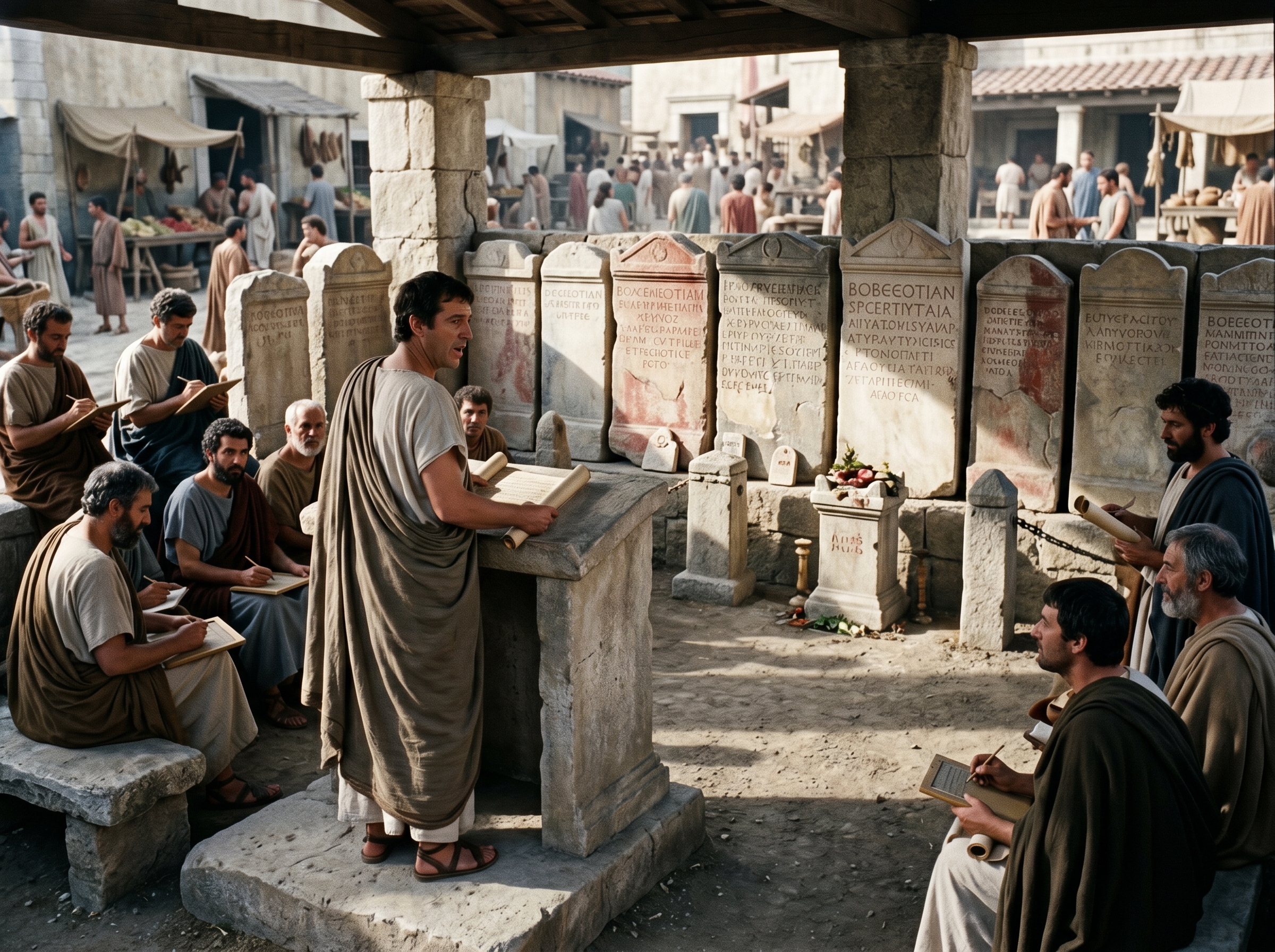
Raised podium reading with decree stelai behind
Voice, stone, and crowd worked together to turn a speech into something you could point to the next morning. A herald stepped up onto a low, roughly dressed stone base and read motions that scribes had already copied on wax; those spoken decisions were then set beside him in a closely spaced row of inscription slabs so anyone could check the words later.
The podium itself was modest, half in sun and half in shadow, which made a live voice cut across the agora while the stelai caught the light. You would have noticed chiseled letter-bands with dark pigment still clinging in the grooves, a scattering of small votive markers between slabs, and delegates leaning close with styluses and rolled-up draft papyri. The effect was civil procedure made tangible: one could hear the argument, watch it be recorded, and then read it in stone.
Heralds read aloud from a low stone base; scribes took fast notes on wax before decisions were translated into carved stelai.
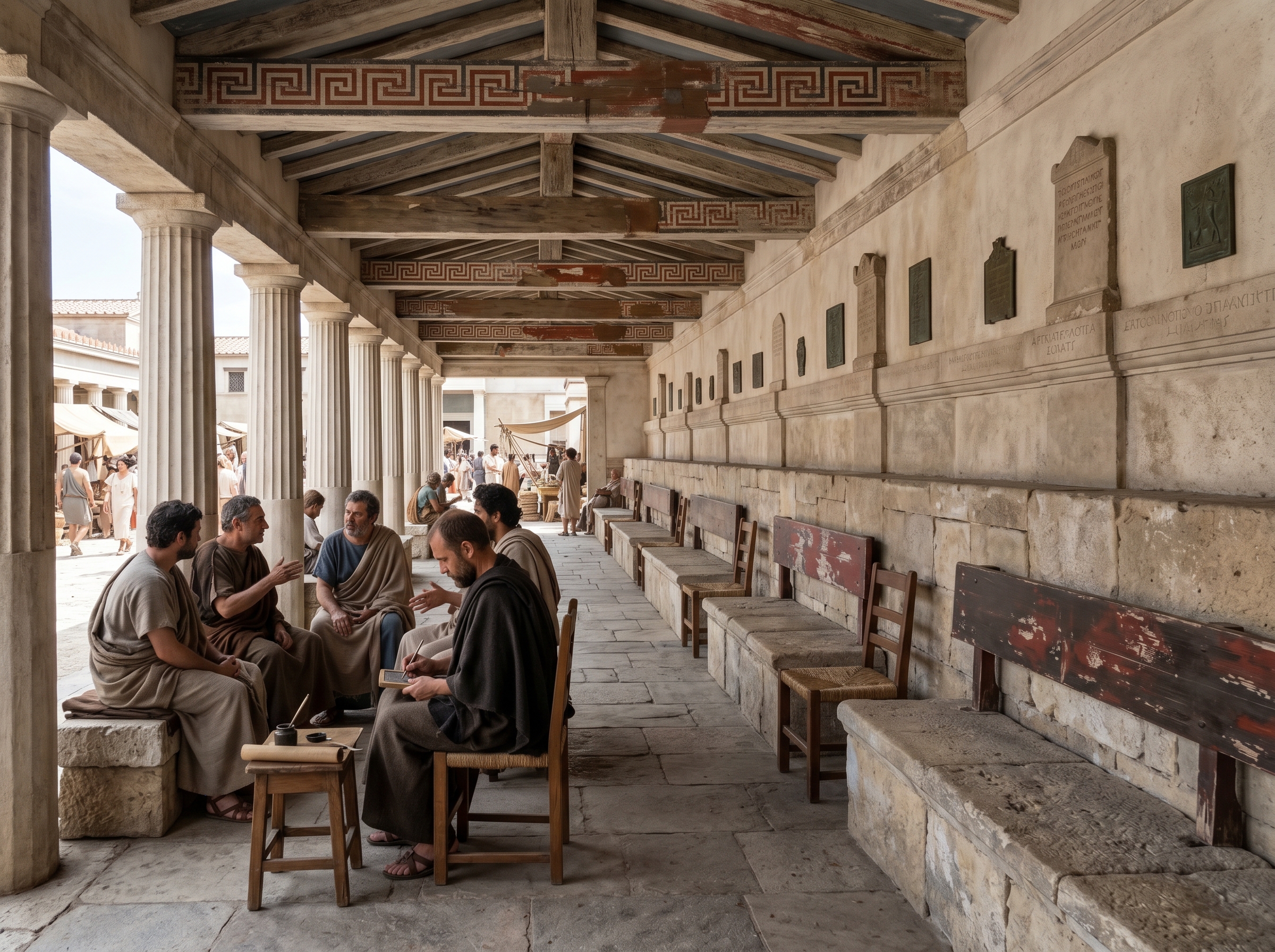
Delegates under a roofed stoa: painted wood and stone seating
The stoa’s furnishings did more than make people comfortable; they enforced a kind of equality. Stone benches were set at the same height, small wooden chairs or removable backs matched across the line, and that uniformity kept large cities and small poleis on the same visual plane when they argued.
Painted beams and a simple geometric soffit framed the meeting and helped trap and soften the market noise outside, which let low-voiced bargaining proceed without every word being carried into the street. A scribe sat at a bench copying a decree onto a wax tablet, an inkwell near at hand, while pigment loss and patched repairs on the wood showed that these fittings were lived in and mended over seasons. Those tactile choices—bench height, chair style, the painted ceiling that darkened the room—were small architectural rules that shaped how decisions were made.
Matching benches and modest wooden fittings created a predictable seating order, a physical grammar that made parity among delegates legible.
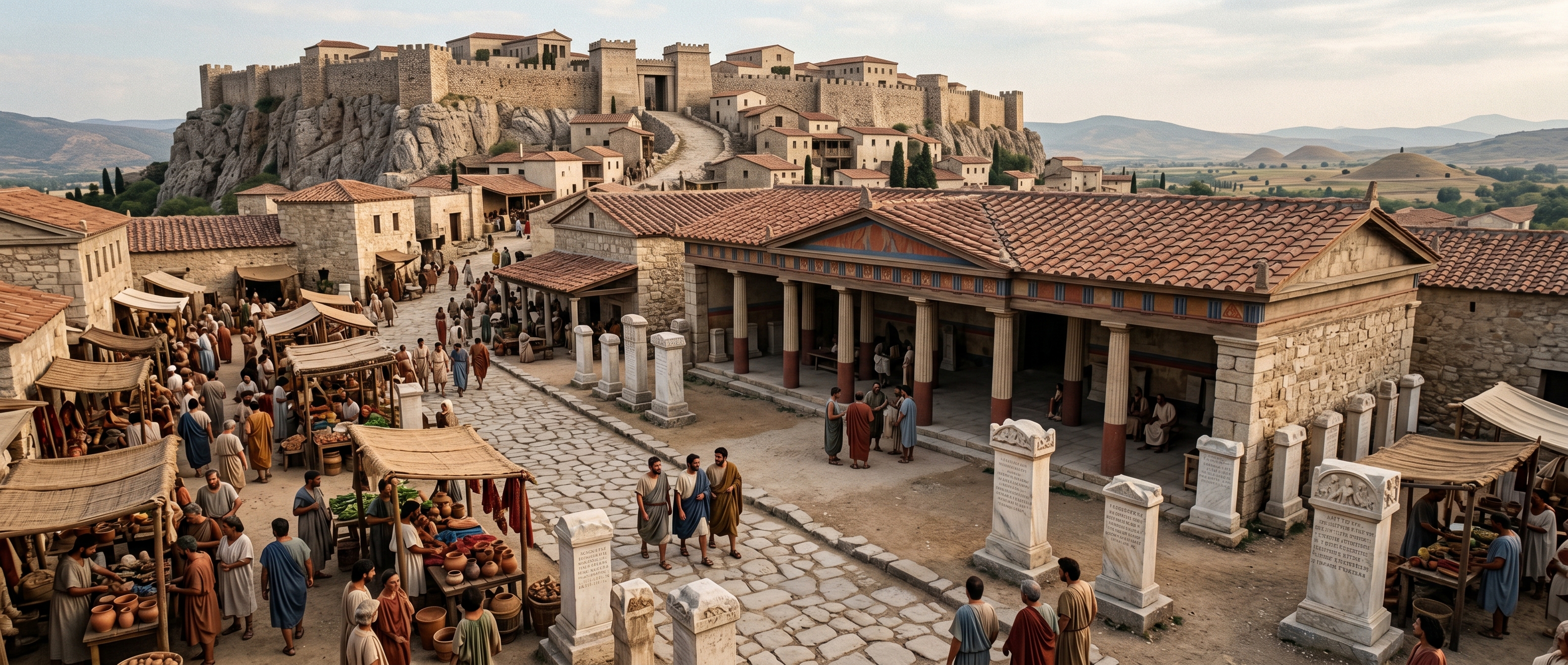
Wide view: synedrion locus between agora and Cadmea
Placing the synedrion between the agora and the Cadmea meant federative politics announced itself from the road. The hall’s red-brown tile roof and painted pediment read against the stone mass of the Cadmea, so anyone arriving along the main approach first encountered laws, votive slabs, and processional axes before they reached the citadel.
In the foreground market stalls funneled people toward magistrates’ bases and the paved approach where small groups of delegates arrived. Beyond the assembly locus you could see tumuli and low memorial markers on the plain—battlefield memory kept visible from town and from the road. The arrangement behaved like a civic billboard: what passed through those benches and stelae was meant to be seen, judged, and remembered by travelers as much as by residents.
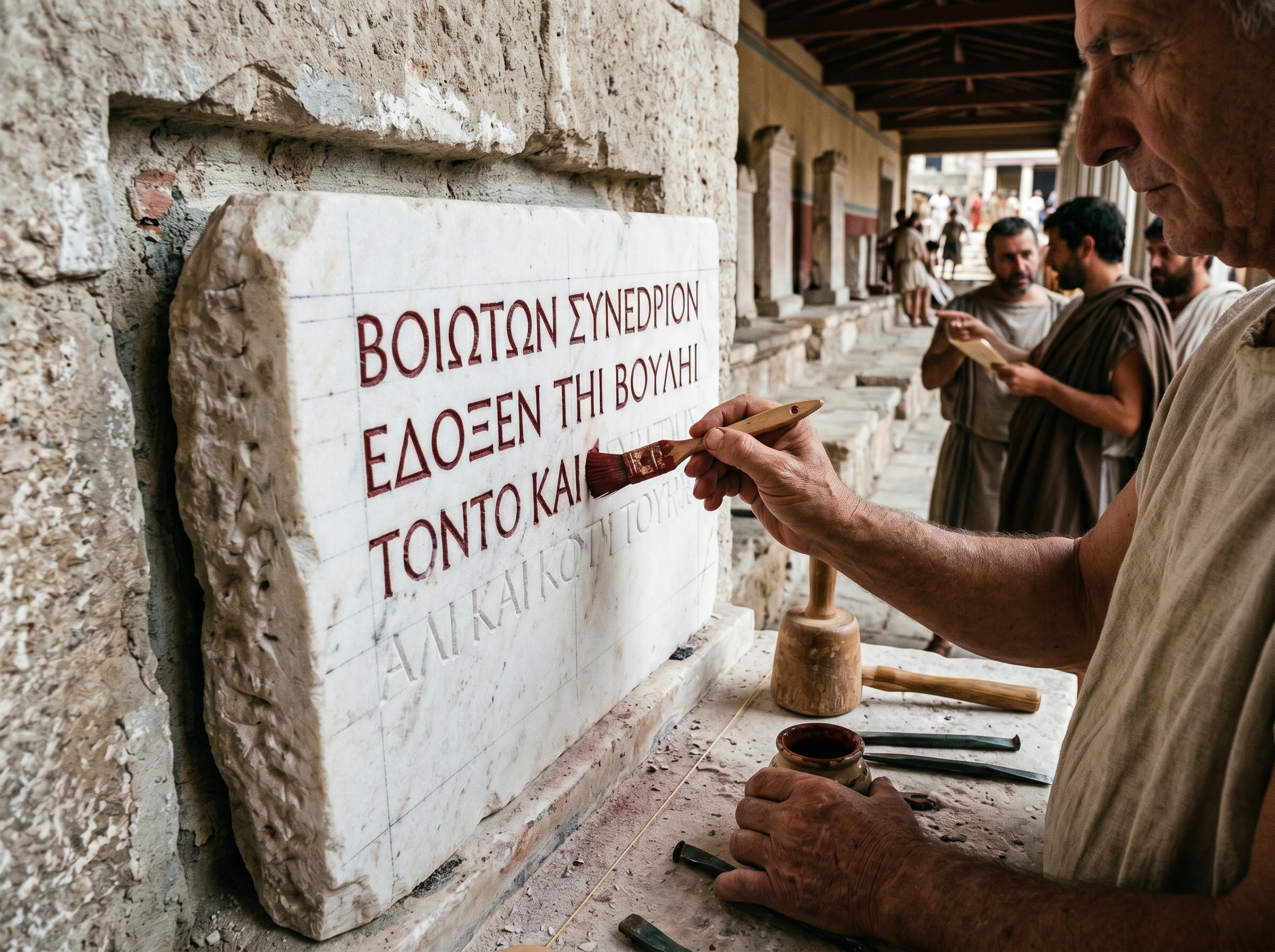
Close detail: a decree slab in mid-installation
Letters were work. A chisel left rough marks and faint pencil-like grid lines guided spacing long before pigment darkened the grooves; an artisan applied a dark wash into each incision so carved words could be read from a short distance in bright sun.
Tools lay nearby—a mallet, several chisels, a length of measuring string and a wooden support frame—and you could see how the base of the slab fit into a shallow socket when set. Citizens watched and compared as the final strokes were made, and corrections or patched letters were often visible for decades afterward. Those visible repairs and the repeated repainting were part of how law stayed legible in a place where weather and argument constantly threatened to erase it.
Carving and pigmenting letters made decrees legible at a distance; the work was public, repetitive, and left visible repairs that future readers could still detect.
City context
The synedrion locus sat beside the agora and formed one of the city’s political arteries. Market stalls, magistrates’ bases, and stoas fed people and information toward the assembly site; merchants could listen in, bystanders could read freshly set decrees on nearby stelai, and visiting delegates stepped straight from inns into a public forum. Ordinary Thebans encountered federal politics as part of daily movement: a law was not only proclaimed but posted where shopkeepers and priests might see it the same day.
Ceremony threaded through routine. Delegates arrived behind processional lines that ran from lower town streets toward sanctuaries, so the council’s sessions often followed or preceded festivals and votive dedications. Military decisions passed through the same public frame as religious offerings: a decree sending out troops could be read aloud from the podium, set in stone on a stele, and ritually thanked at a nearby altar. That proximity made federative decisions visible, collectible, and vulnerable—the very things that helped Thebes bind allies and that later turned those records into proof of fragile ambition after defeats.
Sources
reference
- Encyclopaedia Britannica, entry on the Boeotian LeagueLink
epigraphic corpus
- Regional epigraphic records and decree collections for Boeotia (inscription slabs and public stelai)