At a glance
The Lion at Chaeronea turned a battlefield into a civic stage: a carved marble beast guarded a rectangular mass grave of roughly 254 fallen Thebans, making military sacrifice a visible, routable part of Theban identity. Its scale, placement, and accompanying graves forced visitors to read loss as a public argument about Thebes’ claims and risks.
What did Thebes want people to see when they left the city and crossed the plain toward Chaeronea? The site answered with an image: a carved marble lion, mounted high on a stone pedestal roughly 3.8 meters tall in total display, positioned at the edge of a fenced funeral enclosure and backstopping a rectangular burial pit where about 254 skeletons lay in ordered rows. The monument turned the dead into an arranged surface you could meet on the road.
The lion’s material—white to grey marble—caught midday light differently from the earth tones of the burial pit. Visitors placing offerings would have left votive objects on inscribed bases at the pedestal; cypress plantings framed the enclosure and added a dark, resinous scent to the air. Those concrete details made the site an experience: the scrape of sandals on packed earth, the low murmur of recited names, the sightline from the road to a stone beast that both dominated and marked a place of human bodies.
This was not an isolated hero-tumulus tucked among trees. The lion and the polyandrion sat where passersby could not avoid them. Compared with other Greek memorials that marked single heroes or anonymous shrouds, here was a communal grave anchored by an overt visual emblem of martial power. The juxtaposition—luxuriant marble above neatly arranged corpses—asked questions about who paid for such a memorial, who decided to memorialize the dead in public, and why a city would place such a vulnerable, inviting object out in the open.
Two difficulties complicated the message. The Sacred Band had a reputation for 300 paired warriors, yet the burial contained about 254 bodies; the discrepancy forced later audiences to debate loss, rescue of bodies, and selective commemoration. Second, making the battlefield visible and routable meant memory was public and open to rival viewers. That clarity of address—the plain, the road, the lion—made the site a bold civic claim and, at the same time, a visible measure of Thebes’ exposure on Greek stages of power.
Closer looks
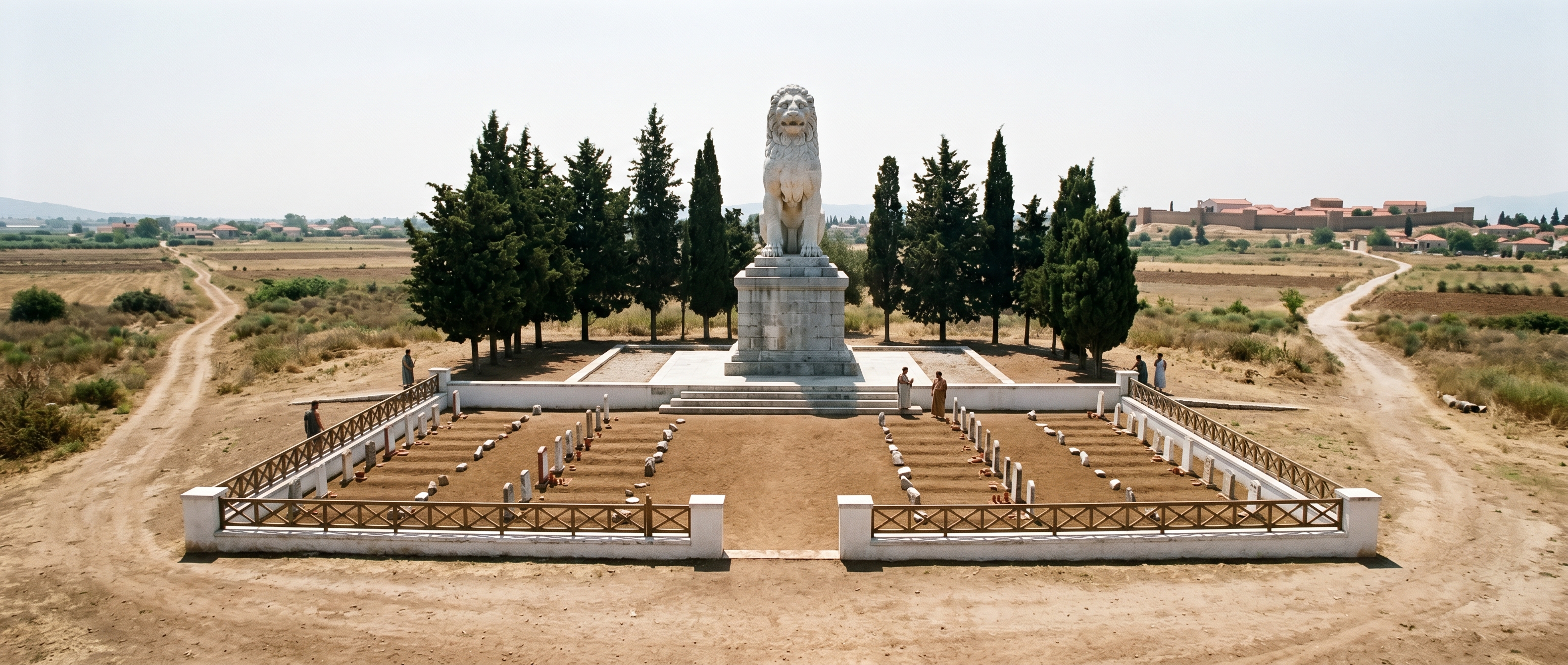
From the road: the lion backstopping the ordered graves
Seen from the road, the monument read like a punctuation mark on the plain: a white-grey block of marble rising above a neatly fenced rectangle of packed earth. The lion and its pedestal—about 3.8 m in total height—caught the sun and broke the monotony of brown soil so that anyone walking the route toward Thebes could not miss the place where men had fallen.
The visual program relied on contrast. The marble’s pale surface flashed against the darker burial pit; the straight edges of the fenced polyandrion answered the sculpted curves of the beast. The road in the foreground organized sightlines: approach compressed time, turning the moment of passing into an act of recognition. Travellers, envoys, and neighboring soldiers read loss as an arranged scene rather than a stray graveyard, because the monument was deliberately scripted to be seen from a distance.
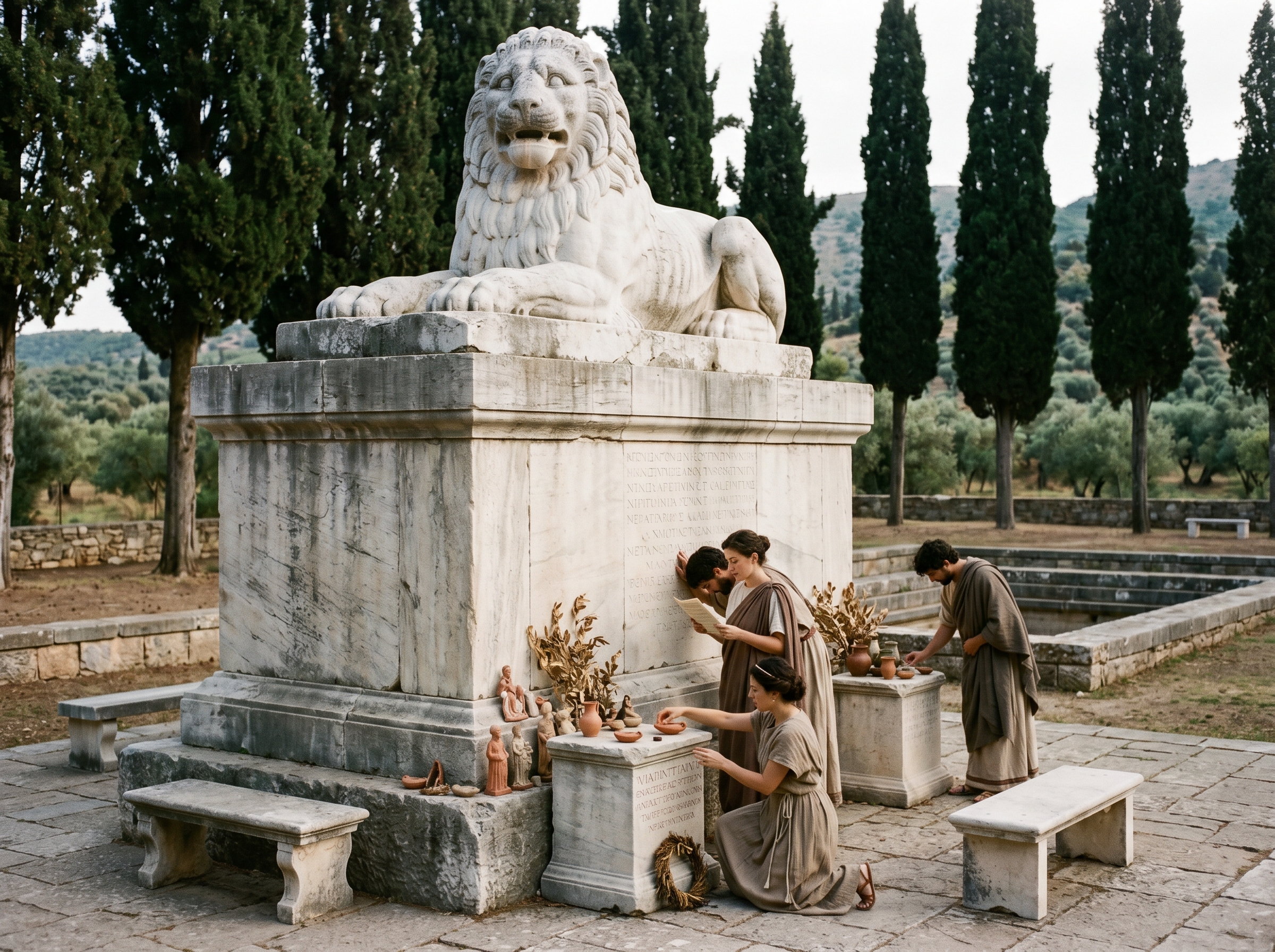
At the pedestal: offerings, inscriptions, and people
Close to the pedestal, the lion became part of everyday rituals: small, repeated acts that kept memory alive. People left simple pottery, oil lamps, and wreath fragments on inscribed bases; some smoothed dust with a palm, others traced letters still visible in the stone.
Those tactile encounters grounded the monument’s meaning. The pedestal’s chisel marks and worn edges showed hands had brushed it for generations. Cypress planted at the enclosure’s edge gave a resinous scent that accompanied offerings and quiet readings of names. This was not theatrical remembrance; it was private loss enacted in public, visible evidence that individual grief and official commemoration overlapped at Chaeronea.
Inscribed offering bases around the pedestal carried dedicatory marks where visitors left votives and short inscriptions.
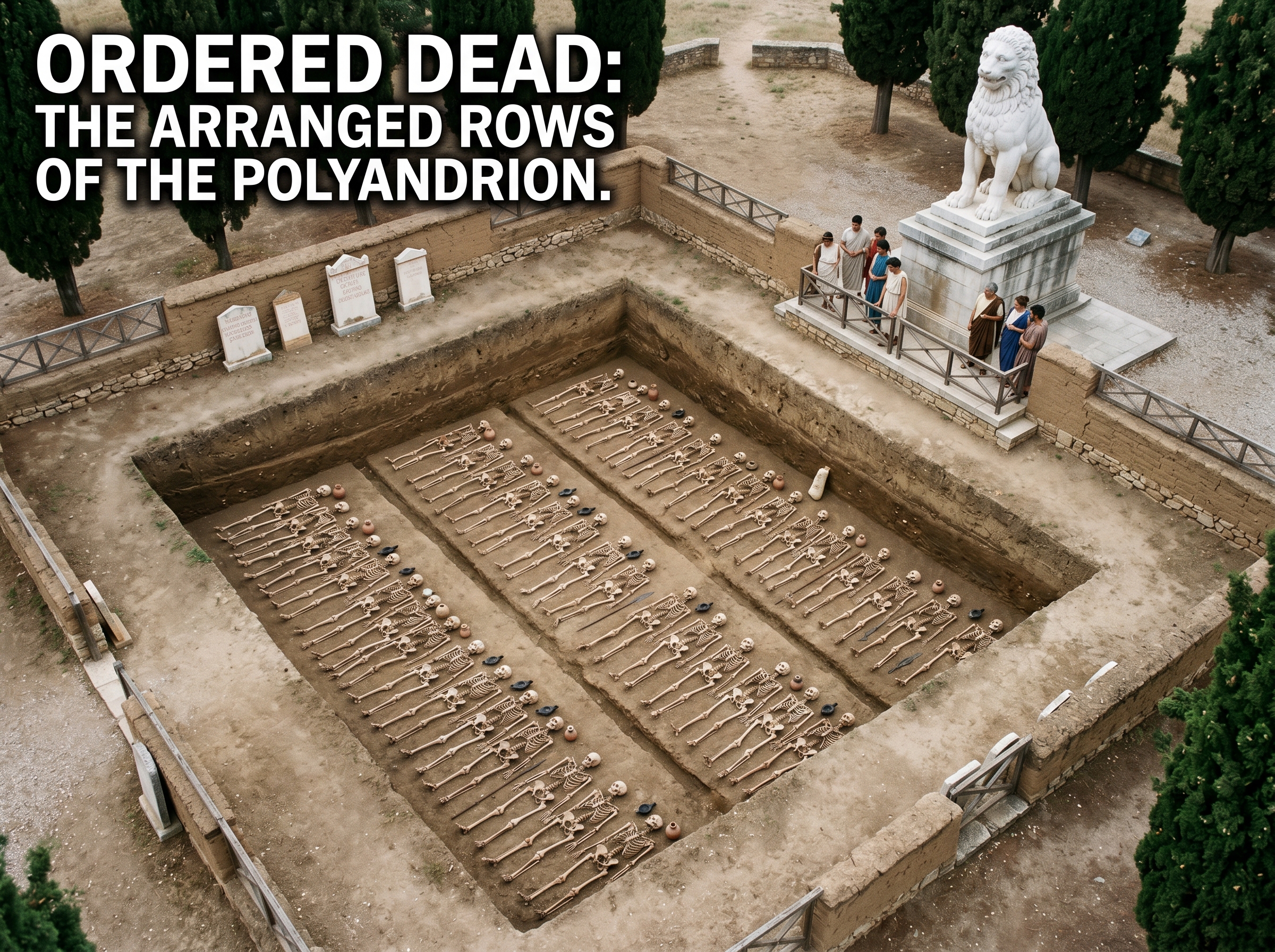
Ordered dead: the arranged rows of the polyandrion
The burial pit made order out of battlefield chaos: roughly 254 skeletons lay in parallel rows, packed with deliberate spacing and orientation. The arrangement turned anonymous deaths into a legible, civic deposit rather than a scattering of corpses.
Archaeological traces suggested quick but careful organization—small gaps between rows, consistent alignment, and an absence of lavish individual goods. That pattern raised a hard question for contemporaries and later viewers: the Sacred Band was famed as a unit of 300 pairs, yet the polyandrion held about 254 bodies. The mismatch forced conversations about who was recovered, who lay elsewhere, and what the city chose to commemorate.
Excavations recorded approximately 254 inhumations arranged in rows, emphasizing collective rather than individual funerary treatment.
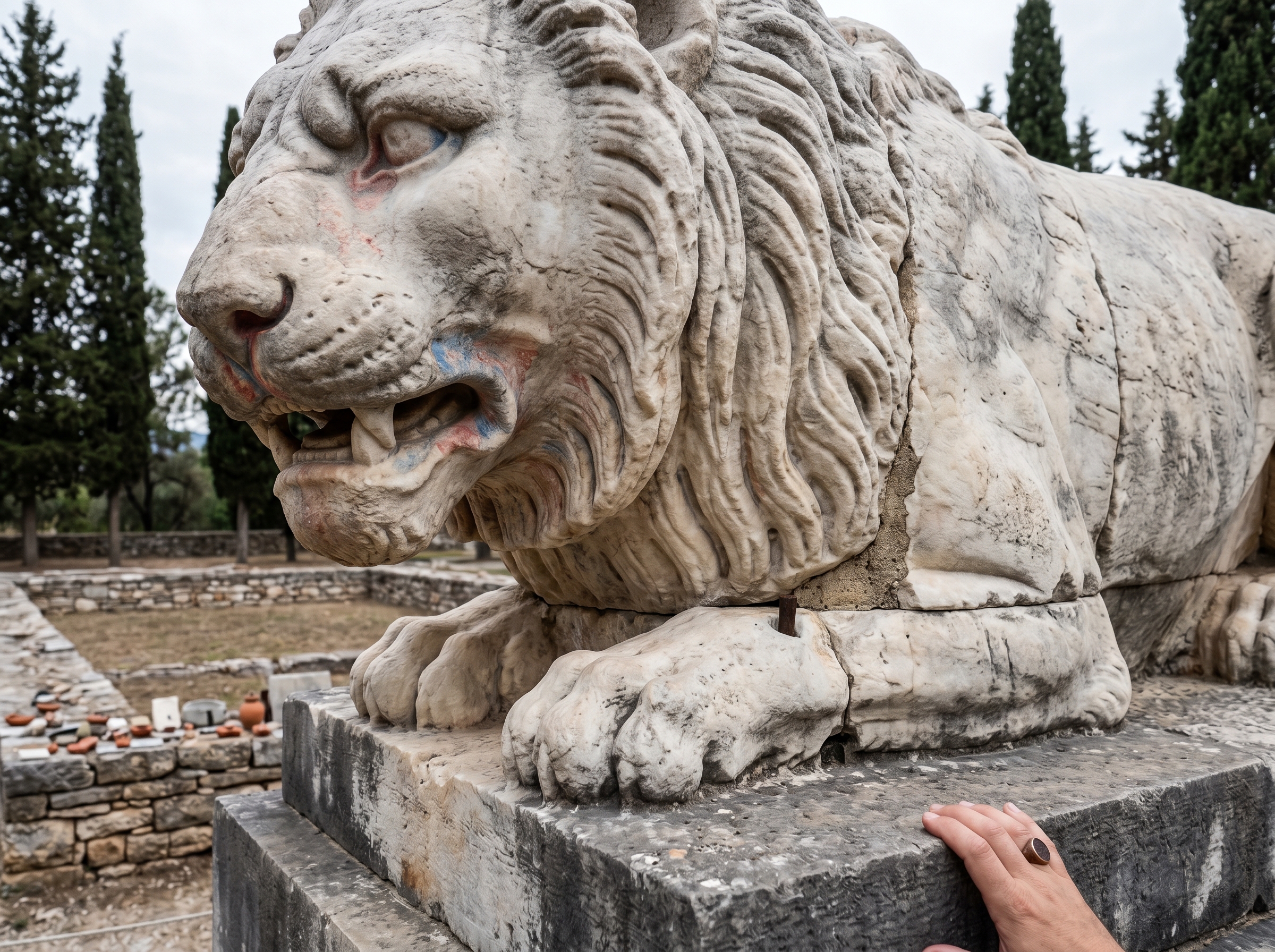
Close detail of the carved lion: material, scale, and traces
The lion’s power came from material decisions as much as from pose. Carved in white-grey marble and assembled on a stone plinth, the animal showed visible tool marks, seam lines where blocks met, and small dowel-holes that hinted at metal fittings used in construction.
Close inspection changed how the monument read at a distance. Deeply carved strands of mane threw sharp shadows; smooth planes caught highlights. Weathering and a thin patina softened original edges, but tiny traces of pigment were plausible on recessed areas—suggesting the beast once had subtler color cues to sharpen facial features at a distance. A votive or a hand near the base provided scale: the lion was deliberately larger-than-life when viewed from the road.
Seams and dowel-holes on the plinth indicate the statue was assembled from multiple blocks and likely secured with metal fittings.
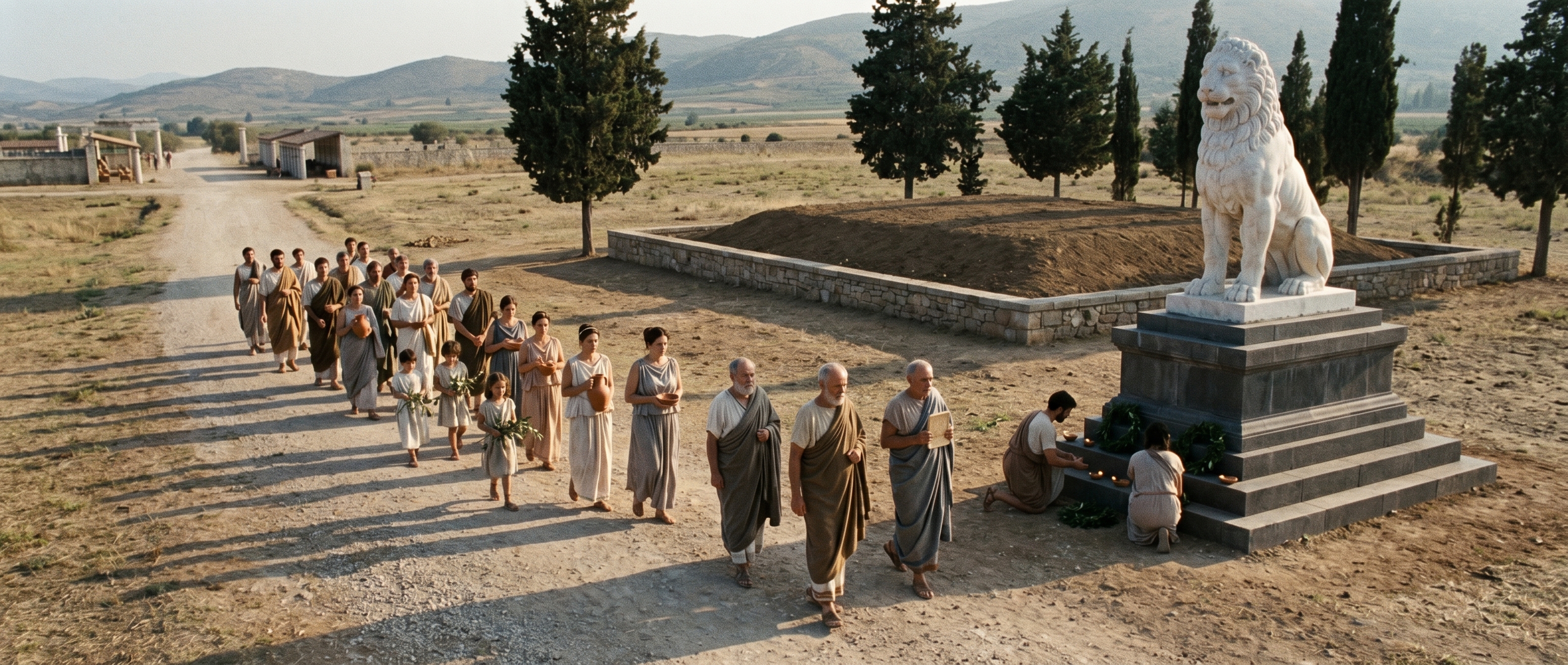
Procession route: reading the monument as civic pedagogy
The monument worked like a civic lesson on the move: processions approached along a clear axis, paused, and treated the graves and the lion as material curriculum. City officials, veterans, and relatives walked the route, halted before the pedestal, and performed short rites that taught younger citizens what Thebes valued in war.
Framed by faint stoas and market edges in the middle distance, the approach turned the memorial into a terminus for federative display. Delegations passing that way encountered an argument about sacrifice and authority made with stone and soil—the kind of message a city sent not inside a council chamber but out where allied and hostile eyes could read it on the plain.
City context
The lion and burial belonged to a civic grammar Thebes had been constructing for decades: religious platforms, council loci, and procession axes that made public acts visible. Military valor in Thebes was not confined to maneuvers on the plain; it circulated through temple courts and civic rostra. The Chaeronea monument extended that circuit beyond the city walls. Delegations traveling to Thebes or merchants using the road saw the lion and the ordered graves and understood, at once, a claim about sacrifice and authority.
Ordinary Thebans encountered the site through ritual and memory. Families came to place offerings on inscribed bases; veterans and civic officials used the place during commemorative rites; youths learning the city’s history would have been marched past the enclosure as a lesson in civic identity. Because the memorial sat where it could be read from the road, its audience included not only Theban citizens but federated allies, visiting envoys, and hostile eyes—so that the monument performed both inward consolation and outward persuasion.
Sources
reference
- Britannica: Battle of Chaeronea (338 BCE)Link
site dossier
- Lion of Chaeronea and Sacred Band burial — site dossier (physical and contextual details)