At a glance
Why would a conqueror spare a poet’s house while razing a city? The story of Pindar’s house turned a private, domestic space into a piece of public memory—an emblem that linked literary prestige to political calculation. Reading the house against Thebes’ streets shows how built things could be repurposed as instruments of reputation and rule.
What happened when a place that had held poems, guests, and everyday life became a political prop? Ancient writers said that when Alexander punished Thebes in 335 BCE he left the house of Pindar untouched. Imagine a modestly grand Theban dwelling—stone footings, mudbrick walls, a timber roof covered in red terracotta tiles, and a whitewashed façade catching the late-afternoon sun—standing unburned among broken walls and charred timbers.
Physically, that house would have felt domestic rather than monumental. A central open courtyard (aulê) opened onto three to six rooms whose painted plaster reflected daylight inward. Floors creaked with routine tasks: cooking smoke moving up through the roof tiles, vessels clinking, a half-dozen men reclining for conversation around a single small table—roughly a dozen people at a symposium would fit comfortably in its reception rooms. If it belonged to a well-known household, painted interior panels or dedicatory marks might have announced connections to poets and patrons.
The crucial question is not whether a famous man had lived here—he did—but why the building's survival mattered. In Thebes, public identity ran on visible signs: votive tripods, temple pedestals, and the Cadmea’s stone mass. A preserved poet’s house translated literary prestige into a tangible object that an outsider could point at. For Alexander it offered a way to project magnanimity toward Greek culture while annihilating civic opposition; for Thebans, the spared house could be read later as claim, loss, or insult.
Seen close-up, the house highlighted a wider city habit: private spaces participated in public memory. Houses with whitewashed walls and tiled roofs formed the backdrop for processions up to sanctuaries; their courtyards sheltered conversations that shaped federative politics. If one of those houses was singled out during a sack, the gesture linked domestic life to the larger narratives of power that ran across the plain and into the temples.
Closer looks
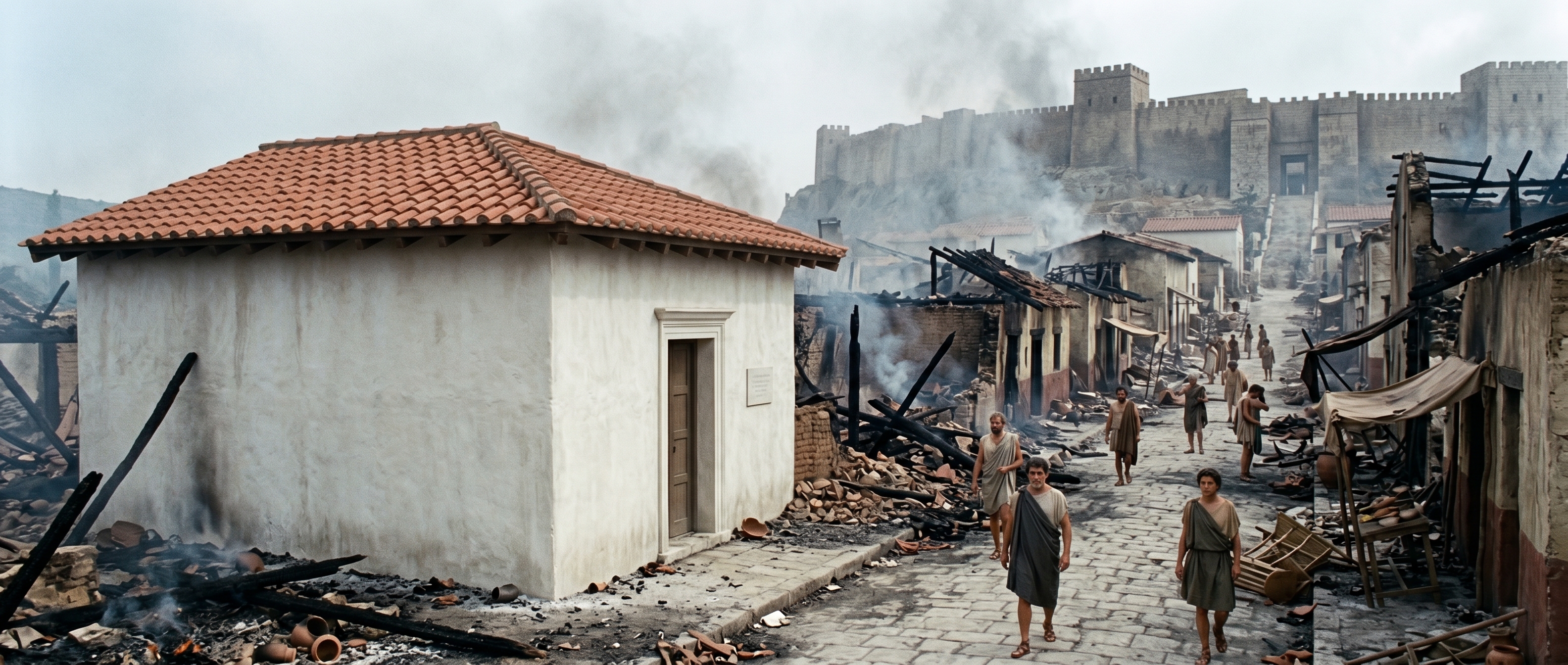
The spared house standing amid the razed street (wide)
A single intact house turned destruction into a public performance. Among collapsed roofs, smoking timbers, and toppled mudbrick walls the whitewashed façade and neat row of terracotta tiles read like a deliberate message: cultural prestige left standing amid civic punishment.
The house had the proportions of a modestly grand Theban dwelling—stone footings, mudbrick upper walls, a timber roof—and it occupied a processional frontage people passed on their way to the Cadmea and the Ismenion. That placement made the gesture legible to traders, envoys, and pilgrims: sparing a poet’s dwelling was not private mercy but a visible argument about who counted as cultured and why. The contrast between soot-free eaves and blackened neighbors turned an ordinary domestic elevation into a tool of reputation and restraint, usable by a conqueror to claim magnanimity without sparing civic life.
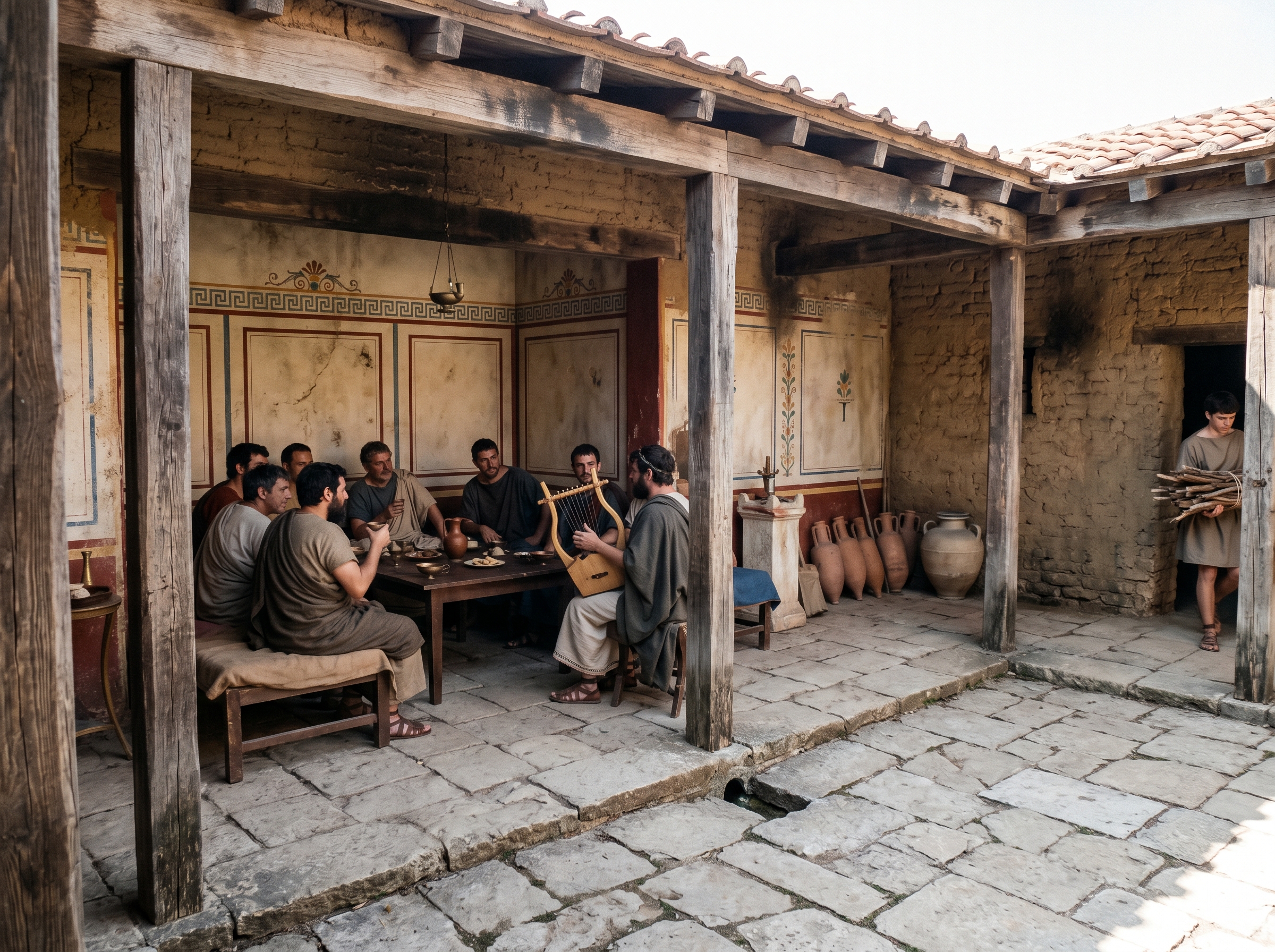
Aulê and reception room during a daytime symposium
The courtyard was where everyday domestic rhythm and high politics bled together. A small group reclining around a single low table, tuning a lyre or passing a painted cup, could form bonds that later showed up in the Boeotian synedrion.
A typical aulê opened onto three to six rooms; light pooled across flagstones and a narrow drain; a reception chamber lay fully open to that light, its painted plaster reflecting more than decoration. Conversation here moved between poetry, alliance-making, and hospitality obligations. Poets could perform lines that reminded guests of shared ancestry; a well-timed hymn or anecdote hardened a friendship that later translated into votes or armed support. In other words, domestic symposia were small, repeatable political acts—quiet and mundane, but cumulatively powerful.
Houses hosted gatherings of about a dozen men—large enough for meaningful political exchange, small enough to keep decisions personal and binding.
Façade close-up: whitewash, tiles, and commemorative readability
A street-facing façade functioned like a civic billboard in miniature. Lime-whitewash, a tidy stone threshold, and a row of intact terracotta eaves made a household legible to a passing stranger; the same elements conveyed upkeep, status, and readiness to host ritual visitors.
The lime render kept a trowel texture that revealed repairs and weathering: a fresh patch before a festival announced attention; a blistered corner suggested neglect. A recessed wooden door, low sill, and exposed timber rafters told viewers about domestic scale—this was a private home, not a public shrine—while the presence of painted panels or a small attached plaque could invite a commemorative reading without needing an inscription. Small maintenance choices along the street therefore became readable signals in civic life.
Whitewash was refreshed before festivals; that ritual maintenance made façades a semi-public register of civic energy and hospitality.
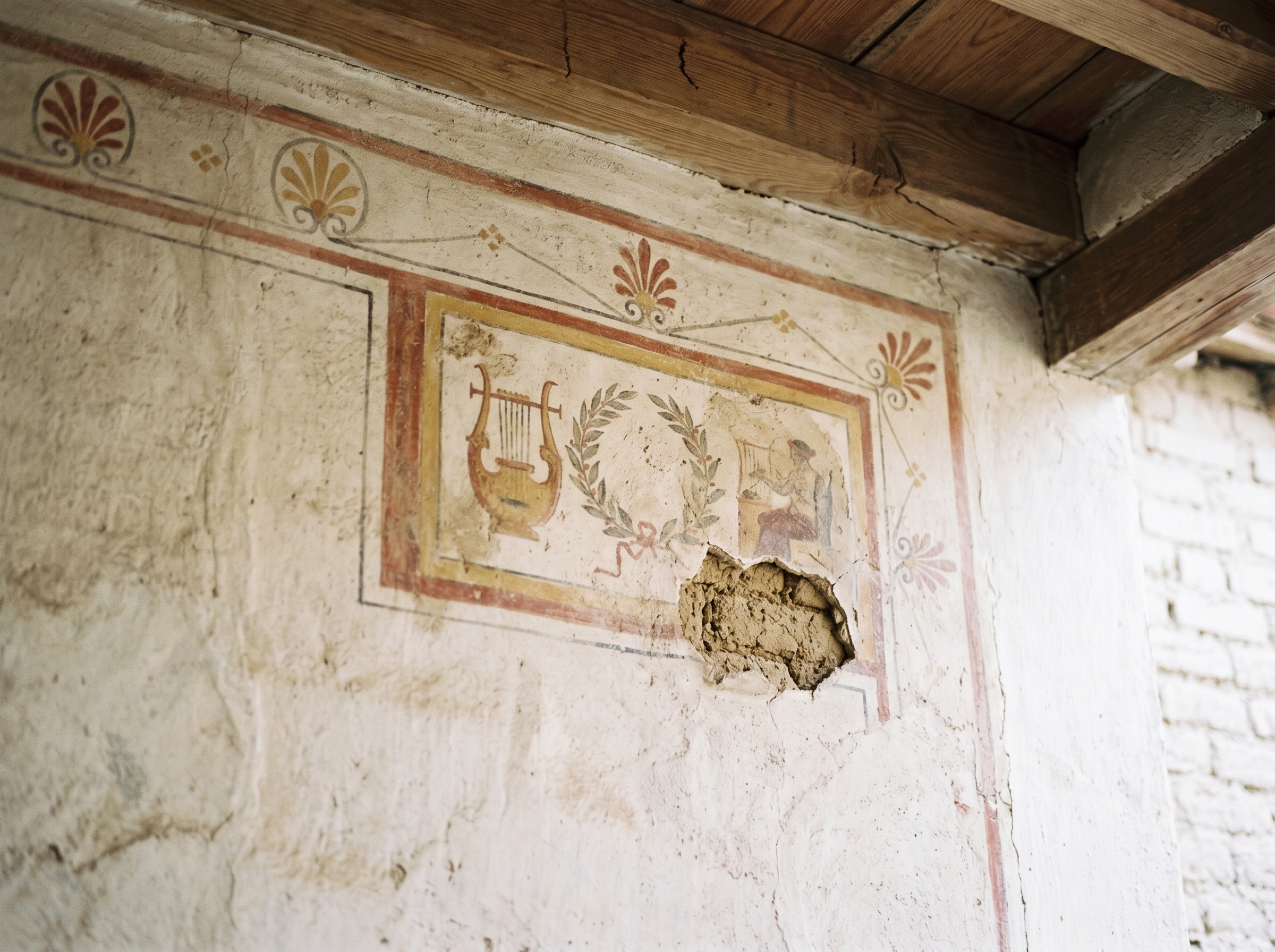
Painted plaster panel inside the reception room (lost or literary element)
A faded painted band or modest frieze hinted at how memory could be stitched into everyday rooms without archaeological proof. Literary tradition attached prestige to Pindar’s name; a restrained wall panel suggested how households might have framed that prestige for guests—even if later storytellers probably exaggerated the details.
The panel would have been small: a geometric border, a palmette, or a garland in reds and ochres, its pigment reduced to faint streaks where plaster had flaked away to reveal mudbrick. No clear inscription named the poet. Still, such surfaces functioned in lived experience: they set the stage for recitations, anchored claims of descent or friendship, and made a household’s cultural identity visible in a modest, domestic scale. The panel was less proof than prompt—a device people used to create a memory that literature later insisted had always been there.
There is no archaeological confirmation for a poet-specific panel; the idea survives mainly in literary retellings and must be treated as plausible but unproven.
City context
The house sat among the row of one- and two-storey dwellings that climbed toward the Cadmea; from the main streets the citadel’s stone mass dominated, while roofs of fired tile and pale plaster defined the city’s silhouette. Processional routes and market axes ran past such houses. On festival days visitors and delegates passed their façades on the way to temple podia, so private frontages were part of Thebes’ public face.
Everyday life and public ritual overlapped here. A courtyard held domestic chores and symposia, then hosted guests who might be civic negotiators or visiting poets. That overlap explains why a single house could be invested with extra meaning: when an external power spared it, the gesture altered how Thebans and onlookers read the city. The decision to preserve a poet’s home reframed cultural prestige as a tool in the politics of destruction and memory.
Sources
ancient source
- Diodorus Siculus, Bibliotheca historica (account of Alexander's campaigns and the sack of Thebes)
- Plutarch, Life of Alexander (passages on Thebes and actions after the city's fall)
- Quintus Curtius Rufus, Historiae Alexandri Magni (narrative of the sack and its gestures)
secondary literature
- Robin Lane Fox, Alexander the Great (modern discussion of Alexander's policies and cultural gestures)
online article
- American School of Classical Studies at Athens, 'Surprises in excavations on the Ismenion hill' (context on Theban sanctuaries and processions)Link