At a glance
Leuctra was where Thebes turned a single tactical choice into a public fact: Epaminondas deepened and echeloned his left wing across a broad, gently rolling plain and then marked that victory with low stone mounds and trophies so travelers could read Theban power from the road. The field and its commemorations made a military maneuver into a civic claim visible to allies and rivals alike.
What did it mean to make a battle into a part of a city’s civic voice? At Leuctra the question had a literal answer: a wide, open agricultural plain with gentle undulations became the stage for an oblique, concentrated attack, and later the same field was dotted with small tumuli, tropaia, and altars that turned ground into memory.
Physically the place was simple. The plain spread flat for a few hundred metres with shallow rises that Epaminondas used to mask the weight and angle of his left column. Armies showed up as lines of bronze and painted shields, standards, and clanking armour; the Theban left, packed unusually deep—ancient accounts and later reconstructions put its depth into multiple dozen ranks—struck like a wedge. After the shock and rout the plain did not go back to being anonymous. Men hauled up little mounds of earth and set stone markers, small altars, and tropaia: low, visible proofs you could read from the road without entering the field.
Think of Leuctra not as one isolated fight but as two public projects in one place: a tactical experiment in massed infantry and an architectural program of commemoration. That pairing was not unique—compare the burial mounds at Marathon or Plataea—but at Thebes the monuments linked directly to a new kind of civic performance. The tumuli were modest in height (reconstructions suggest around a metre or so) and scattered at points that would have been visible to travelers and delegations approaching the city, making the plain an extension of the urban stage.
Three questions matter when you stand here, even on a map. Who decided which dead received a mound and why a small stone marker rather than a grand monument? How did the visibility of those markers change what passing envoys and nearby farmers thought of Theban authority? And how did turning open ground into commemorative real estate expose Thebes—its cadmea, its temples, and its federated politics—to the hazards of making military glory an everyday spectacle? The plain’s materials and forms—earth, low stone, painted arms, and the line of men—are the evidence you need to start answering them.
Closer looks
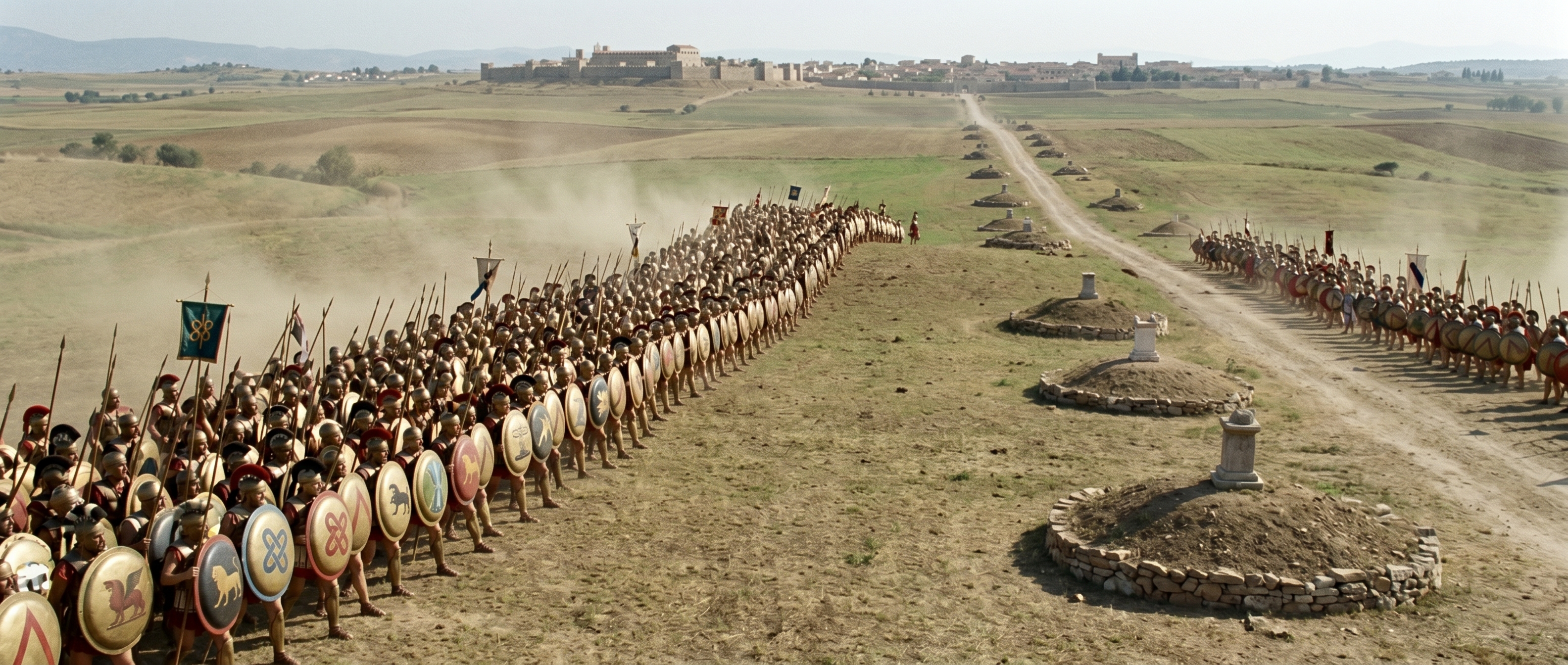
Oblique echelon in the rolling plain (wide panorama)
This view made clear how a handful of shallow rises and a single road turned a tactical novelty into public argument. Epaminondas used the plain’s gentle undulations to hide the true depth of his left column until it was almost on top of the enemy; from the approach road the Cadmea and the city’s silhouette framed those rises so that the field read as an extension of Theban public space.
The plain itself was broad—reconstructions imagine opposing lines spanning roughly 600–800 metres—so a concentrated column fifty ranks deep could be masked until the moment of impact. After the fighting, low earthen mounds of about 1.0–1.5 metres and small stone tropaia were deliberately placed along the road-line. Those modest markers were meant to be seen from a distance: envoys and farmers did not need to enter the ground to register that Thebes had altered the map of power.
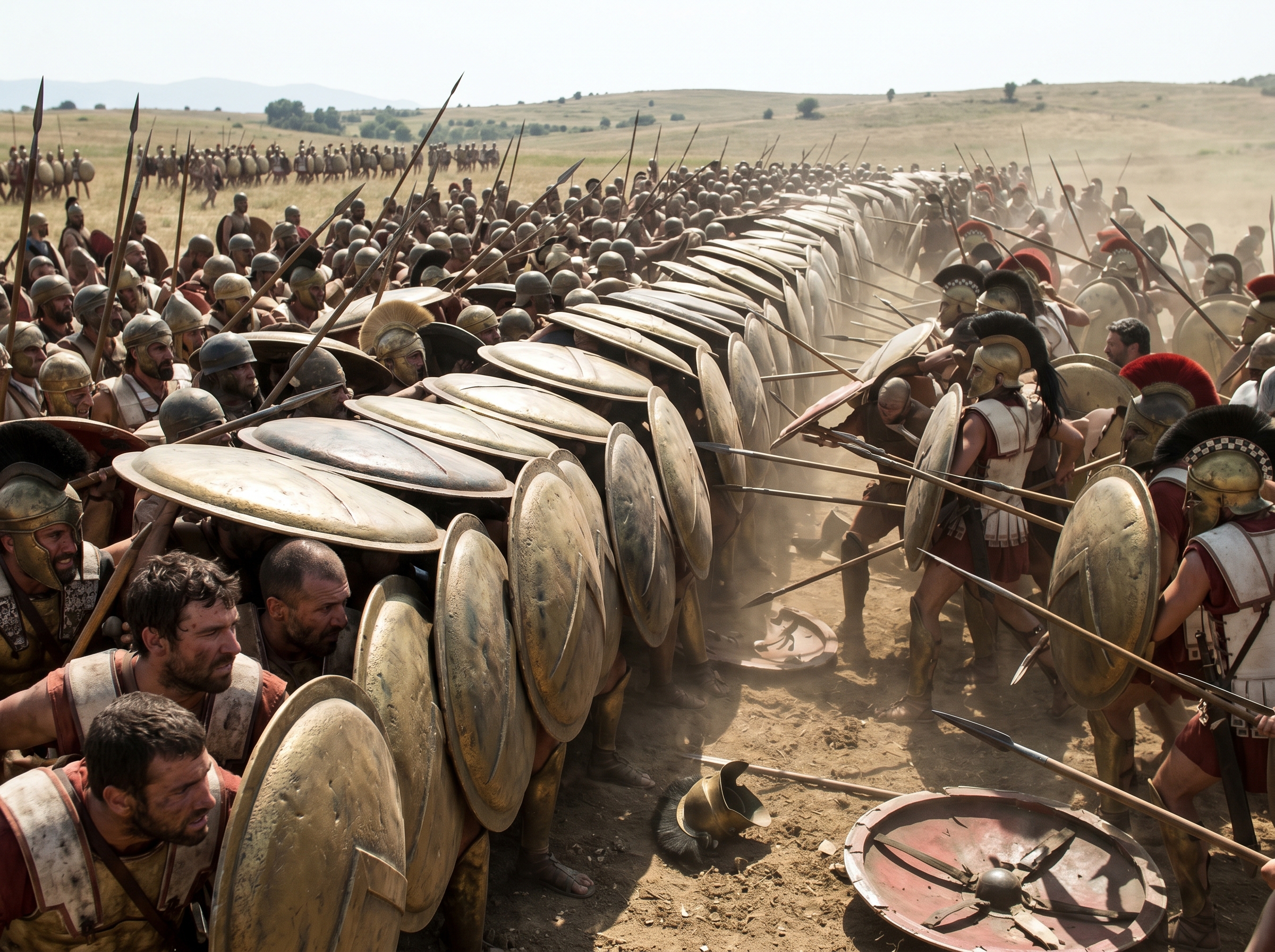
Shock and push of the concentrated left column (standard)
What the deep column meant in practice was brutal and simple: compression turned numbers into shove. The Theban left pressed forward not as a thin screened line but as a densely packed mass—shields overlapping, spearpoints jutting in unison—so the first ranks pushed forward under the weight of dozens behind them.
That pressure did two things. Physically it produced a concentrated force at the impact zone that tore open the enemy flank; materially it created chaotic fragments—broken shield rims, toppled spears, churned earth and dust—that made orderly response difficult. Classic hoplite crewing usually relied on 8–12 ranks; here the depth was roughly five dozen, which converted cohesion into forward momentum rather than merely parity of line.
Deep formation created localized shearing at the point of contact, not a uniform shove along the whole front.
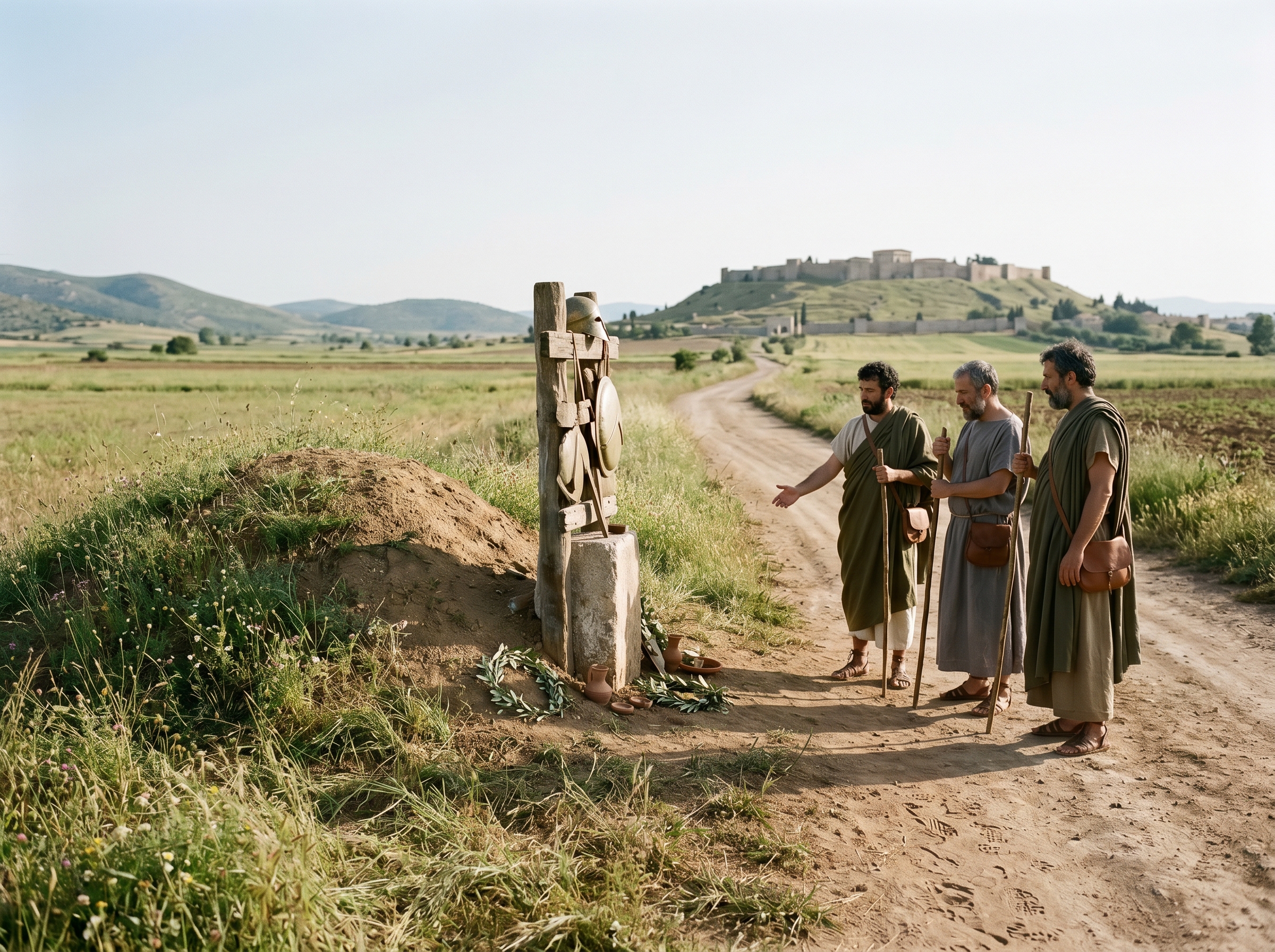
Roadside tumulus and tropaion (human-scale)
These roadside mounds functioned like a chain of short notices posted along the road to Thebes: modest, repeatable, and meant to be read quickly. A low earthen tumulus around a metre high, paired with a small stone marker or tropaion, communicated that something—burial, trophy, or both—stood at that spot without demanding a detour.
Objects left at these spots were humble and specific: garlands, small oil-flasks, a wreath at the mound’s crown, or a handful of broken spear-points leaned against a post. Their modest scale was a political choice. Big monuments were expensive and singular; many small mounds could be scattered along the route, turning the approach into a sequence of reminders that Theban force and loss had taken place here. Not everyone who fell received a mound; decisions about who got one were civic acts as much as funerary ones.
Tumuli were scaled to be visible from the road but inexpensive enough to be used repeatedly along the approach.
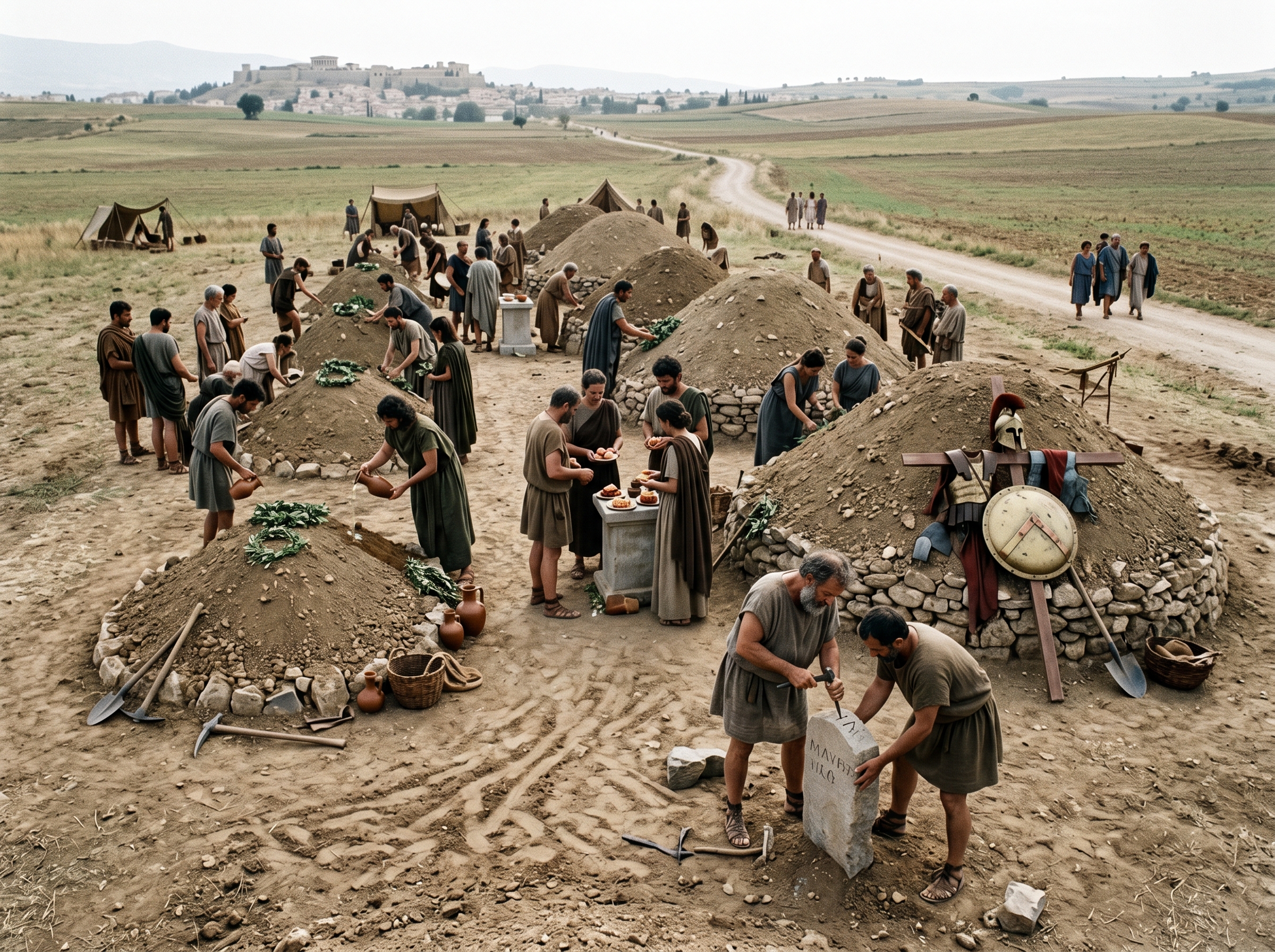
Funerary and votive activity at the mounds (standard)
Commemoration was work: families, veterans, and civic agents shaped earth and objects into public memory through repeated small rituals. In the days after a battle people gathered at clusters of low mounds to lay wreaths, pour libations of oil and wine, and set up tiny altars or inscribed stones that named the dead or recorded a tropaion made from captured gear.
Those actions turned ephemeral events into a negotiable civic resource. A tropaion—assembled from enemy spears or shields—advertised victory to passing delegations; carved markers could be referenced later in council debates about honors or pensions. Maintaining those mounds required ongoing attention: re-wreathing, replacing weathered offerings, and clearing vegetation, all of which kept the memory alive and politically useful long after the battle smoke had cleared.
Tropaia often incorporated captured arms, making the trophies themselves portable pieces of political theater.
City context
Leuctra did not sit far from the circuits that moved through Thebes. Training grounds, muster routes, and processional axes ran off the lower town toward the plain; a Theban on campaign left the Cadmea and could follow a clear visual thread that tied the city’s sacred places to its military claims. From the Cadmea’s terraces and the road into the plain, the small mounds and tropaia registered Theban success in a single glance.
Ordinary Thebans met the battlefield in civic rhythms. Festivals and delegations that processed up to Apollo Ismenios or across the agora passed markers that reminded them of recent victories and losses; veterans and relatives came out to the mounds for funerary rites and votive offerings. In that way the plain acted like an extension of the city’s political theatre: victory became a visible argument in negotiations, not merely a story told at council.
Sources
reference
- Britannica, "Battle of Leuctra"Link
ancient source
- Plutarch, Life of Pelopidas (in Plutarch's Lives)
book
- Hans van Wees, Greek Warfare: Myths and Realities (2004)