At a glance
The Royal Stables and Chariot House made the imperial spectacle mobile: they were the backstage machinery that kept the king’s horses, chariots, and attendants ready for parade and travel. Reading these service spaces shows that Persepolis’s power depended as much on supply, shelter, and movement as on carved stairways and columned halls.
What did it look like when the pomp of Persepolis moved? The stables and chariot house answered that question in plain material terms: rows of stalls and bays built against the terrace’s service ranges, compact rooms for harness and fodder, and open ground for hitching and trimming animals before a procession. The buildings combined dressed limestone foundations and walls with timber superstructures and packed-earth floors; metal rings set in stone, stone mangers, and shallow drains spoke of constant animal use rather than ritual illusion.
Physically, the complex read as work rather than temple. Long, low compartments held horses in individual stalls; adjacent bays sheltered chariots on wooden runners or racks so their painted wheels and bronze fittings could be worked on out of the weather. Small storerooms opened off these spaces—sacks of barley and fodder, leather trunks of bridles and breastplates, racks for spare wheels and toolkits. The roofs were broad and sheltering, not monumental: beams and reed matting kept sunlight and rain off animals and the leather that needed to stay supple.
During festival days the stables were not hidden. Horses and chariots moved from stalls into anterooms and then onto the procession routes that threaded up the terrace. The visual program of Persepolis — stair-reliefs showing delegations and named gifts — counted on motion as much as carved presence. A chariot trimmed, harnessed, and led through a gateway turned stockpiled resources into immediate political effect: mobility made spectacle mobile.
Two questions matter here. First: how did backstage logistics shape the choreography of power? The answer is literal—the same thresholds and yards that organized tribute also controlled how, when, and by whom the royal cavalcade appeared. Second: what did the care for animals and transport say about imperial scale? Maintaining horses, chariots, and attendants required steady labor, specialized skills, and stowage for feed and spare parts; those practical needs underwrote the theatrical moments that the terrace staged.
Closer looks
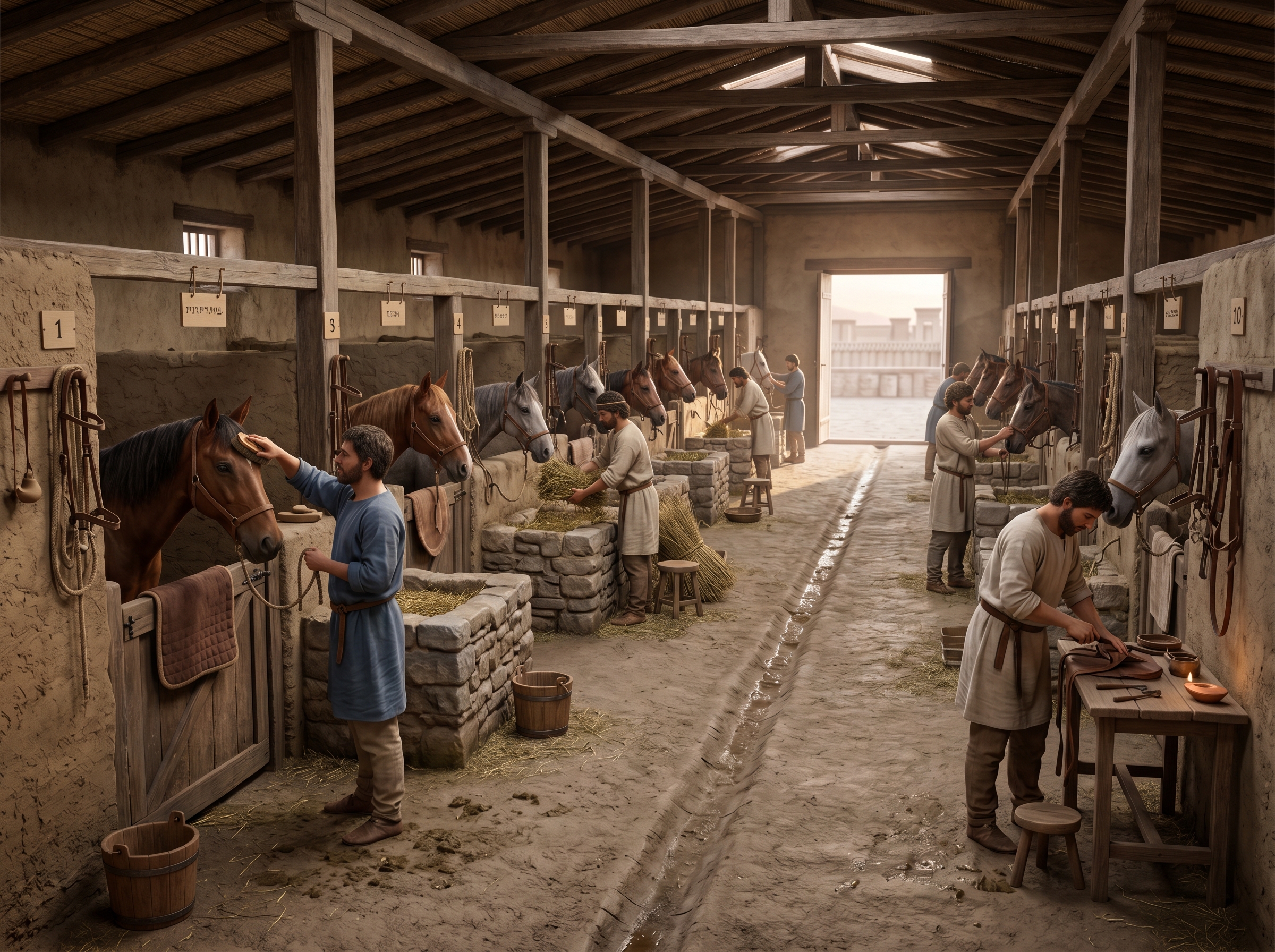
Row of stalls at dawn with grooms preparing horses
Daily labor made the ceremonial parade possible. The ordered line of low stalls, grooms with buckets and small stools, and the steady rhythm of brushing and oiling turned raw animals into presentation-ready mounts.
Packed-earth floors sloped gently to shallow drainage channels so urine and wash-water ran away instead of puddling. Stone mangers sat recessed into the low partitions between stalls; leather bridles and breastplates hung on wooden pegs above them. Roof beams and reed matting kept sunlight off tack that had to remain supple in the dry climate, and attendants routinely rubbed oil into leather each morning to prevent cracking and to bring up a quick shine before a procession.
That morning routine mattered to timing. Grooms worked to a schedule: feeding, grooming, and harness checks were sequenced so horses would be calm, dry, and warm enough to march up the ramp without overheating. The modestness of the room made clear that spectacle began with labor, not with a single heroic moment on the terrace.
Estimated stall capacity for the range-plan suggested space for roughly 20–40 horses, which shaped how routines were organized at dawn.
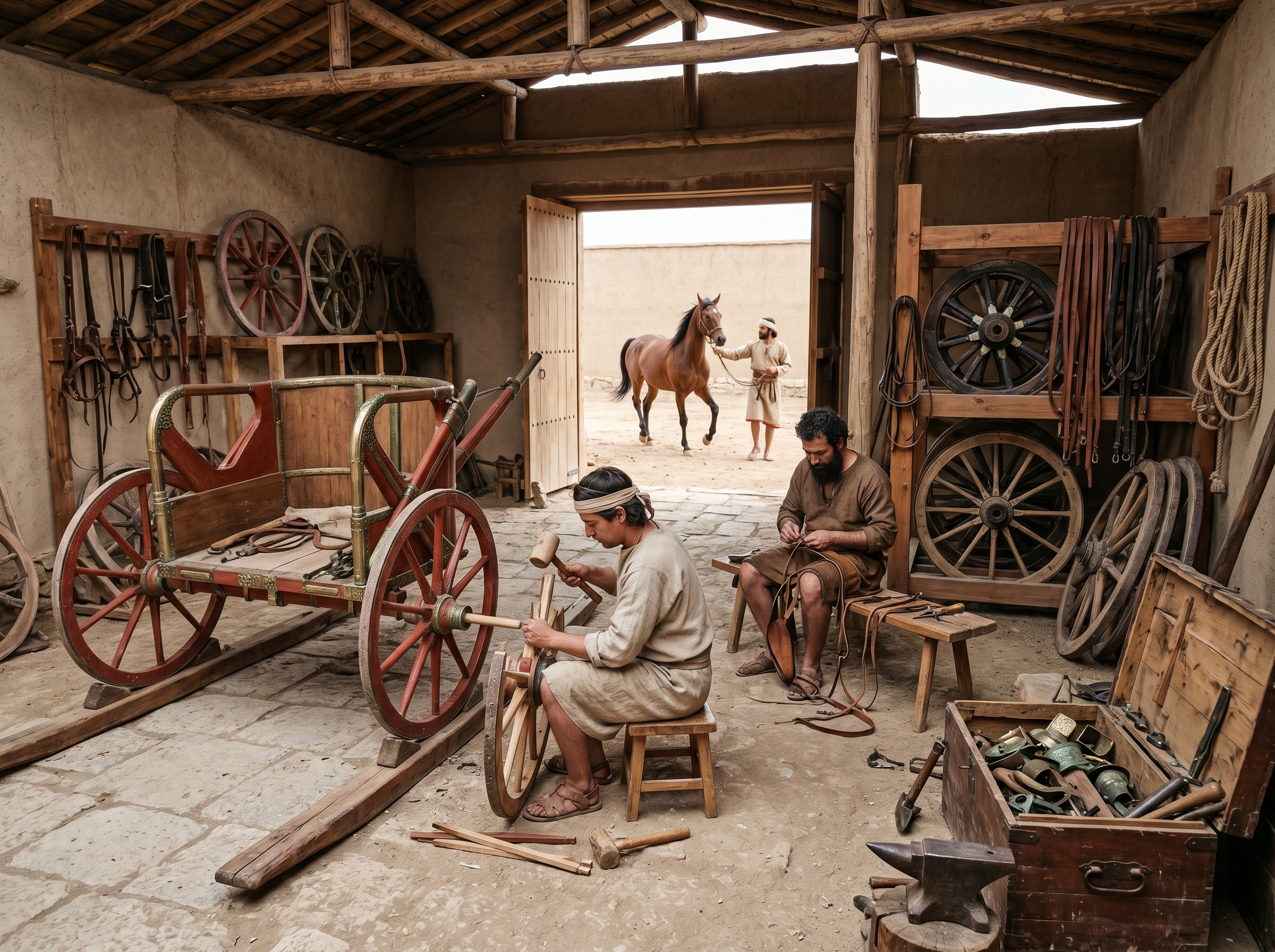
Chariot bays being serviced: wheelwrights and harness-makers at work
Chariots required specialized craftwork as much as they required space. Wheels, bronze fittings, and painted spokes needed constant attention, and the chariot bays held the toolkits and workbenches that kept vehicles parade-ready.
Paired bays rose from the stone floor onto wooden runners so wheels could be rolled out without scraping. Craftsmen used wooden mallets, awls, spokeshaves, and a small anvil to tighten spokes, dress hubs, and refit bronze linings. Racks held spare wheels; coils of reins hung nearby; trunks contained replacement bronze fittings. A partially disassembled axle or a wheel set aside made it plain that repairs were manual, precise, and often urgent.
Something practical followed from that precision: chariots could be readied, and sometimes partly dismantled, on short notice so they could travel folded or packed for long journeys. Maintaining them demanded both speed and a knowledge of fragile balance—one badly timed repair could unseat a warrior or ruin the intended display.
Bronze fittings on hubs and linchpins needed regular greasing, which craftsmen applied before each sortie to prevent metal seizure.
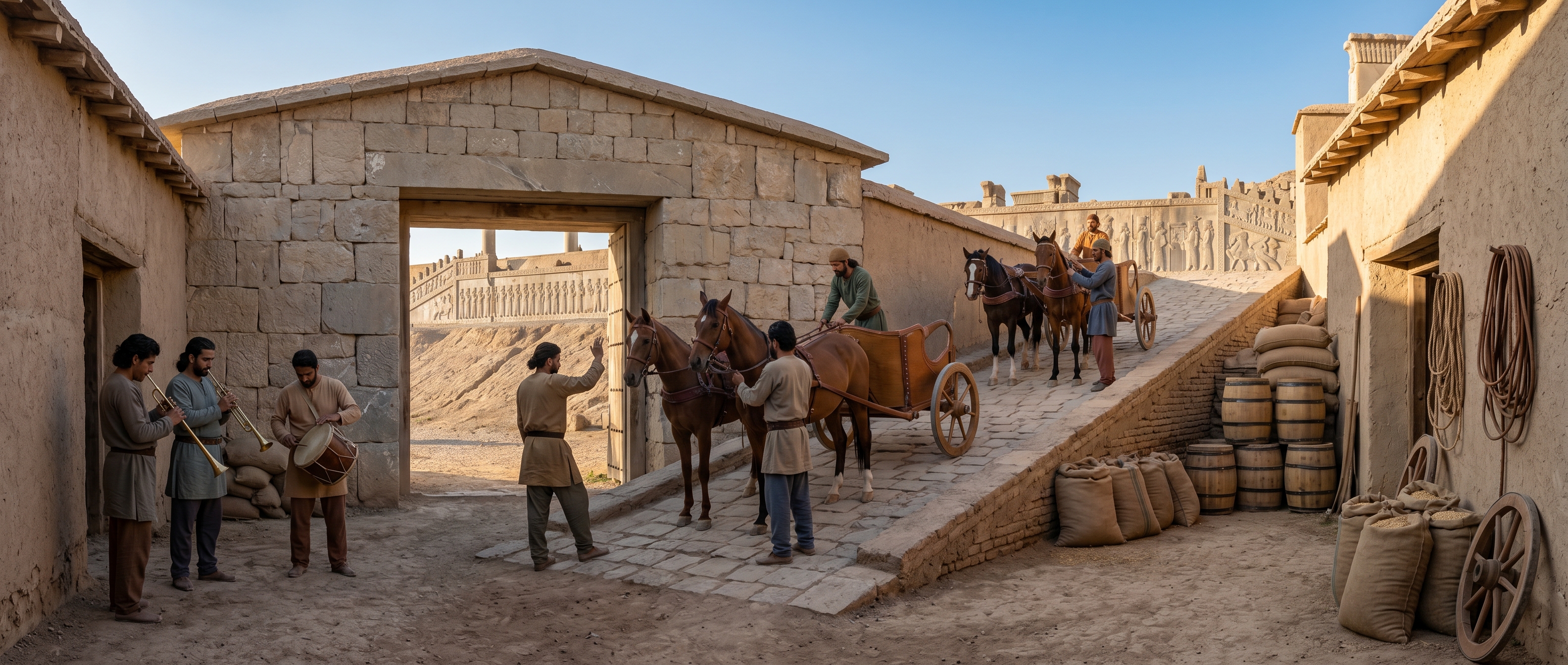
Gateway and the procession outlet: horses and chariots moving toward the terrace
The threshold turned backstage preparation into a public act. Low limestone gateways and a short sloped ramp framed the last private adjustments before horses and chariots met the terrace’s carved stairways.
Attendants guided teams up the ramp, fastening final straps and testing harnesses while trumpeters or horn-players nearby checked mouthpieces and breath control so the first notes would carry to the audience above. Sacks of barley and stacked fodder sat to one side, ready for immediate feeding after a parade. The ramp itself created a staged reveal: movement slowed here, ornamentation was polished on the spot, and the approach aligned animals and vehicles with the terrace’s reliefs so arrival read like choreography rather than happenstance.
Control of that narrow threshold shaped who the king’s audience would be able to see and hear, and how quickly a logistical space could be converted into a pageant element.
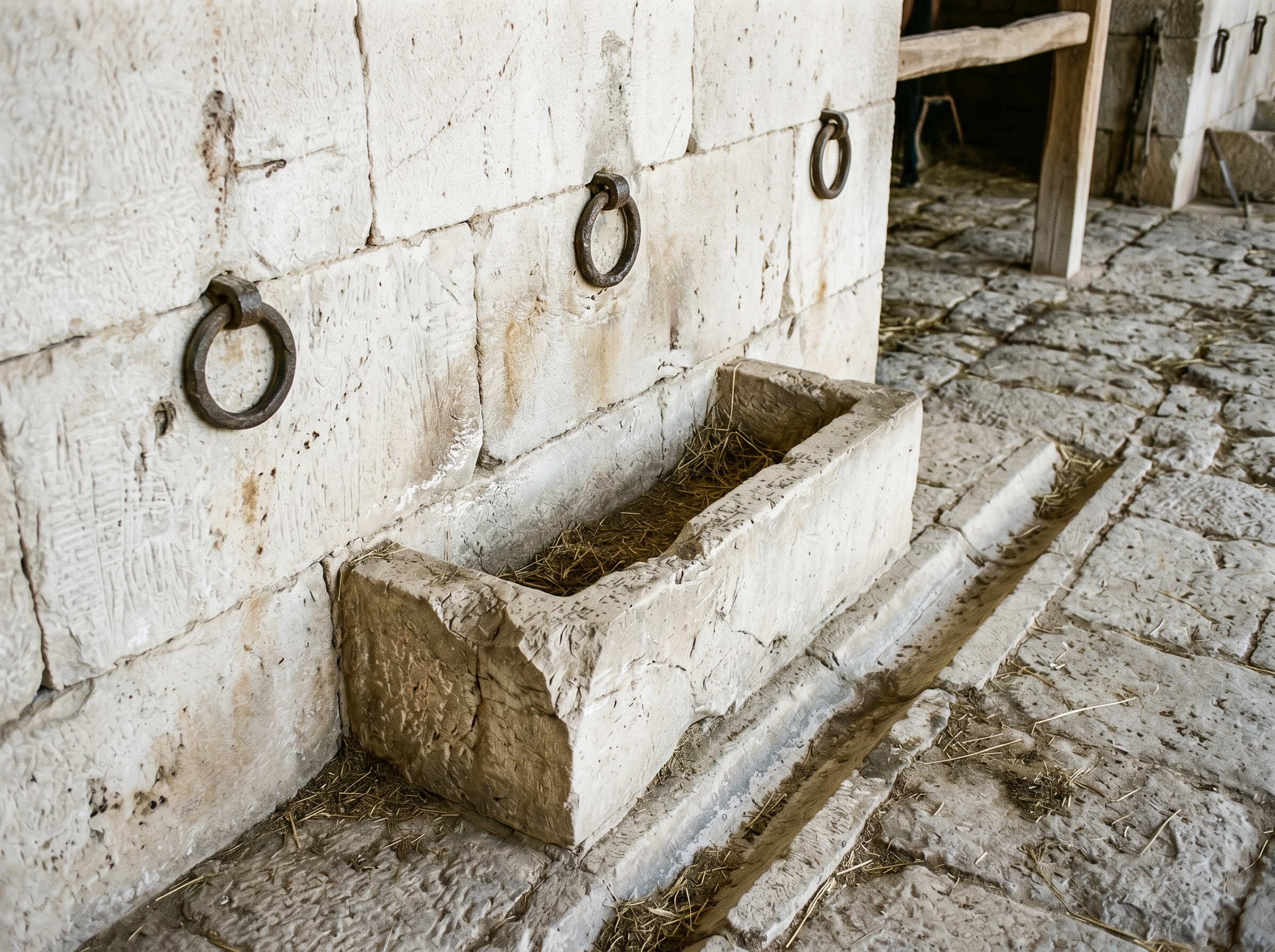
Close-up of stone fittings: iron rings, mangers, and drains
The small stone details told a blunt, practical story: this place was used, repaired, and used again. Iron or bronze tether rings set flush in dressed limestone, carved mangers with abrasion marks, and narrow drains recorded continuous animal use more reliably than any relief could.
Rings were hammered into cut blocks so ropes could be tied quickly without gnawing at the stone. Mangers bore grooves from repeated scraping, and drains sloped toward the yard to carry waste and wash-water away during routine cleanings. Mason’s tool marks and patched repairs left visible lines where stones had been refitted or retooled, a palimpsest of maintenance rather than decoration.
Those mundane traces also became forensic clues. Organic remnants trapped in drains and crevices—straw, barley fragments, leather shreds—helped later observers reconstruct feeding practices and the rhythm of care that sustained the animals behind the terrace’s public face.
Excavations at similar Achaemenid service ranges recovered barley husks and leather scraps in drains, confirming these channels handled ordinary stable waste.
City context
The stables and chariot house occupied the backstage of Persepolis’s ceremonial theatre. Positioned to link storage and workshop areas with the main processional routes, they kept animals and vehicles close to the staircases and gateways that funneled delegations to the king. Ordinary work—cleaning stalls, sharpening axles, sewing leather—happened where the carved processions could pass on their way to audience halls.
Ordinary people encountered the complex differently from foreign envoys. For stablehands and craftsmen it was a workplace defined by smells, repeated labor, and schedules tied to festival calendars. For an arriving delegation it was a logistical node: attendants collected horses and chariots here, trumpets were tested, and last-minute dressings were applied so that when a group climbed the terrace they appeared as a polished element of imperial order. In that way, the stables turned the practicalities of mobility into a visible part of authority.
Sources
interpretive corpus
- City essay: Persepolis as a purpose-built theatre for imperial authority (provided corpus)
site description
- Landmark research: Royal Stables and Chariot House (provided corpus)
book
- Pierre Briant, From Cyrus to Alexander: A History of the Persian Empire
- Amélie Kuhrt, The Persian Empire: A Corpus of Sources of the Achaemenid Period