At a glance
Who was allowed to meet the king, and under what choreography? The Gate of All Nations answered that question in stone: a broad, roofed threshold guarded by colossal sculptures that announced entry into the imperial stage. It turned a moment of movement—the approach, the bow, the exchange—into a controlled lesson about who belonged and how they belonged.
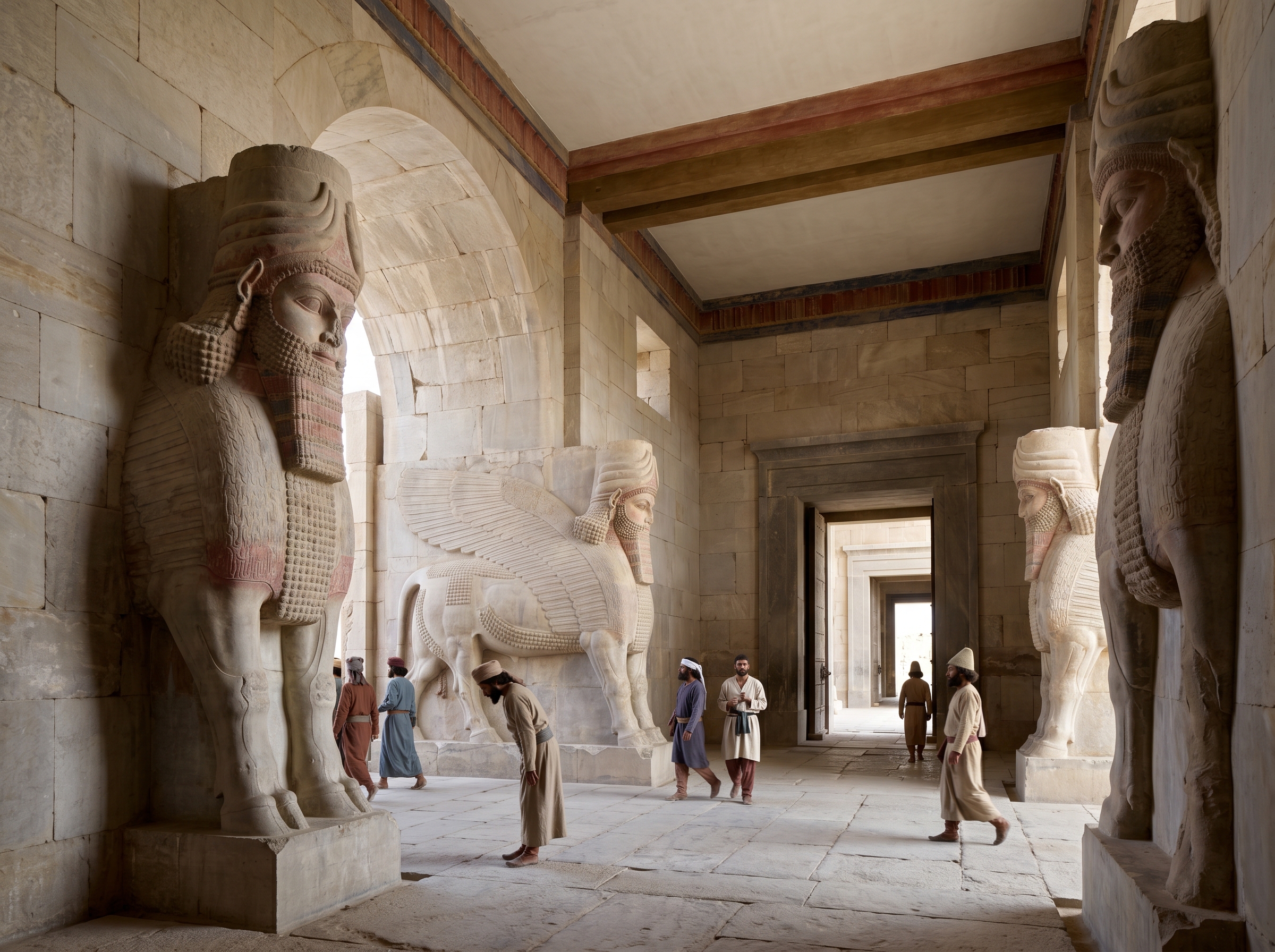
What did it mean to move from the world outside Persepolis into the king’s presence? The Gate of All Nations gave that question a physical form. Set at the western approach to the terrace, the gate was a built pause—a low, cool room of pale limestone flanked by monumental guardian figures that rose multiple meters above any human standing beside them. Those guardians dominated sightlines: approaching visitors first saw stone bodies and humanlike faces, then the framed opening that led on toward the Tripylon and the Apadana.
The gate did not simply block or admit. Its architecture ordered bodies. A procession funneled along defined approaches, slowed and gathered under the guardians’ shadow, and then passed through a single threshold into a sequence of further chambers and stairways. Stone surfaces were finished for visibility from below; carved processions and lists on nearby stair-reliefs extended the gate’s message by naming who had come and what they had brought. Color once brightened faces and garments, making identities legible at a distance.
Compare that entry to a city gate that opens toward trade. The Gate of All Nations acted less like a portal for traffic and more like a theatre’s proscenium. It announced a multinational scene: the empire welcomed different peoples, but only after they had accepted the choreography of approach, display, and tribute. Anyone who reached the Apadana had already passed a physical and symbolic initiation here.
That initiation tied rituals to logistics. Guards and attendants stationed at the gate controlled circulation; storehouses and stables sat nearby to receive and hold the goods and animals that accompanied delegations. In short moments—especially spring audiences—the gate concentrated movement and attention into a performance that taught obedience through ritualized movement as much as through carved inscription or royal presence.
Closer looks
Colossal guardian sculptures framing the entrance
The Gate’s great guardians halted movement before any word was spoken about loyalty or rank. Visitors first met these composite figures: human faces set on large, animal bodies, carved at a scale—several meters tall—that made anyone beside them seem incidental.
The sculptures were integrated with the gate chamber, not perched on distant pedestals; their shoulders met the low roofline and their presence framed the small rectangular doorway that led on toward the Tripylon. Paint traces on faces and garments—reds, blues, ochres—meant those humanlike visages read from a distance in daylight. The visual order was deliberate: look up at the guardians, take the measure of power, then step through a threshold already defined for you.
The Gate and its guardians were part of Xerxes’ building program (c. 486–465 BCE) and were carved to dominate any approaching procession.
The cool, roofed chamber under the Gate’s ceiling
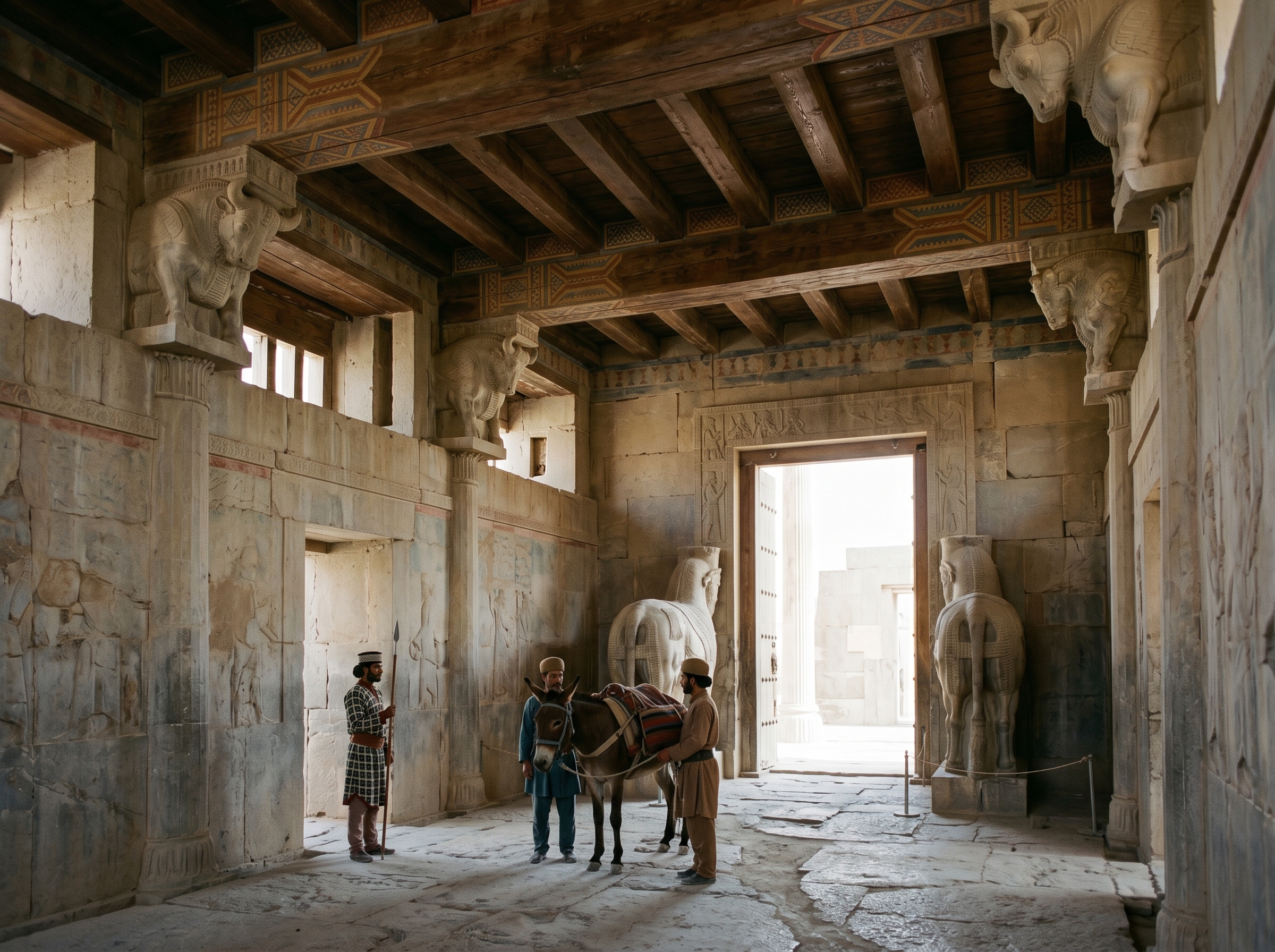
The gate was a pause more than a passage: a low, roofed room designed to gather bodies and quiet them. The ceiling sat close enough that speech lowered and footsteps slowed, concentrating attention on what came next.
Stone capitals hinted at double-bull timber prototypes and the roofline preserved impressions of wooden beams and painted bands. Daylight entered mainly through the doorway and a few narrow openings, carving the chamber into bright edges and cool shadow. Near the joints you could still see tool marks where finishers adjusted blocks on site—an architectural moment completed by craftsmen while the terrace grew around them.
Double-bull capitals and carved beam patterns imitated wooden roofs so the stone chamber retained the look and scale of the original timber construction.
A staged procession passing through the Gate toward the Apadana
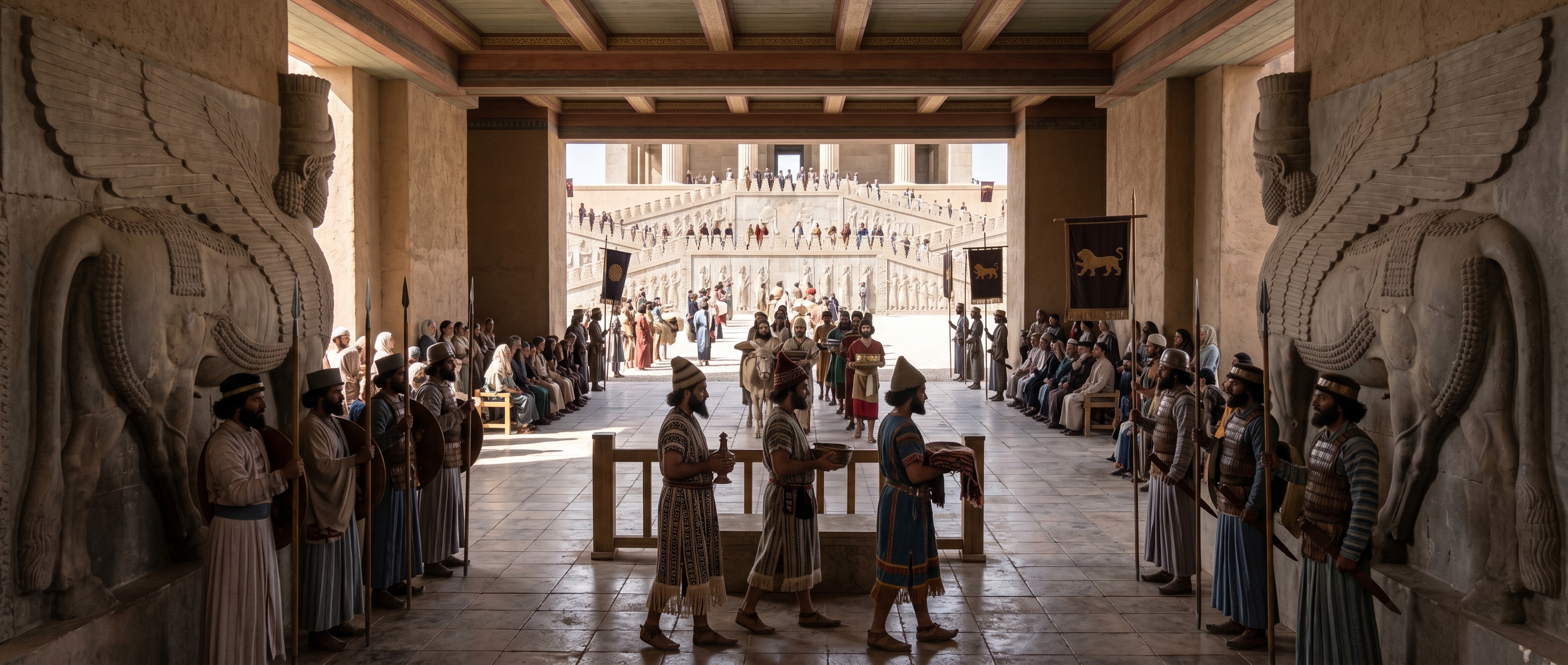
The Gate organized movement into a rehearsed sequence: people did not spill through it, they were funneled. Delegations formed narrow lines, attendants kept pace, and guards used simple cordons and architectural funnels to hold order as the approach continued toward the Apadana’s staircases.
Costumes and carried goods provided immediate identification—different hats, robes, and objects signaled place and rank as the line advanced. The procession was timed too: springlight struck the stair-reliefs and garments at particular angles, so arrivals, offerings, and bows became visible statements staged for viewers waiting below. In short moments the gate turned approach into a public lesson in how to appear before the king.
Close-up of carved delegations and how they read from the Gate
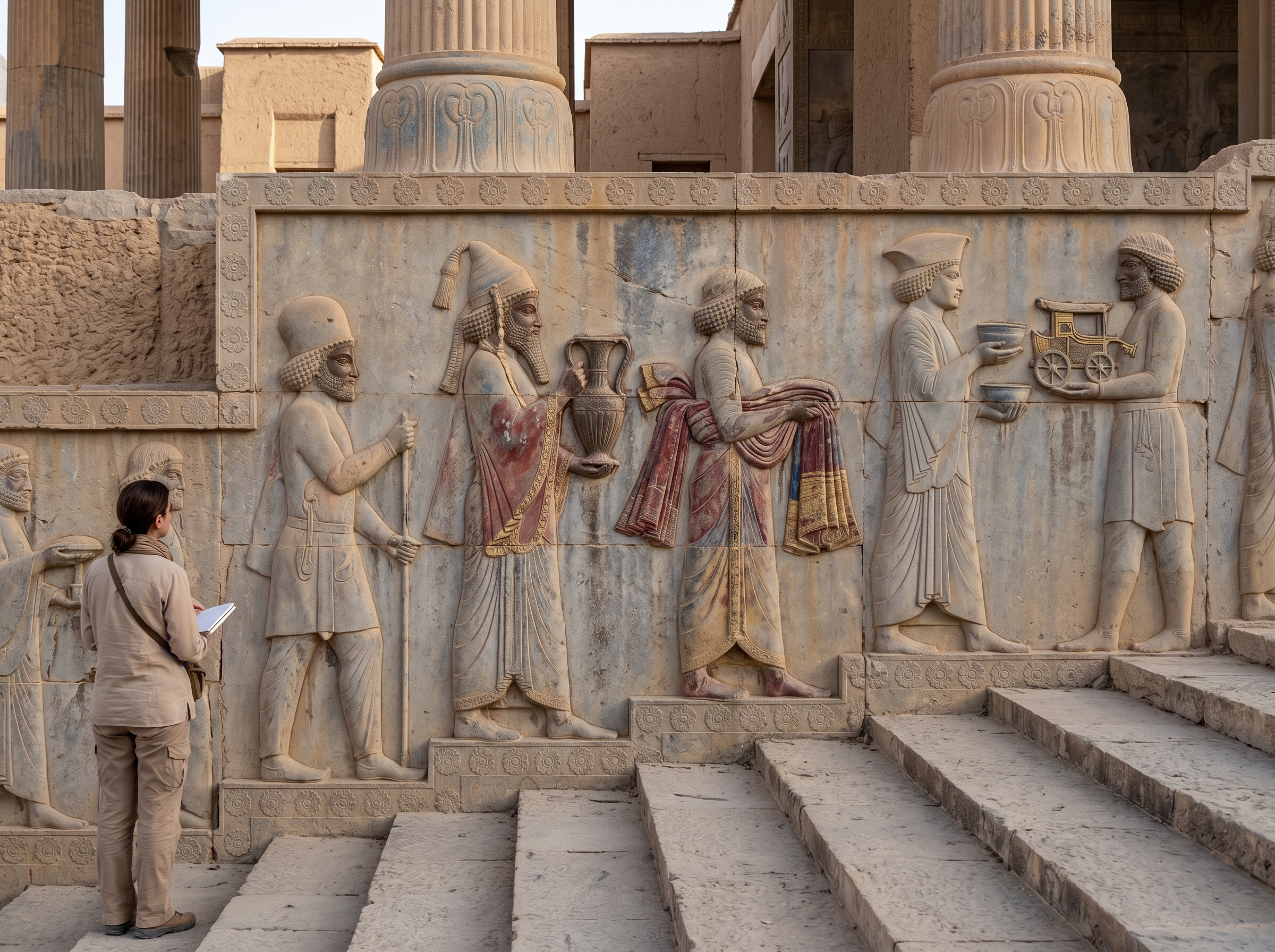
The stair-reliefs acted like a visual ledger: they named peoples by costume and goods rather than by portrait. Carved in shallow relief, the figures used clear outlines, distinctive hats, beards, and stylized gift objects so a viewer several meters away could decode origin and tribute at a glance.
Tool marks and the flatness of the carving were purposeful choices. Deep modeling would have blurred in bright daylight; shallow, incised forms caught shadow and color instead, and pigment traces on robes and objects amplified those cues. The result was a repeatable formula—one stone procession echoed by the living line that had just passed under the Gate.
Reliefs were carved shallowly and painted so costume and gift types remained legible from the approach rather than for close inspection.
City context
The Gate of All Nations sat at the public front of Persepolis’ ceremonial circuit. It was the first architectural command on the terrace: pass under its guardians, cross the Tripylon, then mount the Apadana’s staircases to reach the king’s reception hall. Courtiers, foreign envoys, and imperial officials all moved along that scripted route; ordinary urban residents rarely used it for daily life, but they felt its effects in the city’s rhythms—work teams, pack animals, and storehouse traffic flowed toward the same core that the gate framed.
Daily use was bureaucratic and practical; seasonal use was performative. In quiet times the gate regulated flows of goods and labor—stonecutters, teams bringing tribute, attendants moving animals into stables. During New Year audiences the gate became a focus: crowds gathered, delegations rehearsed bows, and the visual program of carved delegations and painted garments turned individual arrivals into a public lesson in imperial order. Knowing how people moved through this single threshold reveals how Persepolis turned architecture into a language of power—one taught by scale, sequence, and controlled visibility.
Sources
essay
- City essay: Persepolis — theatrical terrace, sequence of thresholds, carved delegations, and seasonal audiences
summary
- Landmark summary: Gate of All Nations — construction dates, guardian sculptures, and role as imperial threshold