At a glance
The Apadana reliefs turned tribute into a public inventory: named peoples in distinct dress marched up the palace staircases carrying gifts that declared their place inside the Achaemenid order. Seen in motion—processions climbing toward a roof of towering columns—the carvings made inclusion legible and ritualized obedience.
What did imperial inclusion look like? Along the Apadana’s great staircases, more than twenty carved delegations answered that question in stone. Each panel showed a line of figures in carefully observed costume, led by an official and bearing items identified by inscription. The arrangement read clearly from below: a sequence of faces and objects that encoded rank, origin, and obligation.
The reliefs were carved in pale limestone and set into the broad, shallow steps that led up to the Apadana’s platform. Figures were measured to register at a single viewing angle. Relief depth was moderate so shadows sharpened outlines in sunlight; garments, hair, and the objects held in hands were rendered with steady economy to make them legible from the plaza. Capitals shaped like double bulls rose above, recalling the wooden roofs those stones supported and framing the human processions beneath.
Those panels worked like a labeled map. Each delegation carried its own kinds of gifts—metal vessels, textiles, game or livestock—and each received an identifying inscription. Compare that to contemporary temple spectacle in Egypt or Babylon, where ritual centered local cult. Persepolis instead staged a multinational court. The carved lists translated political membership into a visual protocol: to be pictured and named on the Apadana steps was to be counted inside the imperial performance.
The reliefs also pointed to practical systems behind the pageant. The same stairways that catalogued peoples connected directly to storehouses and the imperial treasury. Tribute was not only displayed; it moved. Carved delegations announced what would enter the palace economy and where it would go. Reading these panels changed the Apadana from a set of monumental rooms into a choreography of arrival, accounting, and display.
Closer looks
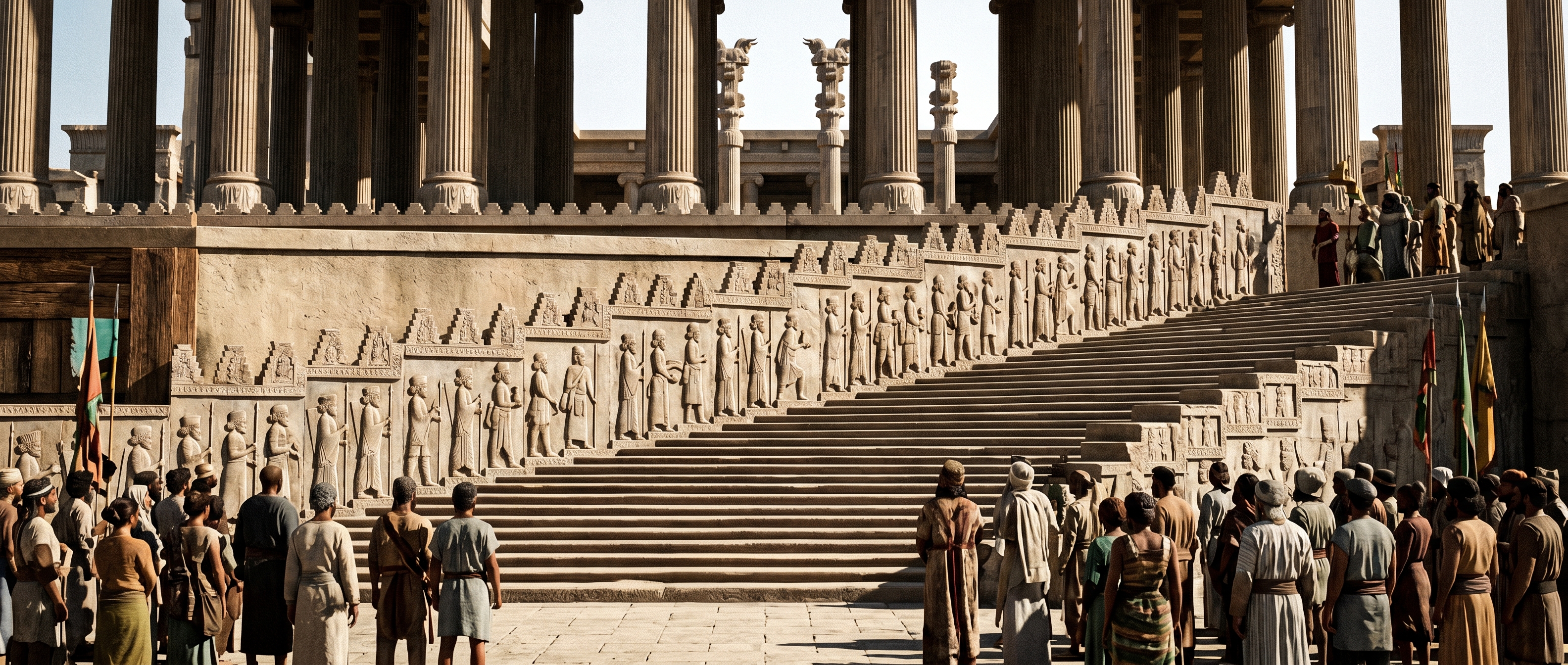
From the plaza: facing up the Apadana staircase
Approaching the Apadana felt like entering a script: the stair risers read as lines in a public roster, each procession panel arranged so an arriving crowd could identify origin, rank, and gift from a distance. The figures had been measured and spaced to register when seen from the plaza; shallow, broad treads kept the carved bands nearly level with a viewer’s sightline, turning the whole ascent into a readable stage.
Sunlight carved the reliefs into black-and-white shorthand. Moderate depth and crisp outlines made garments and objects legible at a glance, and the stone’s weathering left visible tool marks that hinted at different workshops and itinerant teams who finished blocks on site. Seeing the staircase from below explained why presentation was ritualized: the architecture forced a pause at the foot of the steps, where the carved catalogue named who would pass and what the palace would receive next.
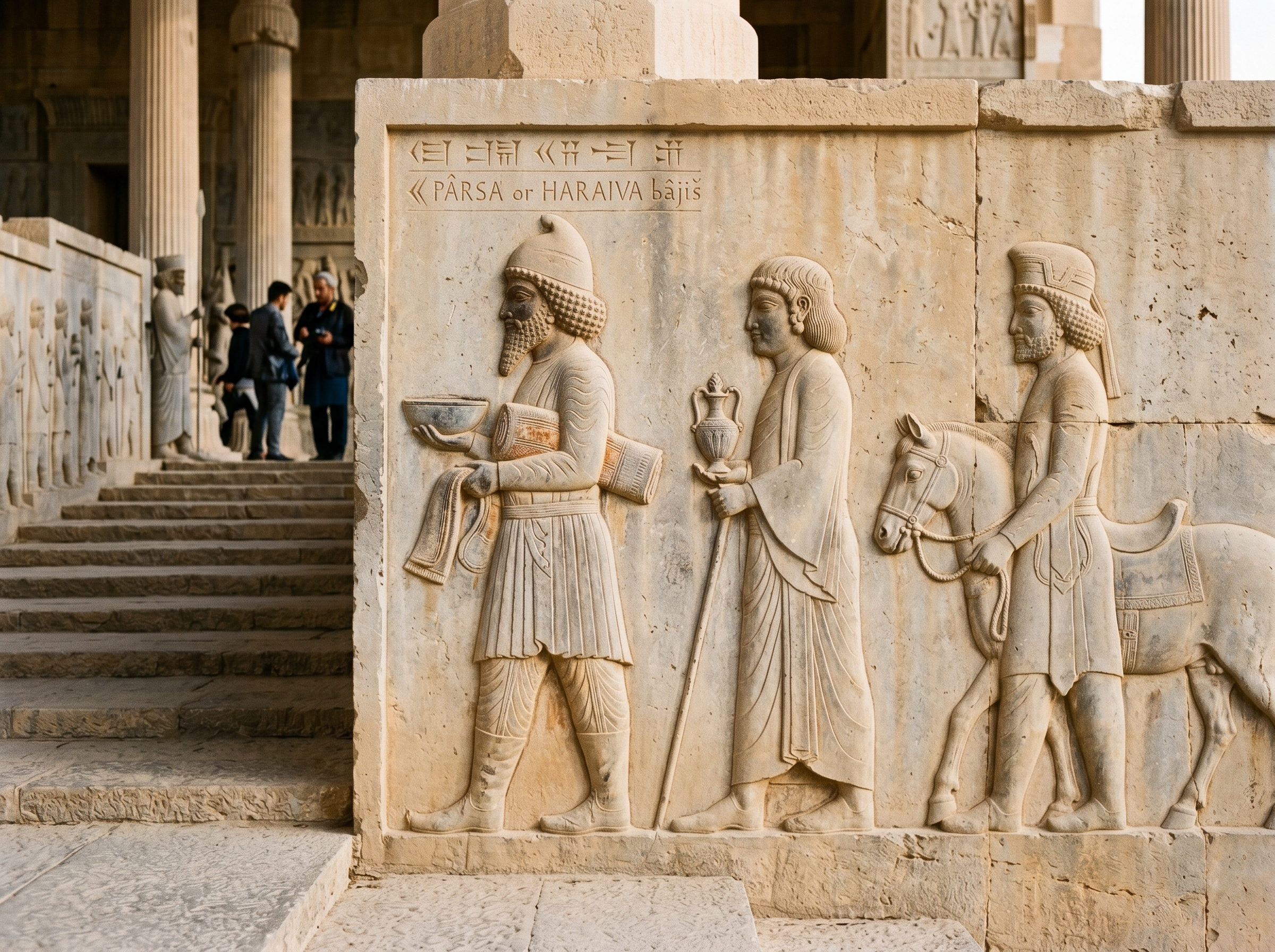
Detail: a single delegation panel with inscription and gifts
A single delegation panel acted like a labeled entry in an inventory: a narrow band of carved people, a handful of objects, and an inscription that tied identity to obligation. Carvers economized their forms so a metal bowl, a rolled textile, or a live animal read instantly from several meters away; hair, tunic folds, and footwear were stylized with consistent cues that specialists could decode at a glance.
The inscription beside the figures used local cuneiform conventions—most often Elamite at Persepolis—to name origin or gift. Surface pitting and fine chisel strokes remained in the stone; those marks revealed a two-stage process where basic shapes were blocked out elsewhere and finishing touches were executed on the terrace, sometimes while scaffolding still hummed with workers.
Note the economy of the carving: a few decisive lines defined a bowl or garment so it could be recognized from a distance.
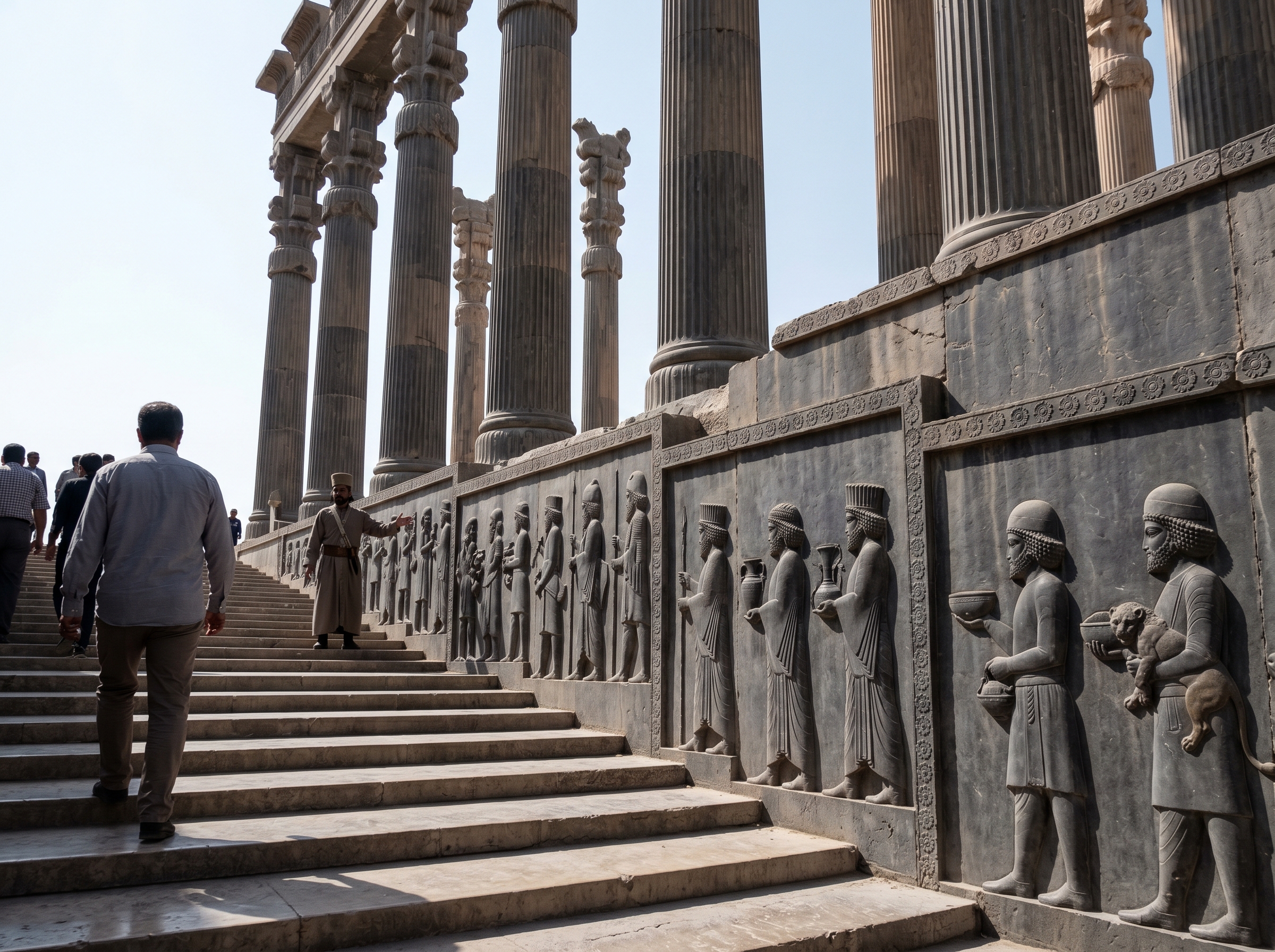
Mid-ascent: the human scale between stair-reliefs and columns
Climbing the steps put a person at nearly the same height as the carved delegations, creating an odd mirror: living visitors met their stone counterparts eye-to-eye as they neared the platform. The riser panels sat at chest or head level, so procession became an encounter where human bodies and carved images ran a parallel choreography.
The climb itself controlled motion. Treads were shallow and broad, which slowed footsteps and narrowed the space for simultaneous ascent and descent; that forced orderly movement and made room for small official entourages. Above, column shafts rose in a steady rhythm; their scale dwarfed the human figures and made the Apadana’s roof feel like a civic canopy that absorbed individual presence into a structured forum.
The shallow treads required a slower, more deliberate gait—movement was part of the ceremony, not incidental to it.
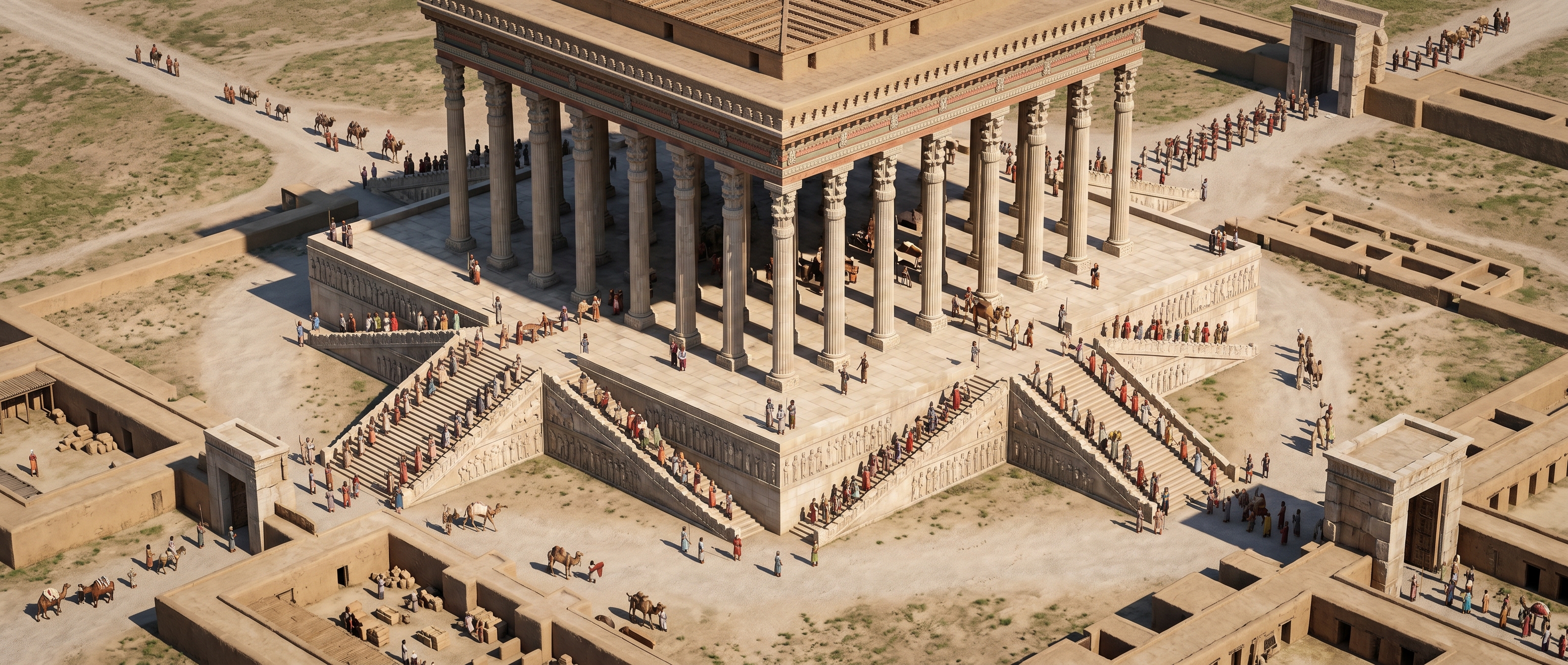
Bird's-eye: the Apadana platform and four stair axes
Viewed from above, the Apadana read like a stage plan: four principal stair axes funneled processions into a rectangular field under a dense grid of columns. The symmetry was practical, not merely aesthetic; it created repeated, predictable routes so that multiple delegations could be processed in rotation without confusion.
Column bases marked a tight lattice that controlled sightlines beneath the roof. Paths from the Gate of All Nations and the Tripylon converged on the four staircases, making the platform the logical endpoint of every formal approach. The plan clarified an operational fact: tribute was choreographed to enter, be identified, and be transferred inward along prearranged lines that tied public display directly to palace logistics.
Backstage: the service route from stair to imperial storehouses
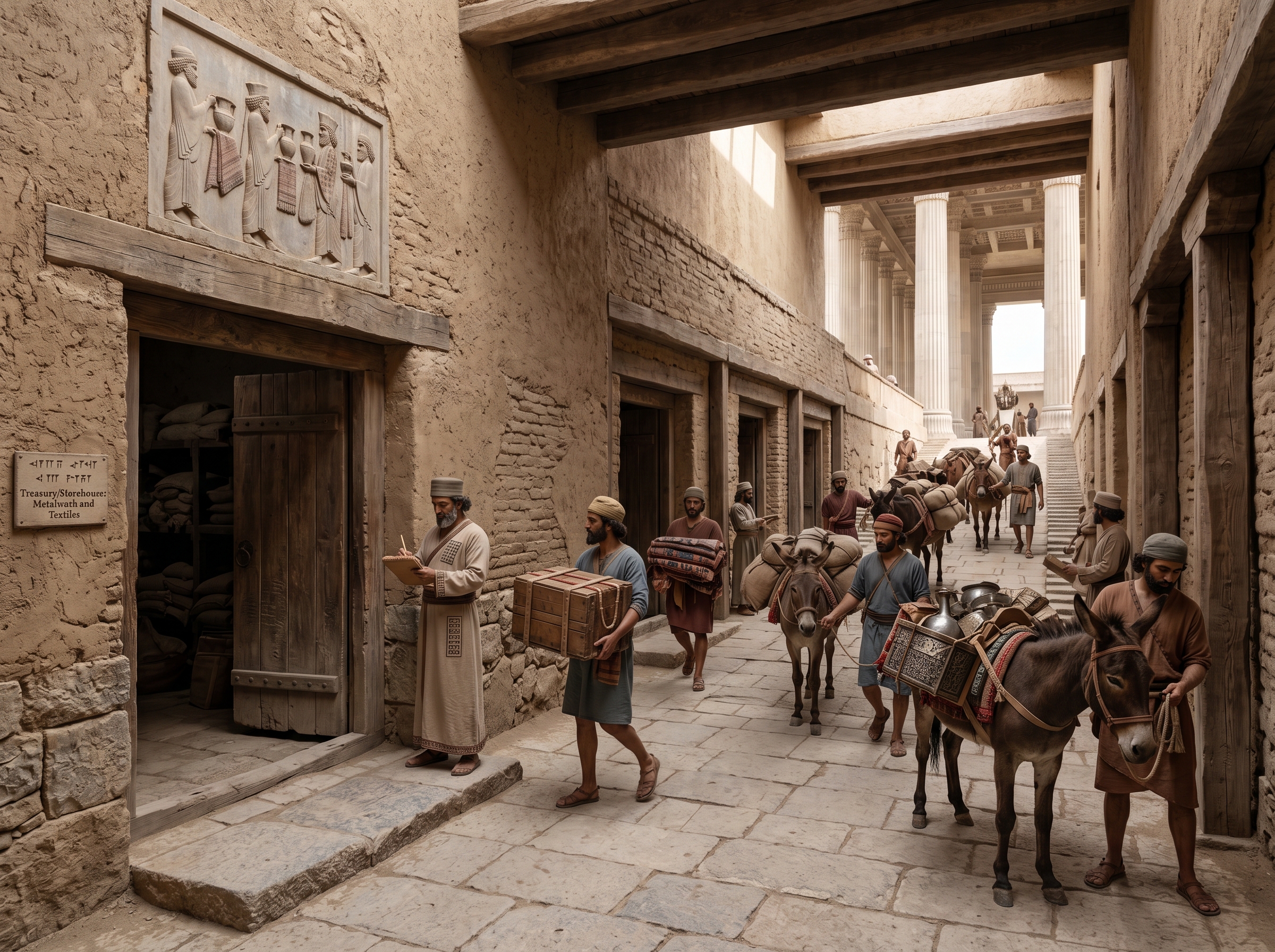
The visible route from stair to storehouse made the reliefs more than propaganda; they were a labeled shopping list that connected to real movement. Service ramps and side passages channeled pack animals and porters straight from the ceremonial approaches into storage rooms and the imperial treasury, so what was pictured above could quickly become an inventory inside.
Thresholds bore wear consistent with heavy loads: smoothed stone, scuffed jambs, and widened grooves where sledges or cart frames had passed. Officials checked lists—often recorded in Elamite tablets kept nearby—so tribute was accounted for as it moved. That practical seam between display and accounting turned the Apadana into both theatre and warehouse at the same time.
The worn thresholds were part of the record: their scuffs and grooves matched the movement of the very goods depicted on the stair reliefs.
City context
The Apadana occupied the high point of the terrace sequence that regulated movement through Persepolis. Visitors passed beneath guardians at the Gate of All Nations, through the Tripylon, and finally climbed the Apadana staircases to stand under the forest of columns. That ascent was a ritual funnel: approach, identification, and presentation happened in a fixed order so that the carved delegations read like instructions for behavior.
Ordinary residents encountered this program indirectly. Craftsmen, stonecutters, stables hands, and the officials who moved goods between the palace and nearby storehouses kept the backstage machinery running. On ceremonial days—spring audiences tied to the New Year—crowds gathered at the base of the stairs. A delegation’s arrival was a scripted performance: procession up the steps, named in stone, gift placed under royal control, and then the object walked into the palace economy. The reliefs shaped what people understood a subject’s place to be by turning procession into public record.
Sources
book
- Pierre Briant, From Cyrus to Alexander: A History of the Persian Empire. (Princeton University Press, 2002).
- John Curtis and St John Simpson, Persepolis: Images of an Empire. (British Museum Press).
- Richard Hallock, Persepolis Fortification Tablets. (University of Chicago Press, 1969).
- Amélie Kuhrt, The Persian Empire: A Corpus of Sources from the Achaemenid Period. (Routledge, 2007).