At a glance
The Imperial Treasury and Storehouses turned ceremonial tribute into concrete state power by storing, counting, and controlling the goods that made royal display possible. Behind Persepolis’s public stairways were guarded rooms, ledgers, and routes for porters and scribes that turned gifts from distant provinces into account entries, rations, and redistributed wealth.
What happened to the gifts carved on the Apadana stairs after they left the hands of delegations? The Imperial Treasury and its adjoining storehouses were where gesture met logistics: goods arrived along the same ramps used in ceremony, then disappeared into a sequence of guarded, windowless rooms where staff counted, recorded, and stowed them.
Physically the complex read like a backstage for a theatre. Thick limestone walls and heavy doors separated bright courtyards from dim storage corridors; low rooms with packed-earth or paved floors sat close together so that porters could move crates and sacks without crossing the ceremonial thresholds. Wooden fittings — shelves, chests, and door frames — would have contrasted with pale stone, while ramps and narrow passages channeled traffic so that only authorized personnel could pass between public halls and private stores.
Accounting sat beside stacking. Administrative tablets were kept not in public view but in offices tucked into the storage quarter, where scribes recorded names, quantities, and seal impressions. Guards controlled access points timed to processional schedules: on festival days goods might be displayed briefly before being sealed away again. Compared with an open marketplace, these rooms operated by rules of restriction — they were secure, segmented, and bureaucratic rather than commercial.
Understanding this place complicates the idea of Persepolis as mere spectacle. The carved processions declared who belonged to an imperial order; the treasury made that declaration operable. Without rooms to hold tribute, people to count it, and gates to control it, the ritual of presentation would have been an empty show. The storage complex turned visual submission into an administered resource that fed the palace, salaried workers, and the rituals that reproduced authority.
Closer looks
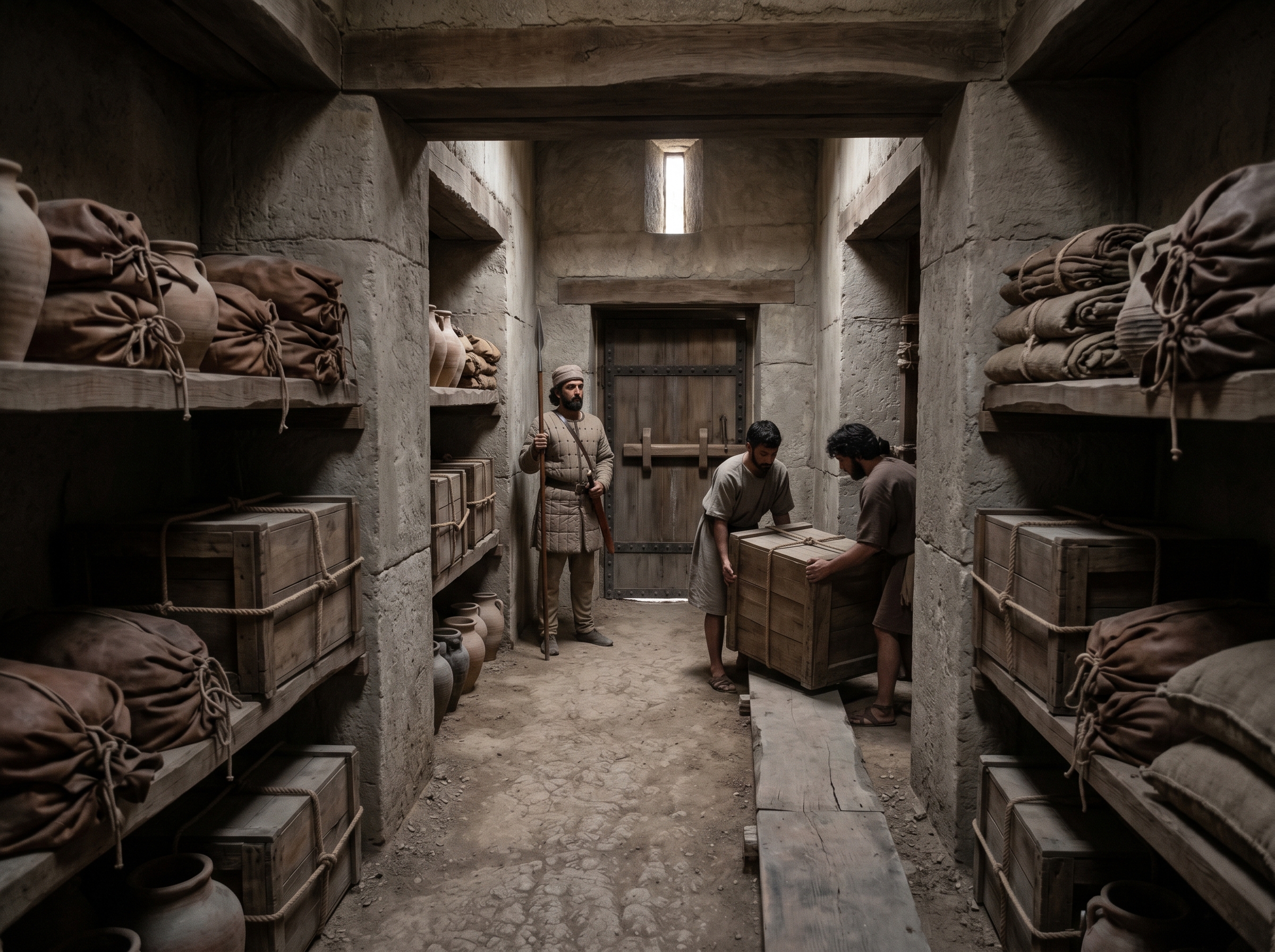
Dim storage corridor lined with chests and sacks
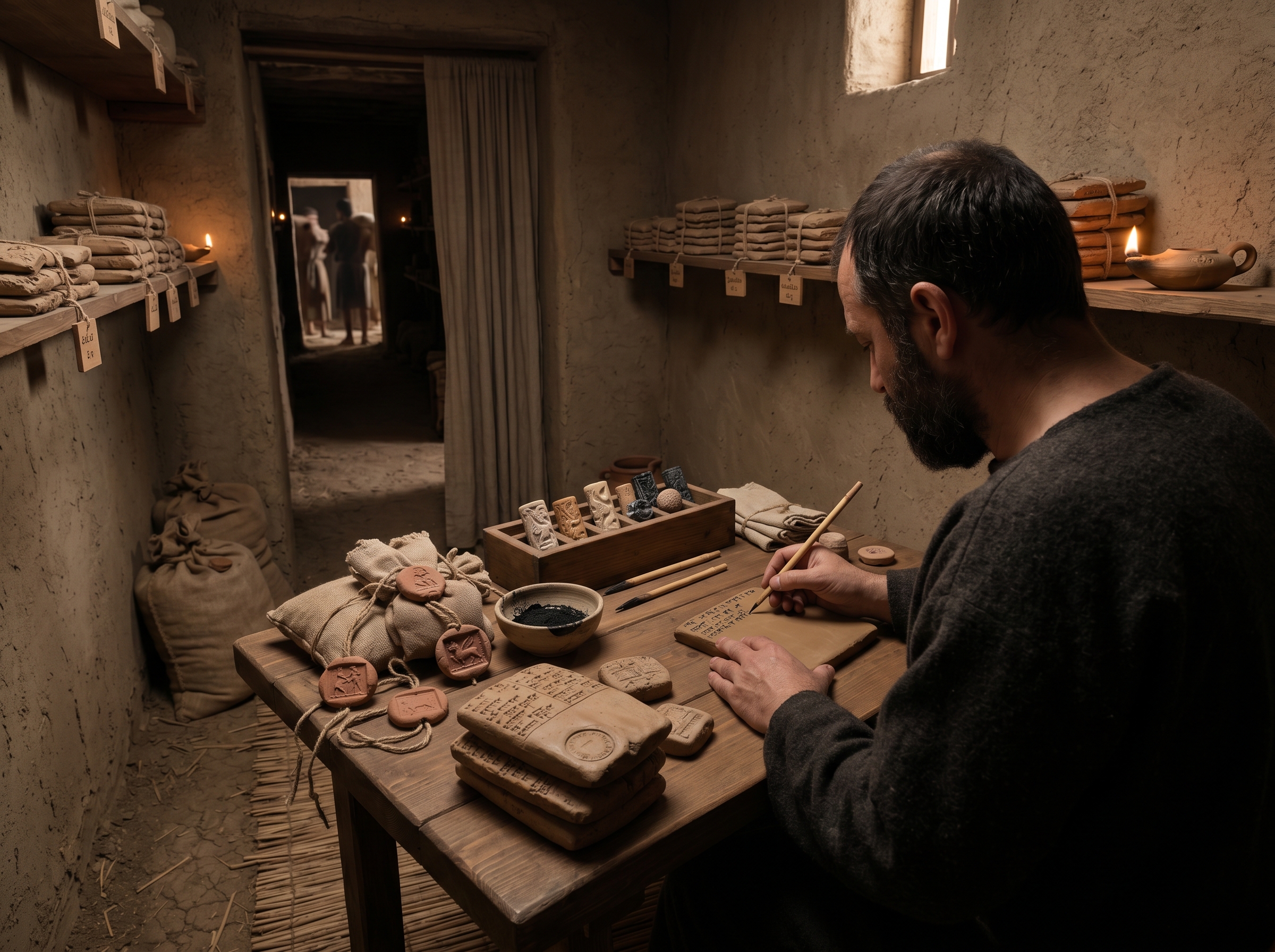
Scribe’s counting room with ledgers and seal impressions
Persepolis turned gifts into records with a reed stylus and wet clay. Scribes sat in tucked-off rooms, pressing marks into tablets and stacking dried documents whose impressions would be referenced whenever a chest changed hands.
On the table lay a small arsenal of accountability: a partially written wet tablet, piles of sealed and labeled clay slabs, a rack with clay sealings still tied to bits of cloth, and a wooden box of carved seals. The impressions used a limited set of motifs and numeric signs so that a few trained clerks could read quantity and origin quickly; most daily accounting at the site used local Elamite tablets, which were compact and efficient for routine bookkeeping.
Many of the Fortification-era tablets were written in Elamite and recorded numbers and seal impressions more often than long narratives.
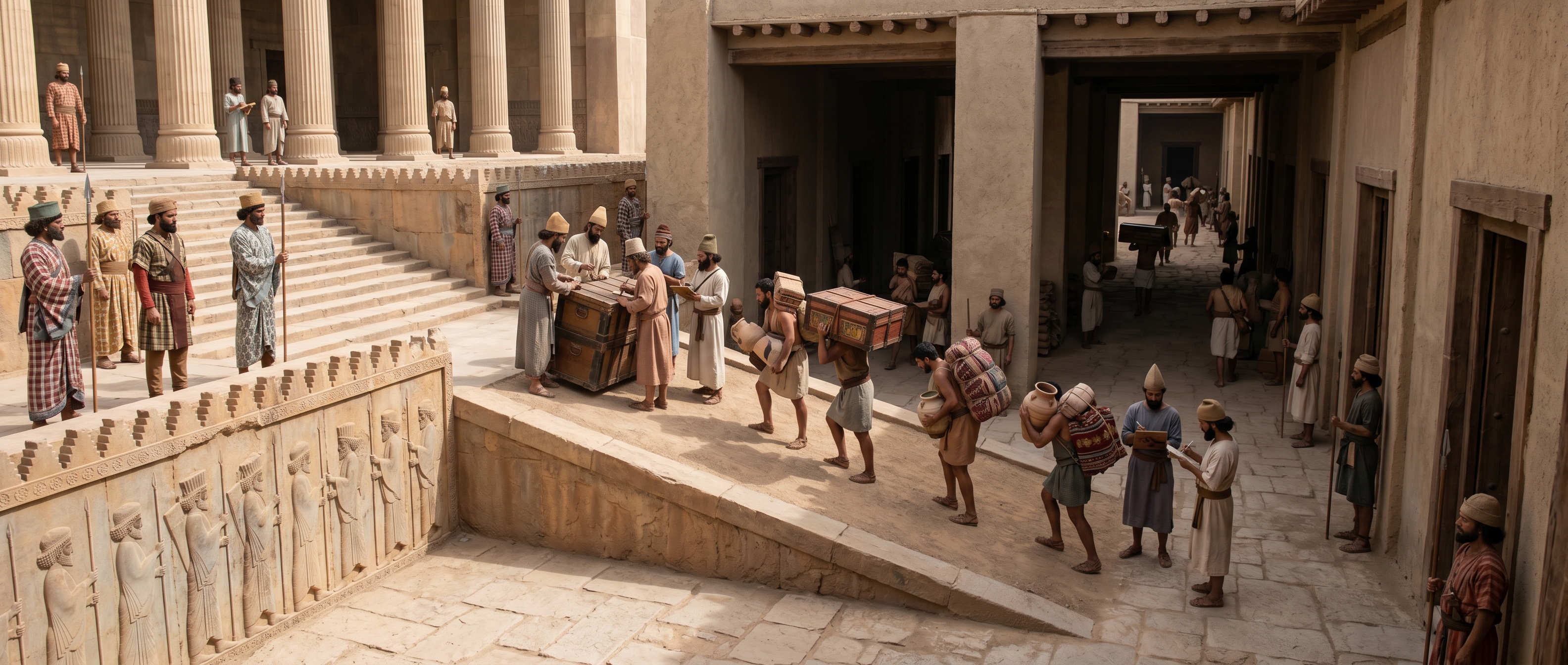
Ramps linking the Apadana stair to the storehouses during a festival
On festival days the ramp became the moment when ceremony met logistics. After a brief public presentation on the Apadana steps, decorated chests and wrapped bundles were routed off the platform and into a shaded channel where officials and guards took over the work of reception.
The lower stairs still carried carved processions and watching attendants while porters lowered chests onto sledges or planks and hauled them up or down a gently inclined ramp. Officials inspected seals against tablet records, nodded, and directed where each crate would be quartered. Those hours concentrated what otherwise happened slowly through the year: a controlled, timed transfer that turned visible tribute into administrable stock.
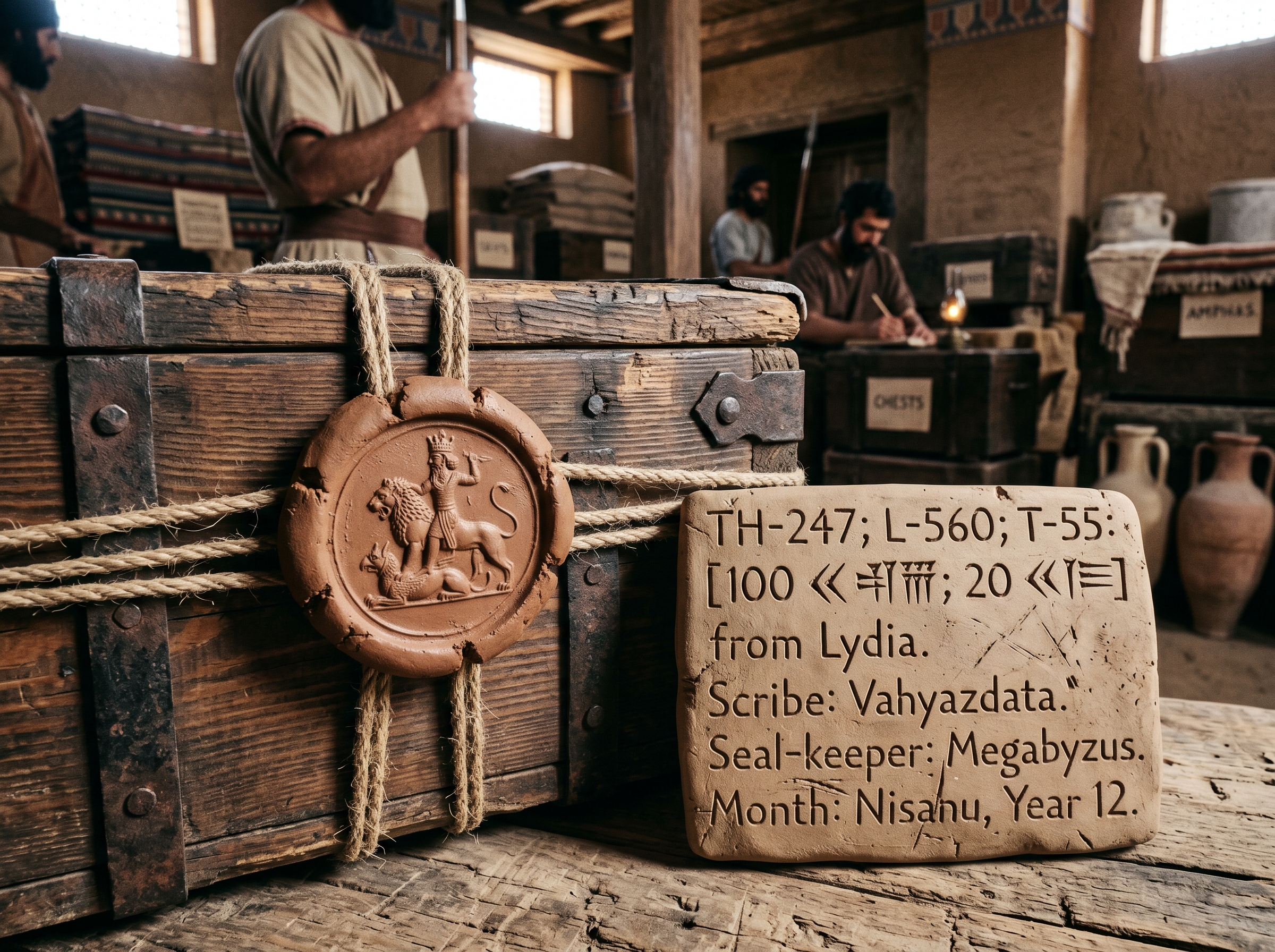
Close-up of a sealed chest with impressed seal and inventory tablet
A pressed lump of clay settled the question of ownership. A cord looped tight around a chest corner and a clay sealing bore an impressed motif; beside it lay a tablet with incised numerals that linked the physical object to an entry in the archive.
The seal impression was not decoration but a legal tag. Cylinder and stamp images identified officials or offices and made it plain who could break the seal and when. You could read those impressions like a signature: the same motif recurred on tablets and storage lists so that a sealed chest and its ledger line belonged to the same chain of custody.
Seal impressions often matched motifs found on administrative tablets, tying a physical package to a named office or agent.
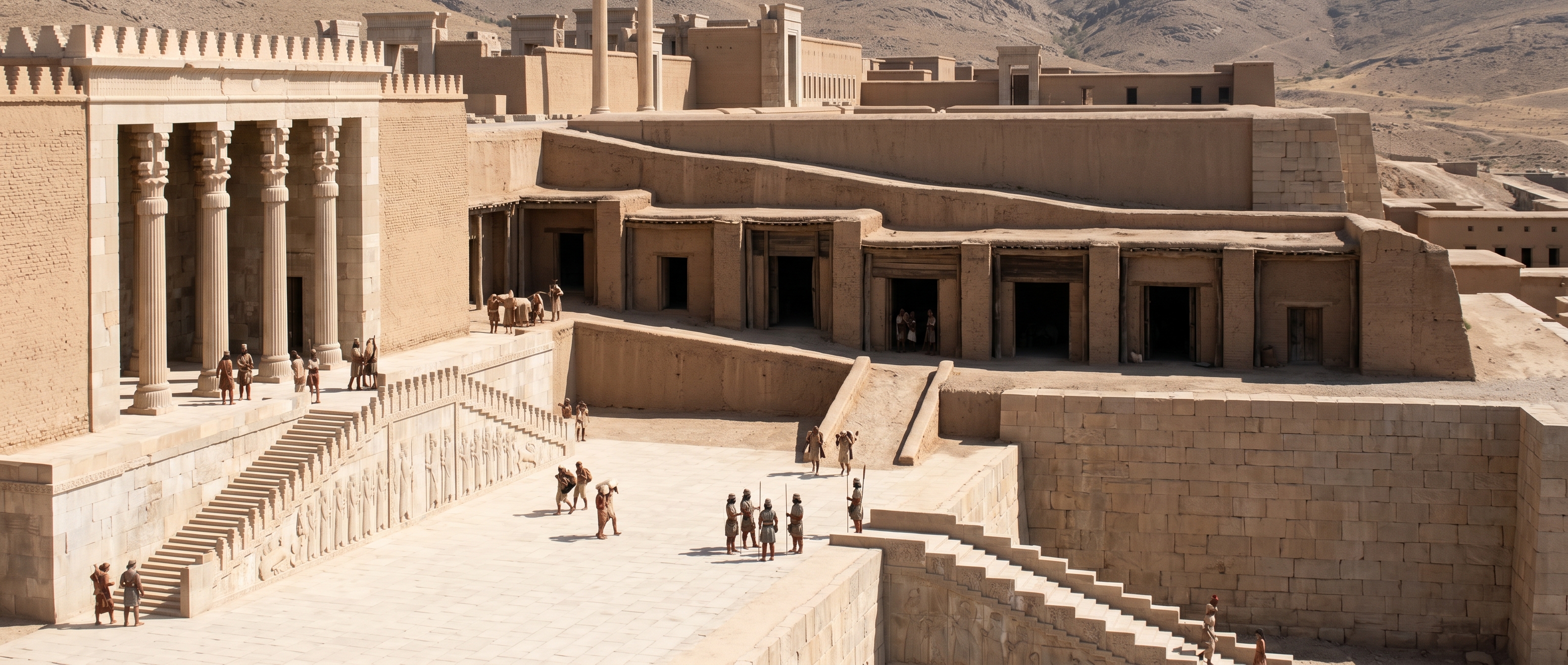
Terrace edge view: bright Apadana and dark storage mouths
The terrace edge put spectacle and backstage less than a stone’s throw apart. Sunlit forecourts with carved stair-reliefs faced visitors while a row of recessed, darker doors opened behind them into the storehouses that actually fed the palace.
From the forecourt the carved delegations read like a public script; step a little inland and you found functional doorways, ramps, and guards moving small groups of workers and chests between zones. That spatial seam kept the performance intact: audiences saw tribute presented and named, while the physical goods were withdrawn, catalogued, and routed out of view so the palace could transform gifts into rations, pay, and stored wealth.
City context
The treasury sat behind Persepolis’s public route of reception: after delegations passed the Gate of All Nations, walked the Tripylon, and climbed the Apadana stairs, their goods entered a different world. Ordinary residents seldom toured these rooms; instead they experienced the place indirectly — through the presence of armed guards, the sight of chests being carried past, or the noise of carts arriving at the terrace edge. Craftsmen and domestic staff depended on its outputs: rations, cloth, and metal from the stores kept the palace functioning between festivals.
Ritual time concentrated the treasury’s work. Spring ceremonies turned slow bookkeeping into intense action: goods were displayed in public, seals were impressed, and then scribes recorded transactions before items were sealed into specific rooms. The same mechanisms that made the Apadana a theatre — thresholds, controlled movement, named peoples — extended into storage. That continuity shows Persepolis not only as a place of staged inclusion but as an administrative hub where imperial order was materially enforced and reproduced.
Sources
book
- Pierre Briant, From Cyrus to Alexander: A History of the Persian Empire (2002).
- Amélie Kuhrt, The Persian Empire: A Corpus of Sources from the Achaemenid Period (2007).
- Richard N. Frye, The Heritage of Persia (1963).