At a glance
In Syracuse, architecture performed politics: temples, walls, ship-sheds and quarries turned military success into public authority. Walk its harbours and you read who paid for ships, who owned grain, and who was kept below in the quarries.
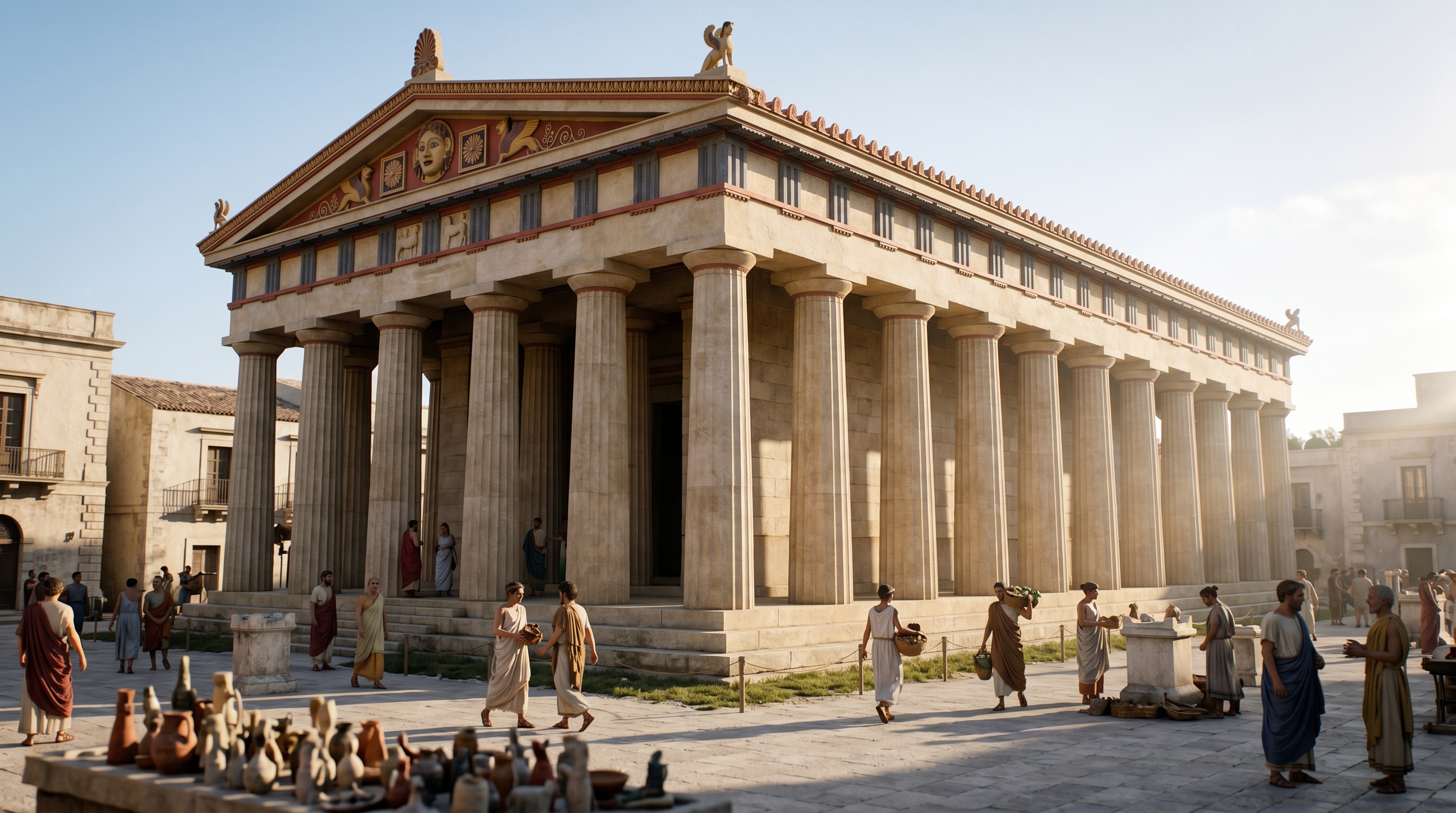
In Syracuse, architecture performed politics: stone, wood and ritual turned military victory into visible claims on the city. The island acropolis of Ortygia concentrated sacred display—shrines, altars and terraces where priests and victorious commanders processed—while the Epipolae plateau and the plain behind it became a belt of fortification and manufacture. At midday the sun picked out bronze and dressed stone on the island; a short distance away a sheer quarry-face showed the raw labour that had made those monuments possible. The city’s public life read as a program of power carved into the ground.
From Gelon’s triumph after Himera (c. 480 BCE) through Hiero’s patronage and Dionysius’ building campaigns, rulers converted battlefield loot into visible civic claims. They used captured arms and statues for dedications, rebuilt sanctuaries, and paid poets and festivals that brought visitors and praise. These acts rewired communal memory: victory was mapped onto sanctuaries, and festivals turned private benefaction into recurring public performance. Compared with Athens, where public building and festivals coexisted with a broad-based political culture, Syracuse concentrated the same cultural forms in the hands of a few men who expected the city’s fabric to advertise their authority.
The city’s split geography shaped everyday life. Ortygia still contained the oldest shrines and the houses of the wealthiest citizens; its lanes and inner courts kept elite ritual and domestic life close to the sacred core. The harbour quarter held workshops, warehouses and merchant offices; shipwrights and coopers rose at first light and worked beneath a smell of pitch and pine. Out toward the quarries, latomies gouged the rock into blocks and caverns; these places produced both the stone for temples and the enclosed spaces where captives or condemned labourers were kept. Walls and gates ordered movement: who lived on the island, who worked the quays, and who was marched through particular gates was made legible by the city’s masonry.
Control of the sea was the economy’s hinge. The Great Harbour combined quays for grain and oil with facilities for warships: oar stocks, lathing benches, piles of timber and tubs of tar filled the dock spaces. Grain from the hinterland moved through weighing-stands and warehouses and out on merchant hulls, while trireme frames and naval stores gave Syracuse the capacity to project force. That combination differed from Carthaginian ports, which emphasized mercantile networks and trading emporia: Syracuse fused merchant throughput with state-directed shipbuilding, so naval investment directly underwrote both wealth and the ability to levy labour for public works.
The latomies made inequality tactile. Quarry faces kept the marks of wedges and adzes; blocks sat with rough faces where men had separated them from bedrock. Caverns later named in literature for their echoes had practical uses as storage and detention as well as rhetorical uses in stories about interrogations. Quarrying supplied the raw material for sanctuaries and walls, and the same spaces sometimes held captives taken in war. That reuse shortened the moral distance between public splendour and enforced labour: the stone that glorified rulers was often the product of coerced work.
Theatre and festival life supplied the choreography of civic identity. A rock-cut theatre on the mainland could seat a crowd large enough to register a ruler’s tastes and his largesse. Choral contests, dramatic performances and processions linked sanctuaries to public space and made ritual into regular instruction. Poets who received patronage composed odes that tied local victories to heroic myths; Hiero’s commissions were one clear example. Compared with Athens, where drama frequently functioned within a contested public sphere, Syracuse’s spectacles often read as staged reinforcement of elite claims. At the same time the city anticipated later Hellenistic patterns: rulers used monumental patronage to build a durable visibility for personal power while preserving a civic vocabulary of temples and festivals.
Stone, sound and smell left a question on the ground: did these large investments bind a diverse population to shared institutions, or did they harden hierarchies that later rulers simply inherited? The answer sat in the city’s surfaces—the stepped rows of seating, the high ramparts, the worked faces of the quarries—each cut by decisions about who would benefit and who would labour.
Key moments
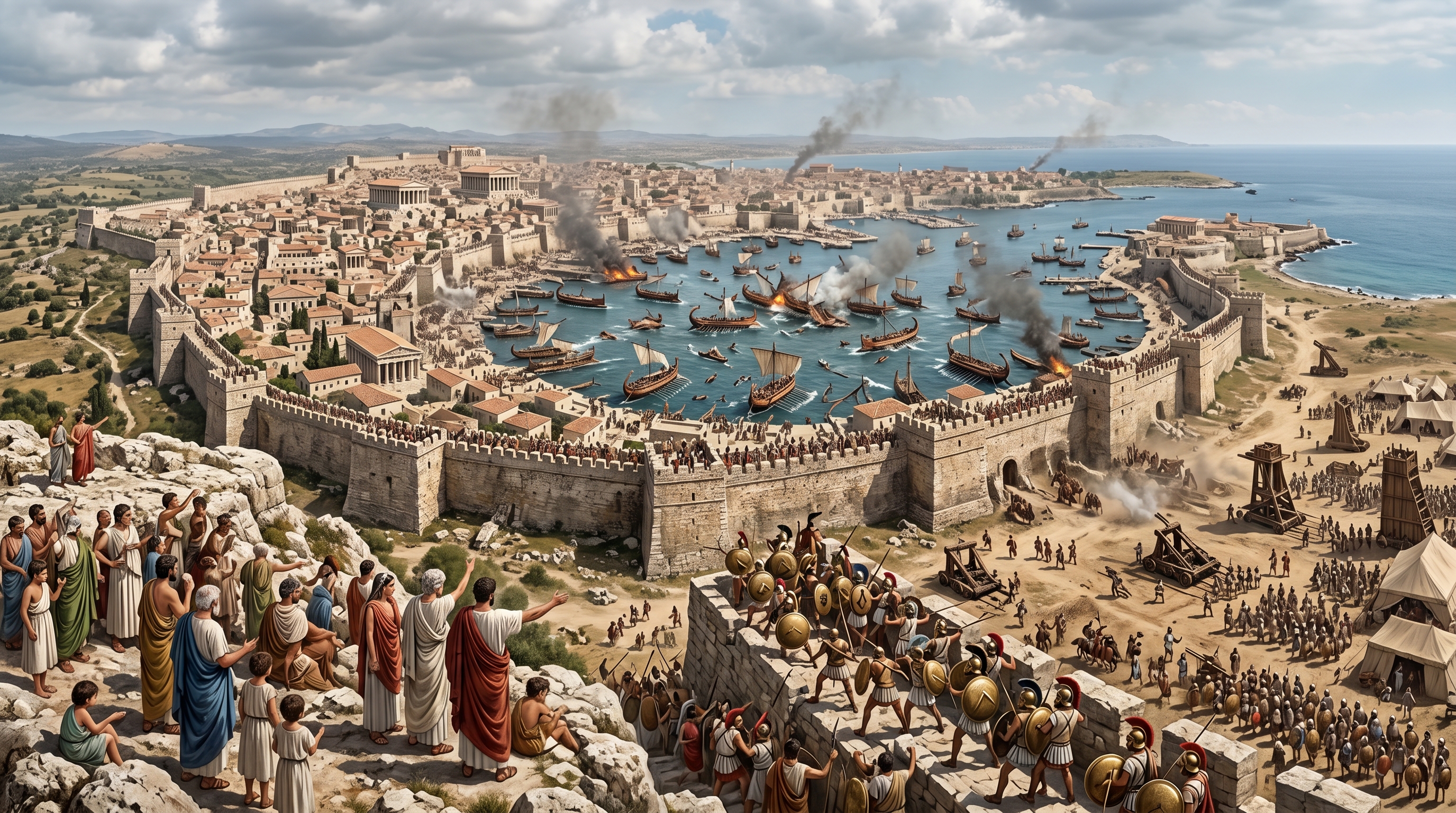
The Athenian Expedition and the Siege of Syracuse (415–413 BCE)
What captured attention during the Athenian expedition was the collision of naval ambition with Syracuse’s defensive geometry. From the Athenian perspective, the harbour promised a prize; from the Syracusan side, the Epipolae ramparts and the island’s shrines offered lines of sight and shelter. Men on the walls shouted down at ships that moved like a tight forest of oars; the plain filled with engines of war and with dust from earthworks. Nights smelled of burnt pitch and smoke from makeshift camps. When the tide of fortune turned against the besiegers it was visible in wreckage and captured oars, in coffins carried across the city, and in the silence of quays once full of activity. The siege showed how fortification, local knowledge and morale could defeat an enterprise designed for open sea combat.
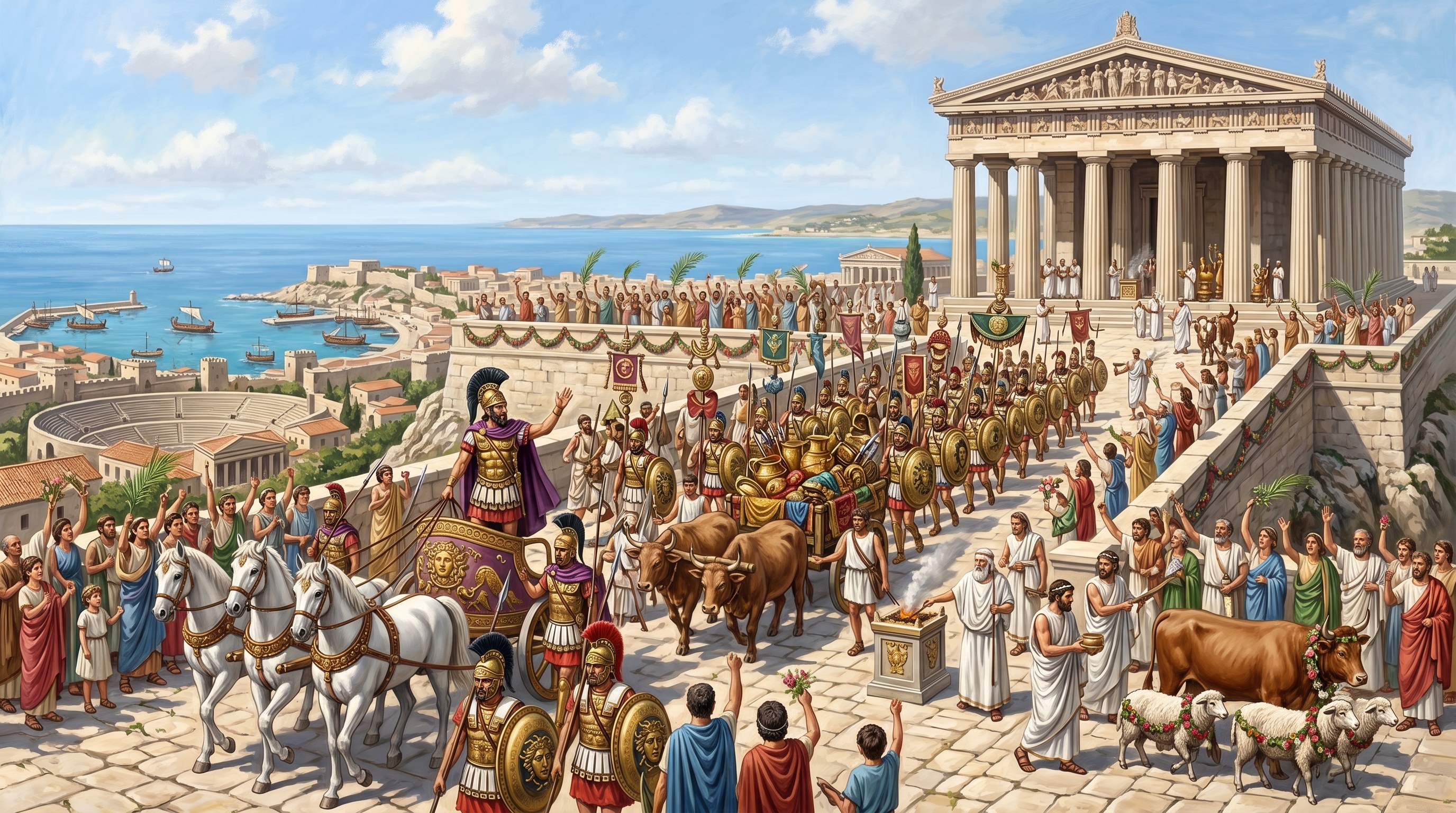
Gelon's triumphal procession after the victory at Himera (c. 480 BCE)
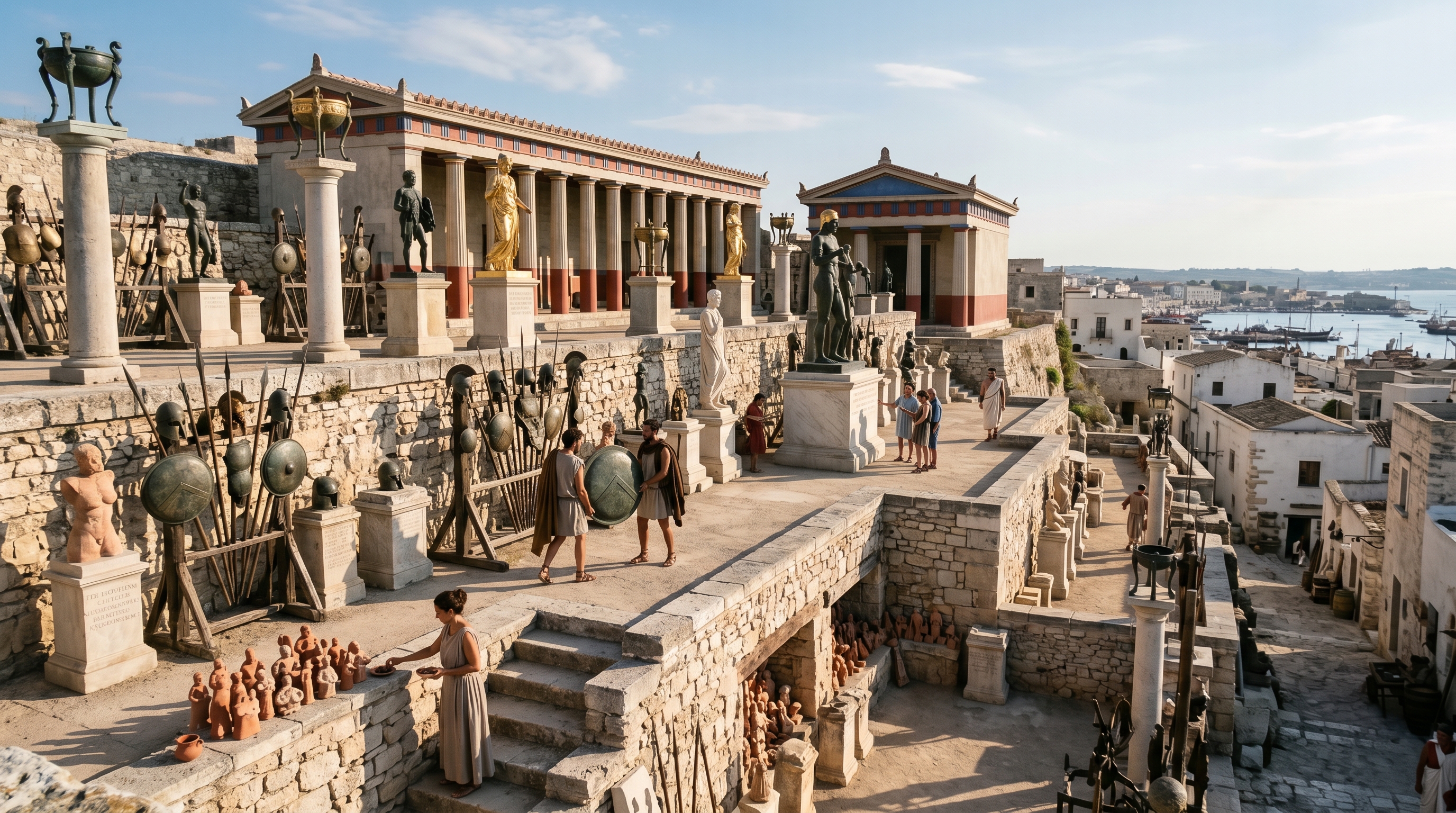
After Himera, Gelon’s procession made victory legible. Columns of armed men marched up toward the island acropolis bearing spoils: shields dented in battle, standards, and statuary stripped from the battlefield. Priests moved first, leading animals for sacrifice; citizens crowded the route, stepping back to let the procession through. On the terraces offerings were arranged and a handful of carved dedicatory inscriptions were set where they would be seen by generations. The spectacle converted plunder into civic property and turned a battlefield success into a regular moment of public memory—one that reinforced the commander’s link to both divine favour and communal pride.
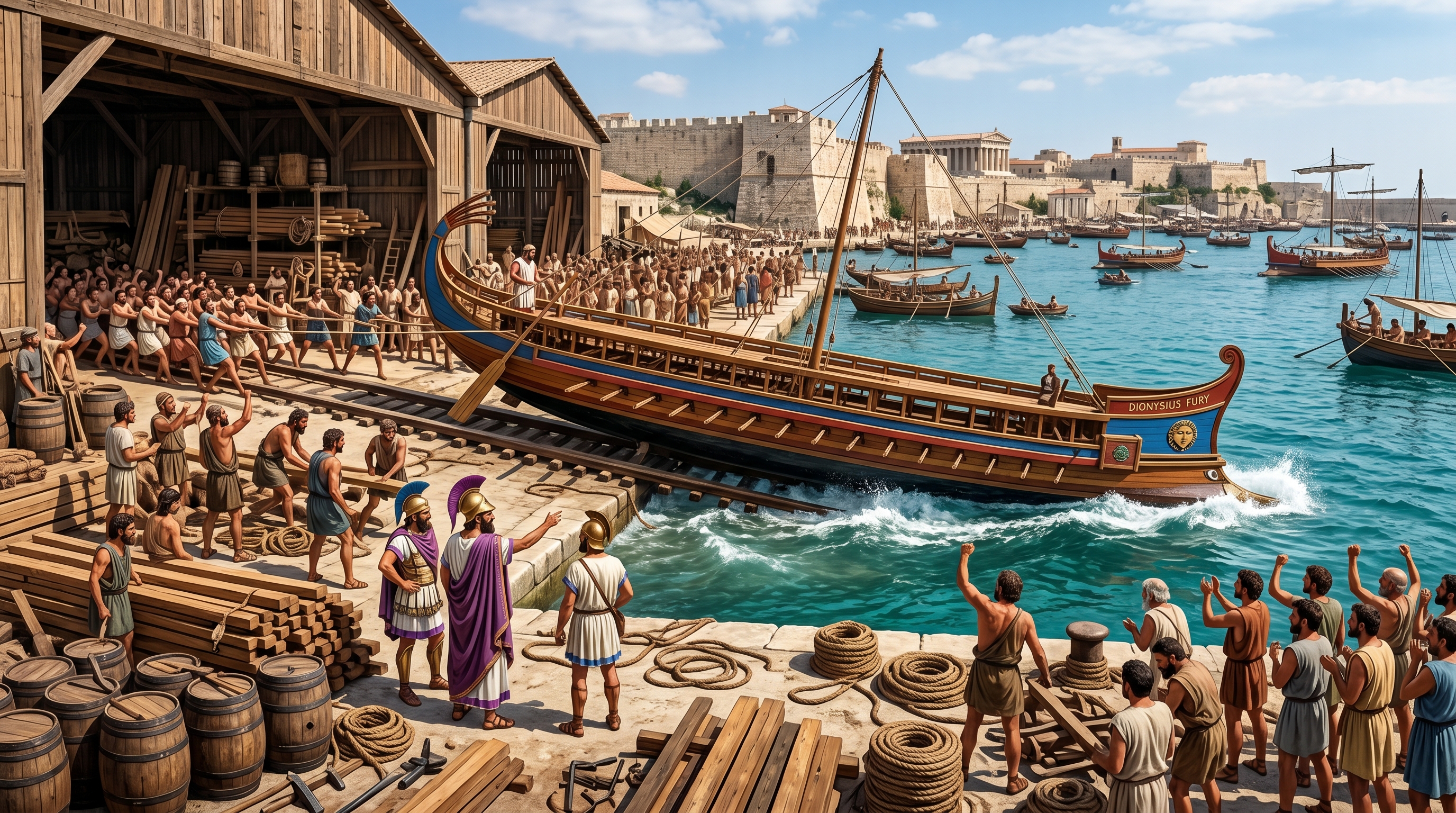
A ship-launch day at the Great Harbour under Dionysius
A ship-launch under Dionysius felt like a public demonstration of industrial capacity. Men pushed huge greased timbers, ropes chafed and shouted orders rose as a trireme slid from its cradle into the harbour with a wet, thunderous sound. Up close you smelled hot pitch and the sour tang of wet hemp; officers inspected oarlocks and rigging while rowers stood ready, muscles taut. The launch was not merely a technical operation but a staged moment: the new hull embodied state investment, ready to patrol lanes, protect grain convoys, and assert the ruler’s command of both labour and sea lanes.
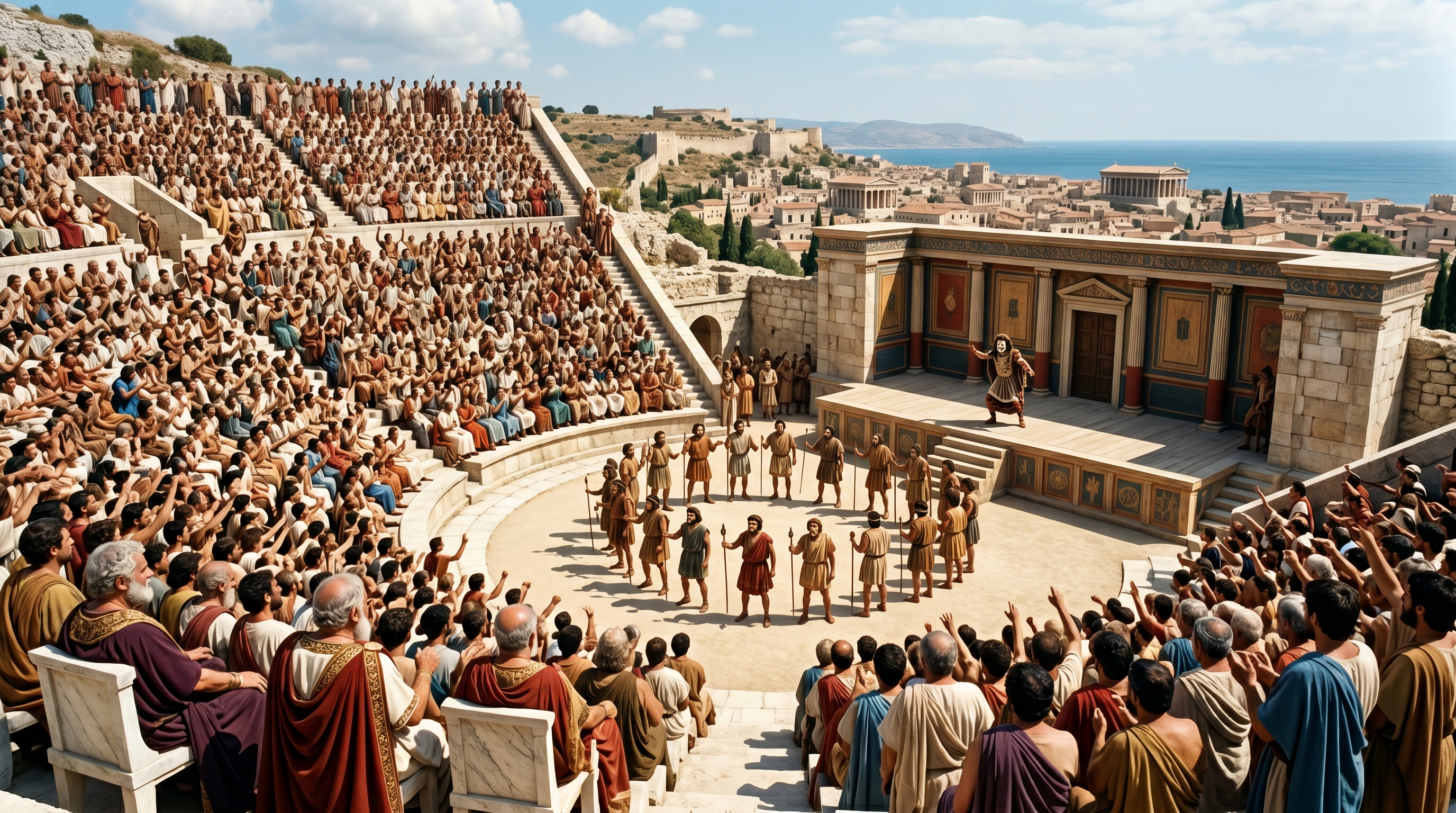
A dramatic competition at the Greek Theatre (Neapolis)
A dramatic competition at the rock theatre was a civic event with political edges. Choirs stamped rhythmically in the orchestra, masked actors moved under painted panels and the crowd answered with applause or derision. Magistrates and patrons occupied the frontal seats; voices carried clear up the tiers because the theatre had been cut to hear the human voice. Winners received crowns and public praise that circulated back into patronage networks. The performance turned legend and current affairs into a shared story, and the applause or silence of the audience registered more than taste—it measured the city’s temperament.
Religion and ritual
Religion in Syracuse was civic performance more than private belief: sanctuaries and processions organized public memory and validated political claims. The island’s archaic shrines and the terraces on the acropolis hosted dedications that often took the form of war spoils placed where the city’s population could see them, turning military success into sacred narrative. Priests, magistrates and rulers shared a stage during festivals that mixed sacrifice, competitive display and reward; texts and odes commissioned by patrons circulated praise that reinforced local prestige. These rituals also connected Syracuse to the wider Greek world—invited poets and artists traveled, and votive styles showed pan-Hellenic affinities—while local cult practices absorbed and negotiated elements from Sicel and Elymian neighbors. Compared with Athens, where large public cults sat within a more widely distributed political structure, Syracuse concentrated the ritual economy so that temples and ceremonies functioned as instruments of elite visibility as well as communal worship.

Military and defenses
Syracuse’s defenses reshaped the city into a military capital: broad ramparts on the Epipolae plateau, new circuit-walls under tyrannical rule, and towers that controlled access to the plain and the sea. Those fortifications responded to existential threats—most sharply, the Athenian expedition of 415–413 BCE—but they also served domestic ends: garrisoned walls kept dissent contained and allowed rulers to stage their control. The city’s building programs produced massive masonry belts and reinforced gates whose remains indicate organized labour and long-term investment. In comparison with mainland poleis, Syracuse combined coastal and inland fortifications at a scale more like later Hellenistic fortified centres; the result was urban space that functioned as both refuge and instrument of political order.
Epipolae plateau and city walls
A broad, defensible plateau overlooking the plain and sea; its ramparts and towers were central to defending Syracuse during the Athenian siege.
Dionysian ramparts and counterwalls
Massive new circuit-walls, towers, and batteries associated with the tyrant’s program to secure the city and its shipyards against both sea and land threats.
Harbour, trade, and craft
The harbour was the city’s bloodstream: quays for grain and oil sat beside facilities for warships, and craft neighborhoods clustered where goods were loaded, repaired and stored. Ship-sheds and naval workshops created capacity for fast trireme construction and maintenance, while market stands and warehouses managed the flow of Sicilian grain to Mediterranean destinations. The smell of pitch and the sight of amphorae stacked for export defined the dockside. Craft organization concentrated skilled labour—shipwrights, coopers, rope-makers—so that naval capability and commercial throughput reinforced each other. Unlike Carthage, which organized an empire around expansive mercantile networks, Syracuse fused commercial operations tightly with state-directed naval infrastructure; that fusion enabled rulers to monetize sea power and support public building and festivals.
Great Harbour and shipyards
A busy complex of quays, moles, and slips where grain ships, war triremes, and merchant vessels were loaded, repaired, and launched — a sensory mix of sailcloth, pitch, and shouted orders.
Ship-sheds (neosoikoi) and naval workshops
Long covered slipways and workshops where hulls were assembled and repaired, and where dockside organization made mass shipbuilding possible.
Agora and merchant quays
The market precinct where merchants, grain brokers, sailors, and local shoppers mixed — stalls, weighing-stands, and administrative offices organized the flow of goods.
Work and punishment
The city’s quarries, or latomies, made the economy visible in stone. Work there left wedge marks, cleavage planes and terraces where blocks were separated from bedrock; this same labour supplied the blocks for temples, walls and public stairways. The quarries also functioned as places of detention: some cavities were used to hold captives or prisoners, and later writers emphasized the dramatic acoustics of particular chambers. Slave labour—captives from warfare as well as purchased workers—played an essential role in both urban construction and the agricultural hinterland that fed Syracuse. The physical presence of quarry scars and prison caverns made coercion part of the city’s visible materiality, and that visibility structured social relations between elites who directed projects and labourers who produced them.
Latomies (stone quarries)
Enormous carved quarries that provided the limestone and tufa for the city's monuments and walls; their scars mark the labor that underwrote urban growth.
The 'Ear of Dionysius' (latomian cavern)
A dramatic cavern in the latomies known for its echo and its literary reputation as a prison where political captives were held and interrogated.
Theatre, spectacle, and civic life
Spectacle in Syracuse had practical political effects: theatre, processions and competitions distributed praise and rewarded loyalty. A large rock-cut theatre accommodated audiences that could witness drama, choral contests and civic announcements, while processional routes linked sanctuaries and seating areas so that ritual movement choreographed what people saw and how rulers appeared. Patronage of poets and dramatists associated rulers with pan-Hellenic cultural prestige—Pindar and others composed odes tied to Sicilian patrons—and prizes and honors reinforced alliance networks. Compared with Athens, where performance often operated inside a contested civic forum, Syracuse used spectacle to consolidate support: the city staged its religion and culture in ways that amplified elite benefaction and turned performance into political infrastructure.
Greek Theatre (Neapolis)
A vast semicircular theatre hewn from the rock with tiered seating that staged dramatic competitions, civic gatherings, and political messaging through spectacle.
Processional routes and festival ways
The streets and ramps linking sanctuaries, theatres, and the acropolis where processions, triumphs, and public ceremonies unfolded before large audiences.
sound
Adzes and hammers pinged in the quarries; in the harbour capstans groaned as men hauled hulls into the water, and from the rock theatre a chorus’ measured chant rose up and carried across the plain.
smell
Pine tar and heated pitch at the slipways mingled with dust from lime-cut stone; sacrificial smoke from the island sanctuaries drifted across the harbour at morning.
light
Sun cut hard on the island’s colonnades, making bronze gleam; in the quarry caverns the light fell thin and cool, leaving benches of stone half in shadow.
touch
Limestone felt rough and chalky under the hand; a newly tarred hull was slick and tacky; theatre benches held the chill of carved rock even on warm afternoons.